


Close Menu
Stratnews GlobalStratnews Global
    Facebook X (Twitter) Instagram
    Trending
    • AI Particle Detector Reconstructs Paths From Photons
    • Water System Cyberattacks Prompt US Security Warning
    • Tesla China Separation Report Ahead of SpaceX Merger
    • IIT Madras AI Workshop on Climate and Energy Systems
    • AzaadiSAT 2: 750 Indian Schoolgirls Reach Orbit
    • The New Geopolitics of Capital: Why India Matters More Than Ever
    • Uttar Pradesh AI Hub Vision Highlighted at CII Summit
    • India Space Investment Crosses $618 Million
    • Support Us
    Stratnews GlobalStratnews Global
    Write for Us
    Friday, July 31
    • Space
    • Science
    • AI and Robotics
    • Industry News
    • Support Us
    Stratnews GlobalStratnews Global
    Home » AI Particle Detector Reconstructs Paths From Photons

    AI Particle Detector Reconstructs Paths From Photons

    Aditya LenkaBy Aditya LenkaJuly 31, 2026 AI and Robotics No Comments3 Mins Read
    AI particle detector

    AI-Powered Camera Reconstructs Particle Paths Using Just a Handful of Photons

    Researchers at ETH Zurich and EPFL have developed a new particle detection system that uses artificial intelligence to reconstruct particle trajectories from only a handful of detected photons. The technology, known as PLATON, could simplify the design of particle detectors while delivering performance comparable to today’s most advanced systems.

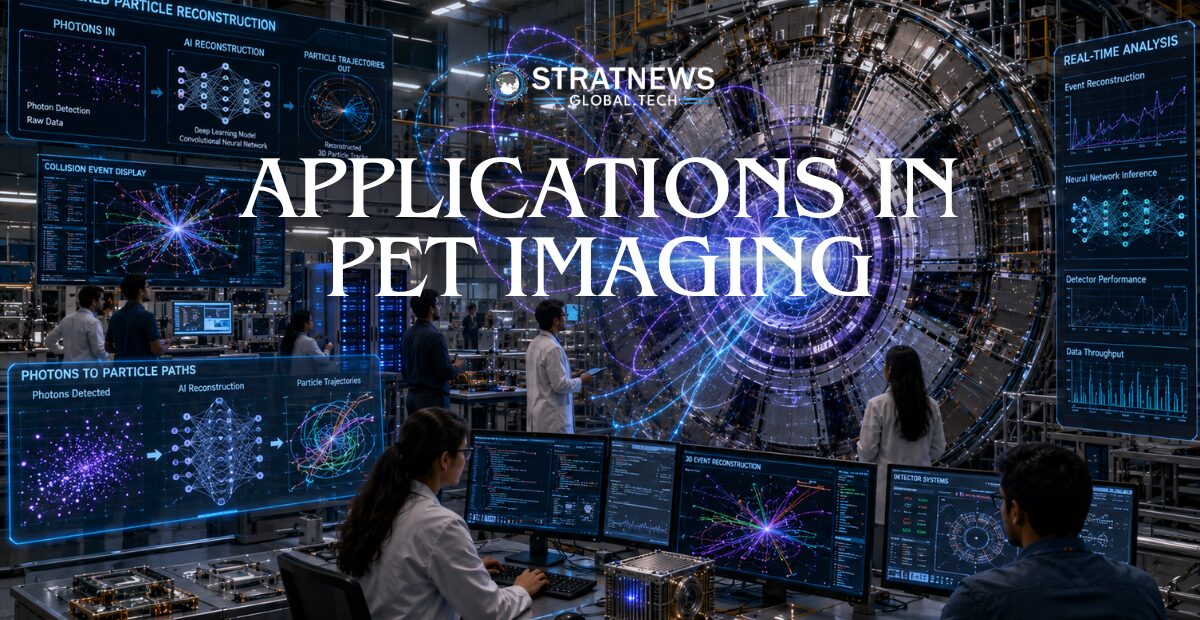
    The researchers believe the innovation could also improve medical imaging technologies, including positron emission tomography (PET) scanners, by reconstructing faint light signals with greater accuracy.

    A Simpler Approach to Particle Detection

    Particle detectors are essential tools in physics experiments, allowing scientists to observe the paths of elementary particles as they pass through specialised materials.

    Traditional detectors use scintillators, which emit tiny flashes of light when struck by charged particles. To determine where these interactions occur, the scintillator is typically divided into millions of small segments connected to optical fibres and photon sensors.

    Although this design provides high precision, it becomes increasingly complex and costly as detectors grow larger. Major experiments, including Japan’s T2K neutrino experiment and CERN’s LHCb, rely on millions of individual detector components to achieve high spatial resolution.

    PLATON takes a different approach by replacing those segmented structures with a single block of scintillating material. Instead of relying on numerous sensors, the system reconstructs particle interactions using advanced imaging and artificial intelligence.

    AI and Light-Field Imaging Work Together

    At the heart of PLATON is a plenoptic, or light-field, camera capable of recording both the intensity of incoming light and the direction from which it travels.

    The system combines this camera with a single-photon avalanche diode (SPAD) sensor, enabling it to detect individual photons produced inside the scintillator.

    Researchers built the prototype using a micro-lens array mounted directly onto the SwissSPAD2 imaging sensor. The design captures extremely faint flashes of light while reducing background noise through gated photon detection.

    Laboratory tests showed that the detector could successfully reconstruct particle interactions using as few as five detected photons. Simulations closely matched the experimental findings, confirming the system’s performance.

    Transformer AI Reconstructs Particle Paths

    The research team also developed a neural network based on Transformer architecture, the same family of artificial intelligence models widely used in modern large language models.

    Rather than processing text, the AI analyses the location and timing of detected photons to determine where the original particle interaction occurred.

    According to simulations, a future version of PLATON could achieve sub-millimetre spatial resolution within a detector measuring 10 × 10 × 10 centimetres while effectively identifying neutrino interactions.

    The researchers also modelled a much larger detector measuring one cubic metre. Even at that scale, simulations indicated that the system could maintain spatial resolution of only a few millimetres, matching the performance of many existing scintillator detectors despite using far fewer components.

    Potential Benefits for Medical Imaging

    Beyond particle physics, the researchers believe PLATON could have important applications in healthcare.

    The team has already filed three patents covering the use of the technology in positron emission tomography (PET) scanners. By reconstructing extremely faint light signals more accurately, the system could improve image quality and produce sharper medical scans.

    If successfully developed for clinical use, the technology could become another example of advances in particle physics contributing to innovations in medical imaging and other scientific fields.

    The research findings were recently published in Nature Communications.

    Author

    • Aditya Lenka
      Aditya Lenka

      A multi-faceted professional with a diverse range of skills and experiences. He currently works as a Producer, Digital Marketer, and Journalist for several well-known media outlets, namely StratNewsGlobal, BharatShakti, and Interstellar. With a passion for storytelling and a keen eye for detail, Aditya has covered a wide range of topics and events across India, bringing a unique perspective to his work.

      When he's not busy producing content, Aditya enjoys exploring new places and cuisines, having traveled extensively throughout India. He's also an avid writer and poet, often penning his thoughts and musings in his free time. And when he wants to unwind and relax, Aditya spends time with his two loyal companions, Zorro and Pablo, his beloved dogs.

      Aditya's dynamic personality and varied interests make him a unique individual, always eager to learn and experience new things.

      View all posts
    AI Featured Global Industry
    Share. Facebook Twitter Pinterest LinkedIn Tumblr Email Reddit Telegram WhatsApp
    Aditya Lenka
    Aditya Lenka

      A multi-faceted professional with a diverse range of skills and experiences. He currently works as a Producer, Digital Marketer, and Journalist for several well-known media outlets, namely StratNewsGlobal, BharatShakti, and Interstellar. With a passion for storytelling and a keen eye for detail, Aditya has covered a wide range of topics and events across India, bringing a unique perspective to his work.When he's not busy producing content, Aditya enjoys exploring new places and cuisines, having traveled extensively throughout India. He's also an avid writer and poet, often penning his thoughts and musings in his free time. And when he wants to unwind and relax, Aditya spends time with his two loyal companions, Zorro and Pablo, his beloved dogs.Aditya's dynamic personality and varied interests make him a unique individual, always eager to learn and experience new things.

      Keep Reading

      Water System Cyberattacks Prompt US Security Warning

      Tesla China Separation Report Ahead of SpaceX Merger

      IIT Madras AI Workshop on Climate and Energy Systems

      AzaadiSAT 2: 750 Indian Schoolgirls Reach Orbit

      The New Geopolitics of Capital: Why India Matters More Than Ever

      Uttar Pradesh AI Hub Vision Highlighted at CII Summit

      Add A Comment
      Leave A Reply Cancel Reply

      Anti Drone System (CUAS)
      Latest Posts

      AI Particle Detector Reconstructs Paths From Photons

      July 31, 2026

      Water System Cyberattacks Prompt US Security Warning

      July 31, 2026

      Tesla China Separation Report Ahead of SpaceX Merger

      July 31, 2026

      IIT Madras AI Workshop on Climate and Energy Systems

      July 30, 2026

      AzaadiSAT 2: 750 Indian Schoolgirls Reach Orbit

      July 30, 2026

      The New Geopolitics of Capital: Why India Matters More Than Ever

      July 30, 2026

      Uttar Pradesh AI Hub Vision Highlighted at CII Summit

      July 30, 2026

      India Space Investment Crosses $618 Million

      July 30, 2026

      ISRO Mission Delays Raise Questions in 2026

      July 30, 2026

      SpaceX Launches Satellite Servicing Mission

      July 30, 2026

      Subscribe to News

      Get the latest sports news from NewsSite about world, sports and politics.

      • Astronomical Events
      • Space Missions
      • Industry News
      • Science
      StratNewsGlobal Tech
      Facebook X (Twitter) Instagram LinkedIn YouTube
      © 2026 StratNews Global, A unit of BharatShakti Communications LLP
      • About Us
      • Contributors
      • Copyright
      • Contact
      • Write for Us

      Type above and press Enter to search. Press Esc to cancel.