


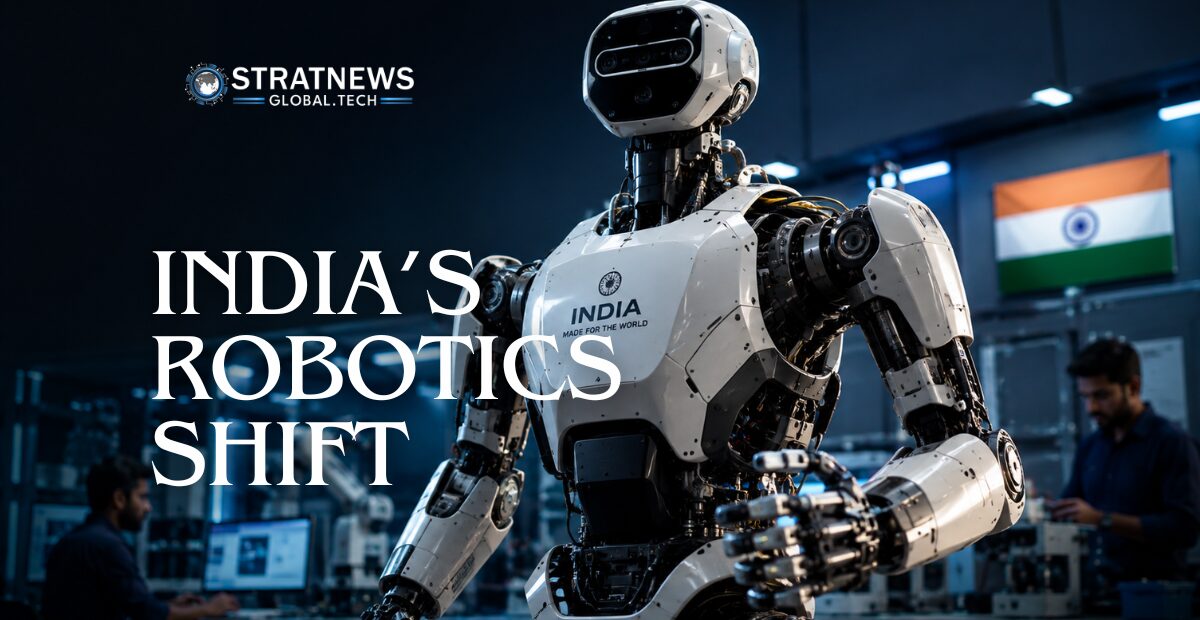
Rebranding India as a Deep-Tech Robotics Hub
Global buyers hired Indian tech firms for decades under one contract type: the service-level agreement. A client specified requirements, an Indian vendor executed them, and payment followed delivery. Intellectual property stayed with the client. That model built a $300 billion IT services industry, but it capped Indian firms at execution work, never at ownership of what they built.
[Backlink insertion opp: What will it take to build the world’s humanoid robotics hub in India?]
Robotics is testing whether that ceiling holds. Reliance-backed Addverb Technologies now sources 60% of revenue from outside India, targets the global top 10 in robotics within five years, and is raising over $100 million to build humanoid and quadruped systems it will own outright. General Autonomy, a nineteen-person Bengaluru startup, demonstrated its Param quadruped robot directly to the Prime Minister at National Startup Day 2026. Neither company sells hours. Both sell designs, patents, and finished systems.
That distinction defines the new Indian value proposition: fewer hours billed, more IP owned. A back-office vendor gets paid once per project and stays replaceable. A design partner shares patent rights, earns royalties on repeat production, and becomes structurally hard to substitute. Indian robotics firms pursuing global contracts now pitch the second model, not the first, and the shift changes what counts as success in a client relationship.
From maintenance work to design partnership
Software built the Indian tech industry’s global reputation first, and robotics inherits that advantage directly. A humanoid or industrial robot succeeds or fails on its control software, perception stack, and AI-driven decision-making as much as its mechanical build. India’s decades of software engineering depth, refined originally for global IT clients, transfers into the code layer that makes a robot autonomous rather than merely mechanical.
Addverb illustrates the transfer directly. The company built its reputation on warehouse automation software and autonomous mobile robots, then extended that software stack into Dynamoid, a mobile robot pairing a robotic upper body with an autonomous base, ahead of a planned humanoid launch by the end of 2026. The mechanical hardware matters, but the software governing perception and movement carries the harder engineering problem, and that is where Indian firms already compete globally.
A back-office vendor maintains someone else’s system and gets paid for uptime. A design partner co-develops the system from first principles and gets paid for outcomes, sharing both the technical risk and the resulting patent portfolio. That shift requires Indian firms to invest in original R&D budgets, not just delivery capacity, before a client will treat them as a co-creator rather than a contractor.
The ecosystem behind the pitch
MeitY’s draft National Strategy for Robotics sets a 2030 target: position India as a global robotics leader through a whole-of-ecosystem policy framework. The strategy proposes a Robotics Innovation Unit under MeitY’s India AI framework, Centres of Excellence split between foundational and applied research, and a mandate for the central government to act as an early demand aggregator for robots built domestically. It names manufacturing, agriculture, healthcare, and national security as priority sectors for deployment.
That framework sits on top of existing infrastructure. IIT-incubated labs have already produced companies including Addverb founders’ prior ventures and newer entrants like General Autonomy, while startup clusters in Noida, Bengaluru, and Pune concentrate robotics talent near component suppliers and pilot customers. India’s operational stock of industrial robots grew at roughly 16% annually between 2016 and 2021, evidence of expanding domestic capacity even as adoption density stays low by global standards.
| Metric | Service-Hub Model | Deep-Tech Hub Model |
|---|---|---|
| Value Driver | Labor Arbitrage | IP & Patent Design |
| Client Relation | Vendor/Execution | Strategic Partner |
| Skill Focus | Maintenance | R&D & Prototyping |
India’s robot density remains low against global peers, a fact that cuts both ways in this pitch. At roughly 4.7 robots per 10,000 manufacturing workers, India trails China’s 392, Germany’s 415, and South Korea’s 1,012 by a wide margin. Framed one way, that gap signals underdevelopment. Framed correctly for a global buyer, it signals a domestic market still forming around export-grade engineering talent rather than saturated adoption, which is a different argument than “cheap and available.”
Positioning for EU and US buyers
International B2B buyers evaluating a robotics partner ask a different question than they ask a services vendor: who owns the resulting patent. Indian firms pitching co-creation need to lead with that answer, structuring proposals around shared IP agreements from the first meeting rather than negotiating ownership after a prototype already exists.
Deep-tech co-creation requires proof before a buyer takes the pitch seriously. Addverb’s revenue mix — roughly 60% from markets outside India, spanning the US, Netherlands, and Australia — gives it a credibility argument competitors without international deployment cannot match. A firm pitching a first-time EU client benefits from citing comparable Indian companies already operating inside that market, even when the pitching firm itself is smaller.
Positioning also means changing the sales conversation from cost to capability. A services pitch opens with day rates and headcount. A deep-tech pitch opens with the engineering problem: sensor fusion accuracy, actuator torque density, or software latency in real-time control loops. Addverb’s push into humanoid and quadruped systems, funded specifically for AI training infrastructure rather than headcount expansion, models that shift for buyers evaluating whether an Indian partner can own hard problems, not just execute defined ones.
Supply chain honesty matters here too. Indian robotics firms still import advanced actuators and sensors, a gap Addverb itself has acknowledged publicly. Global buyers respect a partner who names that constraint and shows a roadmap toward domestic sourcing over one who claims full self-sufficiency it cannot back up.
What stakeholders do next
Founders should audit every active client contract for IP terms before pursuing new international business, since a portfolio full of service-level agreements undercuts any co-creation pitch made in parallel. Policy stakeholders should push MeitY’s draft Robotics Strategy from consultation to funded implementation, since a strategy document without a dedicated mission and budget carries little weight with global investors evaluating India’s commitment.
Investors backing Indian robotics firms should weight IP ownership and original patent filings alongside revenue growth, since a firm generating strong service revenue without patent assets remains a vendor by another name. India’s deep-tech ecosystem has already matched developed-market peers on formation and early-stage funding, per Nasscom-Zinnov tracking. The remaining test is whether that formation converts into companies global buyers hire as co-designers, not contractors, over the next five years.