


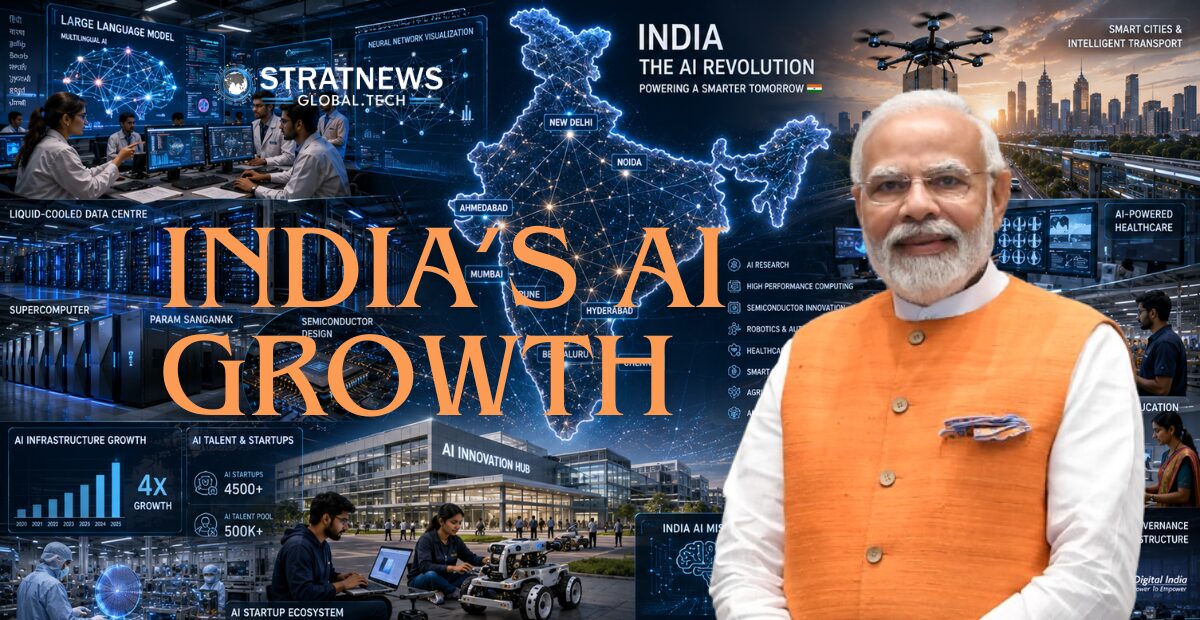
India Writing New Chapters in AI, Semiconductors and Space, Says PM Modi
Prime Minister Narendra Modi said India is entering a new phase of technological and economic progress, with the country’s youth playing a central role in advances across artificial intelligence (AI), semiconductors, space technology and deep tech. He said their contributions have also helped India become the world’s second-largest mobile phone manufacturer and the third-largest startup ecosystem.
The Prime Minister made the remarks after inaugurating the Swami Vivekananda Cultural Youth Centre (Viveka Smaraka) in Mysuru. The centre commemorates Swami Vivekananda’s visit to Mysuru in 1892 and seeks to promote value-based education, leadership and personality development among young people.
Youth Driving Innovation and Growth
Addressing the gathering, Modi said India’s young entrepreneurs are strengthening the country’s position as a global technology hub. He noted that digital solutions developed in India are gaining international recognition and inspiring other nations.
Furthermore, he said India is making rapid progress in semiconductor manufacturing while writing new chapters in AI, deep tech, space technology and innovation. According to the Prime Minister, these developments reflect the growing capabilities of the country’s youth and their contribution to the nation’s technological transformation.
He also highlighted the expansion of India’s private space sector. Referring to a recently launched privately developed rocket, Modi said the achievement demonstrated the talent and determination of young entrepreneurs working in the space industry.
In addition, he said young people are driving the digital economy by building startups, generating employment through Mudra loans and contributing to the Make in India and Atmanirbhar Bharat initiatives.
Education Reforms to Unlock Demographic Potential
The Prime Minister said India can fully benefit from its demographic dividend only by providing young people with quality education, meaningful opportunities and the confidence to pursue their ambitions.
He stated that the country has significantly expanded its higher education infrastructure over the past 12 years. According to Modi, more than 650 new universities, nearly 14,000 colleges and over 4,000 Industrial Training Institutes (ITIs) have been established during this period.
Moreover, he said the government has created nine Indian Institutes of Management (IIMs), seven Indian Institutes of Technology (IITs) and 13 All India Institutes of Medical Sciences (AIIMS). He added that the number of MBBS seats has increased to nearly 1.4 lakh.
The Prime Minister also said the National Education Policy (NEP) is aligning India’s education system with the needs of the 21st century. Alongside this, more than 14,000 PM Shri schools and over 10,000 Atal Tinkering Labs have been established to encourage innovation and scientific thinking among students.
He further noted that reforms allowing engineering and medical education in Indian languages, as well as opening military schools and the National Defence Academy to women, have broadened access to educational and career opportunities.
Sports Strengthening the Nation
Highlighting the government’s emphasis on sports, Modi said initiatives such as the Khelo India Youth Games, University Games, Para Games and Winter Games are helping identify sporting talent from villages and smaller towns.
He said these programmes are strengthening India’s sporting ecosystem while encouraging wider participation across the country. According to the Prime Minister, sport helps young people develop discipline, confidence and good health.
He added that India’s performances at international competitions continue to improve, with athletes setting new records and women athletes bringing pride to the nation through their achievements.