


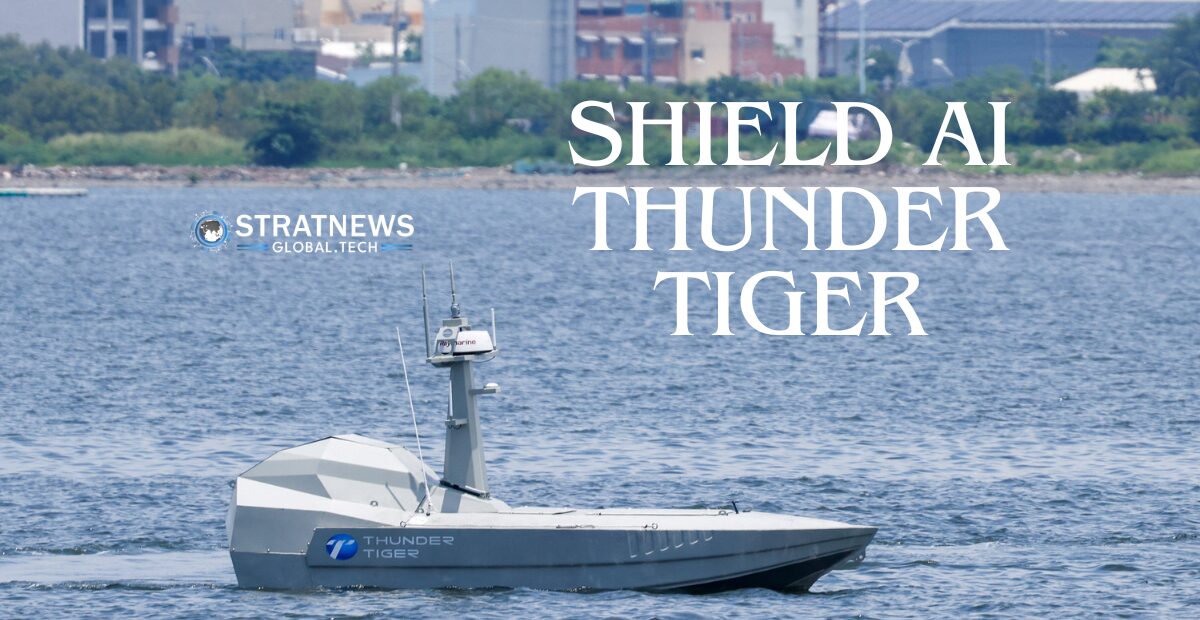
Shield AI And Thunder Tiger Partnership Advances Taiwan Maritime Autonomy
Shield AI announced on 13 May 2026 in Taipei that it had signed a memorandum of understanding with Thunder Tiger Corp. to integrate its Hivemind autonomy software across the Taiwanese company’s unmanned systems portfolio, beginning with unmanned surface vessels (USVs). The first milestone will see Hivemind serve as the AI pilot aboard a Thunder Tiger USV, with a live demonstration planned for the summer. The agreement highlights Taiwan’s growing focus on autonomous, distributed maritime defence capabilities.
According to Shield AI, the partnership aims to support AI-enabled unmanned systems, cross-domain teaming, and Taiwan’s ability to develop and sustain autonomous defence technologies through domestic industry.
Phased Integration For Autonomous Maritime Operations
The agreement establishes a phased integration process that includes simulation-based testing, hardware-in-the-loop integration, and live vehicle trials. As a result, the programme extends beyond adapting software for a single unmanned vessel. Instead, it seeks to validate how multiple autonomous systems can operate together across Thunder Tiger’s wider portfolio.
Shield AI stated that Hivemind has already been integrated across multiple platforms and operational domains. Initially, the Taiwan programme will concentrate on maritime operations before potentially expanding to mixed fleets that combine unmanned surface and aerial systems. Consequently, the broader objective is to move beyond isolated drone operations towards coordinated multi-agent teaming in contested environments.
Hivemind Brings Greater Autonomy To USVs
The integration of Hivemind as an AI pilot represents a clear distinction between remotely operated sea drones and autonomous maritime platforms. Traditional unmanned boats rely heavily on continuous communications links and operator control. Those links remain vulnerable to jamming, latency, cyberattacks, and battlefield saturation.
By contrast, an autonomy layer allows a USV to continue navigating, adjust its route, avoid obstacles, maintain formation, and coordinate with other systems even when communications become degraded. However, this does not automatically transfer lethal decision-making to the machine. Instead, it demonstrates that Taiwan and its industrial partners are exploring higher levels of machine-enabled mission execution where speed, resilience, and dispersion could prove decisive.
Hivemind Provides The Mission Layer
Hivemind forms the core of the programme because it provides the mission software above the physical platform. Shield AI describes Hivemind Enterprise as a modular autonomy software platform designed to develop, test, and deploy intelligent machines.
Its Pilot catalogue includes state estimation, mapping, sensing, object tracking, task planning, behaviour planning, motion planning, multi-agent teaming, and resilience in communications- or GPS-denied environments. In addition, Shield AI’s Commander tool connects Hivemind-enabled systems with command-and-control and mission-planning workflows while keeping human objectives central to autonomous execution.
These capabilities hold particular relevance in the Taiwan Strait. Unmanned systems operating there must function in congested waters, withstand electronic warfare, and coordinate effectively with manned naval, coastal defence, and aerial assets.
Thunder Tiger Strengthens Taiwan’s Industrial Base
Thunder Tiger provides the partnership with a strong domestic industrial foundation. Shield AI describes the company as a Taiwan-based manufacturer specialising in unmanned aerial vehicles, unmanned surface vessels, and related technologies used in defence, inspection, disaster response, and other mission-critical operations.
Its portfolio also includes unmanned aerial and underwater systems. Furthermore, its SeaShark family has been publicly associated with coastal defence missions, intelligence payloads, rockets, loitering munitions, and heavy payload configurations.
As a result, the partnership combines U.S. AI-enabled autonomy with Taiwanese-built platforms that can be adapted, maintained, produced, and potentially expanded within Taiwan’s defence industrial base.
SeaShark Configuration Suggests Modular Flexibility
A notable aspect of Shield AI’s announcement was an accompanying image showing a Thunder Tiger SeaShark 800 unmanned surface vessel fitted with a launcher-type module. However, Shield AI did not identify the launcher model, missile type, payload, or intended mission. Therefore, the image should not be interpreted as confirmation of any specific weapons integration.
Nevertheless, the configuration highlights the possible modular nature of future Taiwanese USV concepts. The same hull family could support reconnaissance, strike, decoy, explosive, electronic warfare, or coastal defence missions depending on the payload installed.
Reuters previously reported that the SeaShark 800 could carry 1,200 kilograms of explosives and travel up to 500 kilometres. Similarly, USNI News reported that the platform family could deploy payloads of approximately 1,000 kilograms.
Strategic Importance For Taiwan’s Defence
The partnership carries considerable strategic significance because of Taiwan’s geography and security environment. Taiwan faces a much larger Chinese naval, coast guard, and maritime militia presence. At the same time, its defence planning must account for blockade scenarios, grey-zone pressure, port disruption, missile strikes, and potential amphibious or air-assault operations.
Reuters reported in June 2025 that Taiwan had begun studying sea drones following Ukraine’s successful use of unmanned surface vessels in the Black Sea. The report also noted that Taiwan’s navy is significantly smaller than China’s, encouraging Taipei to invest in asymmetric warfare concepts centred on smaller, mobile, and lower-cost systems.
Against this backdrop, autonomous USVs could complicate Chinese operational planning by increasing the number of maritime threats and sensors that require detection, tracking, classification, and neutralisation during any operation across the Taiwan Strait.
Lessons From Ukraine And Future Force Design
Although comparisons with Ukraine provide useful insights, the two operational environments differ significantly. Ukraine’s sea drones demonstrated that unmanned surface vessels can pressure a larger navy when integrated with intelligence, aerial drones, coastal missiles, and electronic warfare.
However, Taiwan faces a narrower maritime battlespace with denser surveillance, closer Chinese air and missile forces, layered maritime screening, extensive electronic warfare, and rapid counter-drone adaptation. Therefore, the Shield AI-Thunder Tiger partnership matters primarily because of its software integration and force-design potential.
The central question is not simply whether Taiwan can deploy sea drones. Instead, the focus lies on whether autonomous systems can operate together within a resilient, coordinated, and scalable defence network.
The partnership also aligns with Taiwan’s broader effort to build a layered coastal denial architecture. USNI News reported that Taiwan’s planned Littoral Combat Force is expected to combine unmanned surface vessels with mobile land-based anti-ship missiles and Marine-operated small boat units to strengthen area-denial capabilities.
The same report also cited plans to procure as many as 1,350 unmanned surface vessels across different branches of Taiwan’s military, alongside a far larger unmanned systems programme involving tens of thousands of FPV and quadcopter drones.
If Hivemind enables Thunder Tiger’s USVs and other unmanned platforms to operate as coordinated autonomous teams, Taiwan could develop a more distributed maritime defence layer. Such a capability would help saturate adversary defences, increase operational uncertainty, and reduce reliance on larger manned naval platforms.
Ultimately, the Shield AI-Thunder Tiger partnership signals a broader shift in Taiwan’s unmanned defence strategy from acquiring individual platforms to designing autonomous force structures. Should the planned demonstrations confirm Hivemind’s effectiveness aboard Thunder Tiger USVs in realistic maritime conditions, Taiwan could strengthen its distributed coastal defence by combining domestic unmanned production with U.S. AI-enabled autonomy. While this approach will not replace conventional naval power, it could add another layer of deterrence that complicates Chinese operational planning, raises the potential cost of aggression, and expands Taiwan’s defensive options in the contested waters surrounding the island.

