


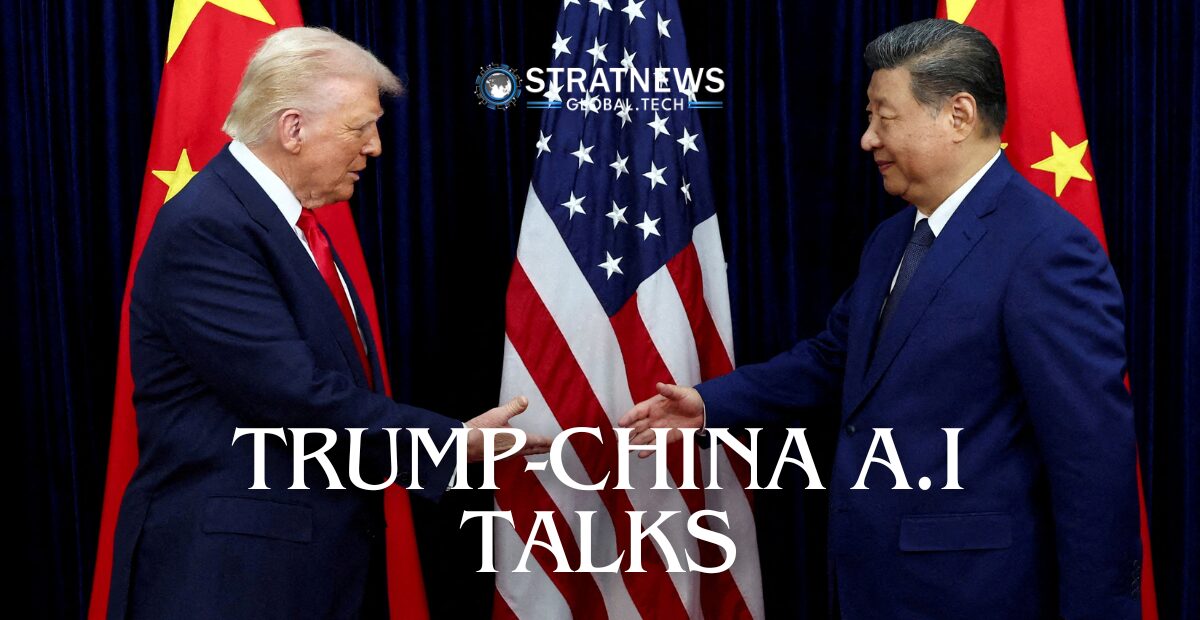
Trump Heads To China Seeking Trade Gains And Market Access
President Donald Trump said he would urge Chinese President Xi Jinping to open China further to American businesses as he travelled to Beijing on Wednesday for a high-stakes summit aimed at boosting economic ties and improving his domestic standing.
Trump added Nvidia chief executive Jensen Huang to a delegation of leading business executives accompanying him during a stop in Alaska en route to China. The visit marks the first trip by a sitting U.S. president to China in nearly a decade.
Trump Pushes For Greater Access To Chinese Market
Ahead of the summit, Trump said he intended to press Xi to allow more opportunities for American companies operating in China.
“I will be asking President Xi, a Leader of extraordinary distinction, to ‘open up’ China so that these brilliant people can work their magic,” Trump wrote in a post on Truth Social, referring to the business delegation.
“I will make that my very first request.”
The group travelling with Trump largely consists of executives from firms seeking solutions to long-running business challenges in China. Nvidia has faced difficulties securing approval to sell its advanced H200 artificial intelligence chips in the Chinese market.
A source familiar with the matter said Trump personally invited Huang to join the trip at the last minute. White House reporters later saw him boarding Air Force One during a refuelling stop in Alaska.
Trade And Technology Dominate Discussions
Trump’s arrival in Beijing follows talks in South Korea between U.S. Treasury Secretary Scott Bessent and Chinese Vice Premier He Lifeng. The discussions focused on preserving a fragile trade agreement reached last year between the world’s two largest economies.
The deal led Trump to suspend steep tariffs on Chinese imports, while China eased pressure on exports of rare earth materials critical to industries including electric vehicles and defence manufacturing.
Chinese state media described the latest negotiations as “candid, in-depth and constructive exchanges”. However, officials released few details after the meeting.
U.S. officials said both sides are also expected to discuss artificial intelligence cooperation, trade forums, investment dialogue and increased American exports to China, including Boeing aircraft, agricultural products and energy supplies.
Meanwhile, Beijing wants Washington to ease restrictions on exports of advanced semiconductors and chipmaking equipment.
Sensitive Geopolitical Issues Loom Over Summit
Beyond trade, Trump and Xi are expected to discuss several contentious geopolitical matters, including the Iran conflict and U.S. arms sales to Taiwan.
Trump has indicated that he may encourage China to persuade Tehran to negotiate with Washington to end the ongoing conflict, although he previously suggested such assistance may not be necessary.
China reiterated its opposition to American arms sales to Taiwan on Wednesday. The future of a proposed $14 billion weapons package awaiting Trump’s approval remains uncertain.
The United States maintains a legal obligation to help Taiwan defend itself despite the absence of formal diplomatic relations with the island.
Trump Faces Political Pressure At Home
Trump enters the summit under mounting domestic pressure. Courts have restricted aspects of his tariff powers, while the conflict involving Iran has fuelled inflation concerns and raised political risks ahead of November’s midterm elections.
Although China’s economy has slowed, analysts believe Xi faces far less political pressure than Trump.
“The Trump administration needs this meeting more than China does, as it needs to show to American voters that deals are signed, money is made,” said Liu Qian, founder and chief executive of Beijing-based geopolitical advisory firm Wusawa Advisory.
Residents in Beijing expressed cautious optimism about Trump’s visit. Some hoped the talks could lead to improved trade policies and reduced tensions between the two countries.
“I don’t know if he’s genuinely sincere,” said Lou Huilian, who works in the oil trade in Beijing.
“But speaking as a Chinese person, and as someone working in trade, I just hope some good policies can come out of this.”
With inputs from Reuters