

Close Menu
Stratnews GlobalStratnews Global
    Facebook X (Twitter) Instagram
    Trending
    • G Spider AI robot canal cleaning in Thiruvananthapuram boosts sanitation safety
    • Data Is The New Oil: Iran’s Strikes on Amazon, Microsoft Centres Redefine Warfare
    • Pentagon blocks Anthropic AI military use after Anthropic supply chain risk designation
    • Sierra Space valuation rises as Sierra Space Series C funding reaches $8 billion
    • India Digital Public Infrastructure model sets global benchmark for population scale systems
    • Karnataka social media ban for under 16 announced by Chief Minister Siddaramaiah
    • NASA moon rocket component shift could see United Launch Alliance hardware used
    • Scientists Grow Chickpeas in Simulated Lunar Soil for Future Moon Missions
    • Support Us
    Stratnews GlobalStratnews Global
    Write for Us
    Sunday, March 8
    • Space
    • Science
    • AI and Robotics
    • Industry News
    • Support Us
    Stratnews GlobalStratnews Global
    Home » Bristol Creates Soft Robotic Exosuit for Astronauts

    Bristol Creates Soft Robotic Exosuit for Astronauts

    Arushi PandeyBy Arushi PandeyFebruary 10, 2026 AI and Robotics No Comments2 Mins Read
    Bristol Robotic Exosuit

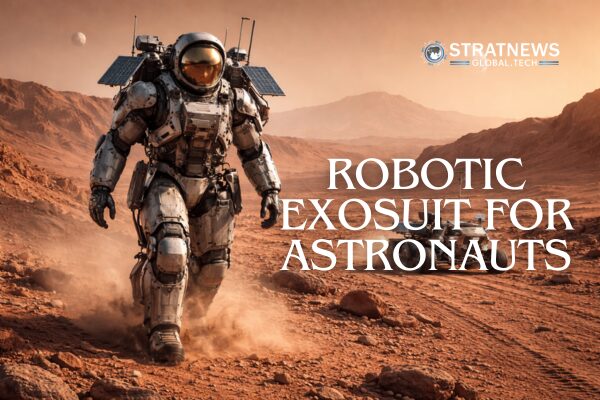
    Astronauts may soon be moving more naturally on the Moon and Mars thanks to a soft robotic exosuit developed by researchers at the University of Bristol. The wearable trousers, designed to be worn under a spacesuit, aim to reduce lower-limb fatigue while supporting everyday mobility tasks in reduced gravity environments.

    “It feels very strange,” said Bristol researcher Emanuele Pulvirenti while demonstrating the exosuit to Reuters. “It’s like having an added layer of muscles. So your own muscles are not working as hard… it almost feels like someone is giving you a little push to move just a little bit easier.”

    Dual Functionality for Mobility and Muscle Maintenance

    The team is developing two versions of the exosuit: an assistive variant to help astronauts move in pressurised suits, and a resistive version that adds load to maintain muscle mass. The ultimate goal is to integrate both functions into a single, garment-like exosuit. Pulvirenti noted that the technology could also have applications on Earth, including rehabilitation systems that either assist movement or provide resistance to preserve muscle strength.

    The exosuit uses inflatable artificial muscles combining an outer nylon layer with an inner thermoplastic layer for airtight inflation. Key structural elements, such as the waistband and knee straps, are reinforced with Kevlar for durability.

    Field Trials Show Promising Results

    In October 2025, the exosuit was tested at the University of Adelaide’s Exterres CRATER facility, a simulated lunar environment. Integrated into a spacesuit, it was evaluated during walking, climbing, and carrying loads on loose terrain. Pulvirenti said both subjective feedback and scientific data—including measurements of muscle activation and joint kinematics—confirmed the suit’s effectiveness.

    Addressing the Challenges of Reduced Gravity

    Pressurised suits can restrict natural leg motion, increasing fatigue during planetary surface operations. Combined with reduced gravity, astronauts’ muscles can weaken rapidly, requiring time-consuming daily exercise to maintain fitness. The soft robotic exosuit is designed to provide dynamic loading throughout the day, complementing traditional exercise regimes and helping crews maintain “Earth-ready” muscle strength during long-duration missions.

    Author

    • Arushi Pandey
      Arushi Pandey

      View all posts
    Featured
    Share. Facebook Twitter Pinterest LinkedIn Tumblr Email Reddit Telegram WhatsApp
    Arushi Pandey

      Keep Reading

      G Spider AI robot canal cleaning in Thiruvananthapuram boosts sanitation safety

      Data Is The New Oil: Iran’s Strikes on Amazon, Microsoft Centres Redefine Warfare

      Pentagon blocks Anthropic AI military use after Anthropic supply chain risk designation

      Sierra Space valuation rises as Sierra Space Series C funding reaches $8 billion

      India Digital Public Infrastructure model sets global benchmark for population scale systems

      Karnataka social media ban for under 16 announced by Chief Minister Siddaramaiah

      Add A Comment
      Leave A Reply Cancel Reply

      Anti Drone System (CUAS)
      Latest Posts

      G Spider AI robot canal cleaning in Thiruvananthapuram boosts sanitation safety

      March 6, 2026

      Data Is The New Oil: Iran’s Strikes on Amazon, Microsoft Centres Redefine Warfare

      March 6, 2026

      Pentagon blocks Anthropic AI military use after Anthropic supply chain risk designation

      March 6, 2026

      Sierra Space valuation rises as Sierra Space Series C funding reaches $8 billion

      March 6, 2026

      India Digital Public Infrastructure model sets global benchmark for population scale systems

      March 6, 2026

      Karnataka social media ban for under 16 announced by Chief Minister Siddaramaiah

      March 6, 2026

      NASA moon rocket component shift could see United Launch Alliance hardware used

      March 6, 2026

      Scientists Grow Chickpeas in Simulated Lunar Soil for Future Moon Missions

      March 6, 2026

      New CPI, New India: The Structural Shift in Inflation

      March 5, 2026

      India Builds AI Talent Pipeline Through Education and Skilling Initiatives

      March 5, 2026

      Subscribe to News

      Get the latest sports news from NewsSite about world, sports and politics.

      • Astronomical Events
      • Space Missions
      • Industry News
      • Science
      StratNewsGlobal Tech
      Facebook X (Twitter) Instagram LinkedIn YouTube
      © 2026 StratNews Global, A unit of BharatShakti Communications LLP
      • About Us
      • Contributors
      • Copyright
      • Contact
      • Write for Us

      Type above and press Enter to search. Press Esc to cancel.