


Close Menu
Stratnews GlobalStratnews Global
    Facebook X (Twitter) Instagram
    Trending
    • India AI Summit Robot Controversy Triggers Political Backlash
    • Instagram Youth Mental Health Trial Puts Mark Zuckerberg In Court
    • Telegram Military Messages Exposed To Foreign Intelligence Claims
    • AI Scientific Discovery Era Heralded By Demis Hassabis
    • China Nuclear Test Allegation Raises Fresh Arms Control Concerns
    • YouTube Recommendation System Outage Disrupts Global Access
    • DoT COAI And STPI Showcase AI Ready Telecom Ecosystem At India AI Impact Summit 2026
    • India To Add 20,000 GPUs To Boost National AI Infrastructure
    Stratnews GlobalStratnews Global
    Write for Us
    Wednesday, February 18
    • Space
    • Science
    • AI and Robotics
    • Industry News
    Stratnews GlobalStratnews Global
    Home » ISRO And NIOT Forge Deep-Sea Future With Samudrayaan

    ISRO And NIOT Forge Deep-Sea Future With Samudrayaan

    Kanika SharmaBy Kanika SharmaJuly 24, 2025 Defence No Comments2 Mins Read
    Deep Sea

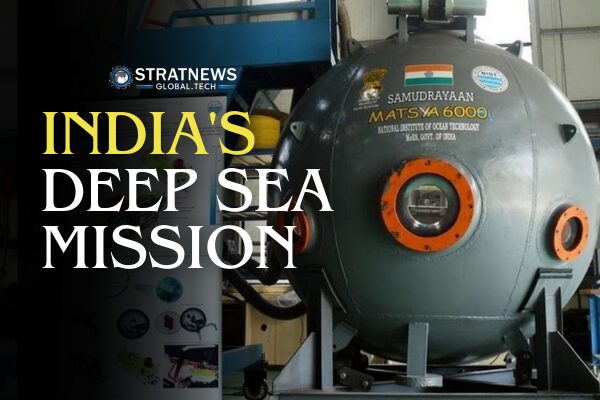
    India’s ambitious deep-sea exploration project, Samudrayaan, has reached a major engineering milestone. The National Institute of Ocean Technology (NIOT), under the Ministry of Earth Sciences (MoES), is developing MATSYA-6000—a manned submersible capable of reaching ocean depths of up to 6,000 metres.

    At the core of this Human Occupied Vehicle (HOV) lies a specially designed spherical capsule, developed in collaboration with ISRO’s Vikram Sarabhai Space Centre (VSSC).

    Made in India: A Titanium Sphere for the Deepest Dives

    The capsule, called the personnel sphere, is 2.26 metres in diameter and has a wall thickness of 80mm. It is made from a high-grade Titanium alloy (Ti6Al4V – ELI) and is designed to withstand immense pressures—up to 600 bar—at temperatures as low as -3°C. It will carry a three-member crew into the deep ocean.

    This is a pioneering feat for India’s marine technology efforts, pushing the limits of engineering and materials science.

    High-Tech Welding and Inspection

    One of the biggest challenges was developing the welding process for such thick titanium. The Liquid Propulsion Systems Centre (LPSC) was tasked with this job. Their existing Electron Beam Welding (EBW) setup, capable of handling up to 20mm thickness, was upgraded to a massive 40kW capacity to handle the new requirements.

    Over 700 weld trials were conducted to refine the process. For safety and quality, state-of-the-art non-destructive testing methods were developed. These include advanced techniques like Time of Flight Diffraction (TOFD) and Phased Array Ultrasonic Testing (PAUT).

    To inspect the welds, a new X-ray radiography facility operating at 7.5MeV—far more powerful than standard X-ray machines—was installed.

    India’s First Deep-Weld Success

    After months of preparation and trial, the first full-scale weld on the actual hardware was successfully completed. This involved welding 80mm thick titanium over a total length of 7.1 metres, all completed in just 32 minutes. It’s the first time such a deep, high-precision weld has been achieved in India.

    The entire welding process, inspection standards, and qualification protocols are now being reviewed by third-party certifiers.

    This marks a huge step forward for India’s Samudrayaan mission and its capability to conduct human deep-sea exploration. Once completed, MATSYA-6000 will place India among the few nations capable of sending crewed missions to the ocean’s darkest depths.

    Author

    • Kanika Sharma
      Kanika Sharma

      View all posts
    Dont miss Featured india ISRO Just In Opinion Picks space
    Share. Facebook Twitter Pinterest LinkedIn Tumblr Email Reddit Telegram WhatsApp
    Kanika Sharma
    Kanika Sharma

      Keep Reading

      India AI Summit Robot Controversy Triggers Political Backlash

      Instagram Youth Mental Health Trial Puts Mark Zuckerberg In Court

      Telegram Military Messages Exposed To Foreign Intelligence Claims

      AI Scientific Discovery Era Heralded By Demis Hassabis

      China Nuclear Test Allegation Raises Fresh Arms Control Concerns

      YouTube Recommendation System Outage Disrupts Global Access

      Add A Comment
      Leave A Reply Cancel Reply

      Anti Drone System (CUAS)
      Latest Posts

      India AI Summit Robot Controversy Triggers Political Backlash

      February 18, 2026

      Instagram Youth Mental Health Trial Puts Mark Zuckerberg In Court

      February 18, 2026

      Telegram Military Messages Exposed To Foreign Intelligence Claims

      February 18, 2026

      AI Scientific Discovery Era Heralded By Demis Hassabis

      February 18, 2026

      China Nuclear Test Allegation Raises Fresh Arms Control Concerns

      February 18, 2026

      YouTube Recommendation System Outage Disrupts Global Access

      February 18, 2026

      DoT COAI And STPI Showcase AI Ready Telecom Ecosystem At India AI Impact Summit 2026

      February 18, 2026

      India To Add 20,000 GPUs To Boost National AI Infrastructure

      February 18, 2026

      Bharat VISTAAR Launched In Rajasthan To Empower Farmers With AI Support

      February 18, 2026

      India AI Impact Summit Signals $200 Billion AI Investments Push

      February 17, 2026

      Subscribe to News

      Get the latest sports news from NewsSite about world, sports and politics.

      • Astronomical Events
      • Space Missions
      • Industry News
      • Science
      StratNewsGlobal Tech
      Facebook X (Twitter) Instagram LinkedIn YouTube
      © 2026 StratNews Global, A unit of BharatShakti Communications LLP
      • About Us
      • Contributors
      • Copyright
      • Contact
      • Write for Us

      Type above and press Enter to search. Press Esc to cancel.