


India’s Digital Public Infrastructure Sets Global Benchmark for Population-Scale Systems
India has emerged as a leading architect of population scale digital infrastructure, transforming how governance, services and economic systems function in the digital era. The country’s Digital Public Infrastructure, often referred to as DPI, links identity, payments and data exchange through open and interoperable platforms. As a result, these systems now support governance, financial inclusion and economic activity across a population exceeding 1.4 billion people.
Unlike closed digital ecosystems, India’s approach treats infrastructure as a public good. The model emphasises openness, accessibility and integration. Consequently, it enables governments, businesses and citizens to interact through secure and interoperable digital rails.
Why Digital Public Infrastructure Matters
Infrastructure today extends beyond roads, ports and electricity networks. Digital systems now form the backbone of modern economies. These systems enable individuals and institutions to verify identity, make payments and exchange data securely.
Well designed digital infrastructure can strengthen governance while expanding access to services. When identity systems connect with payments and data exchange platforms, governments can deliver welfare more efficiently and transparently. At the same time, businesses gain easier access to markets and financial services.
India has demonstrated that such systems can operate at population scale. Importantly, the infrastructure remains accessible and affordable while supporting innovation across multiple sectors.
The JAM Trinity Built the Foundation
India’s digital transformation began with the convergence of three foundational elements known as the JAM trinity. This framework combines Jan Dhan bank accounts, Aadhaar digital identity and widespread mobile connectivity.
Together, these elements created the base layer for digital governance. Through this integration, individuals gained direct and verifiable connections with state systems. Welfare benefits began reaching bank accounts directly, reducing intermediaries and delays.
Aadhaar
Aadhaar introduced a biometric digital identity system that enables secure authentication for residents. By March 2026, more than 144 crore Aadhaar numbers had been issued.
Usage has expanded significantly across services. During the financial year 2024 to 2025 alone, more than 2,707 crore authentication transactions were recorded. Identity verification became portable and almost instantaneous.
Jan Dhan Yojana
The Pradhan Mantri Jan Dhan Yojana launched in 2014 aimed to bring unbanked citizens into the formal financial system. The initiative provides access to banking services, credit, insurance and pensions.
The number of accounts increased from 14.72 crore in 2015 to 57.71 crore by March 2026. Deposits also expanded sharply, rising from ₹15,670 crore in 2015 to ₹2.94 lakh crore by March 2026.
Mobile Connectivity
Mobile connectivity completed the digital triangle. Around 85.5 percent of Indian households now own at least one smartphone.
Wireless subscribers reached 125.87 crore by December 2025. Meanwhile, fifth generation mobile services are available in nearly all districts, covering about 85 percent of the population. This connectivity ensured that digital identity and banking services became accessible across both rural and urban regions.
India Stack Powers the Digital Ecosystem
Building on the JAM foundation, India developed a broader digital architecture known as India Stack. This system integrates identity, payments and data sharing through open application programming interfaces.
The result is a connected framework rather than isolated platforms. Digital systems now support payments, welfare delivery, health services, education, commerce and governance.
Digital Economic Infrastructure
The Unified Payments Interface has transformed retail payments in India. It enables instant bank to bank transfers for individuals and merchants.
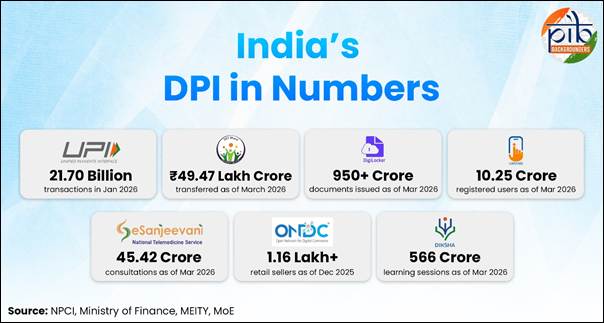
In January 2026 alone, UPI processed 21.70 billion transactions worth more than ₹28.33 lakh crore. With 691 banks connected to the network, it has become the dominant digital payment method in the country.
Other financial platforms strengthen transparency in public spending. The Public Financial Management System tracks government funds and Direct Benefit Transfers. Between 2015 and March 2024, the system helped save more than ₹4.31 lakh crore by removing duplicate beneficiaries and reducing leakages.
Digital commerce infrastructure has also expanded through initiatives such as the Open Network for Digital Commerce and the Government eMarketplace. These platforms widen market access, particularly for small businesses and micro enterprises.
Citizen Service Delivery Platforms
India’s digital infrastructure also powers a range of citizen service platforms.
DigiLocker allows individuals to store and share authenticated digital documents. By March 2026, the platform had more than 67.63 crore users and over 950 crore issued documents.
Similarly, the UMANG application provides access to thousands of government services through a single mobile interface. As of March 2026, it recorded over 10.25 crore registered users and more than 723 crore transactions.
Digital transformation has also reached the judicial system. The e Courts project digitises case management, filing and data access. The third phase of the initiative focuses on paperless courts, digitisation of records and expanded use of emerging technologies such as artificial intelligence.
Expanding Digital Systems in Health and Education
India’s health and education sectors have also integrated digital infrastructure.
The CoWIN platform served as the digital backbone of India’s COVID 19 vaccination programme. It managed more than 220 crore vaccine doses and enabled real time monitoring across the country.
Telemedicine services expanded through the eSanjeevani platform. By March 2026, it had served more than 45.42 crore patients and connected over 2.3 lakh healthcare providers.
Education platforms such as DIKSHA support digital learning for teachers and students. The system recorded 566 crore learning sessions and more than 18.52 crore course enrolments by March 2026.
India’s Growing Global Role in Digital Infrastructure
India’s experience with digital public infrastructure is attracting global attention. Many countries now seek to adopt similar systems for identity, payments and service delivery.
By February 2026, India had signed agreements with 24 countries for cooperation on India Stack and digital infrastructure. These partnerships focus on sharing technical knowledge and design principles rather than exporting proprietary technology.
India’s payment infrastructure has also expanded internationally. UPI now operates in several countries including the United Arab Emirates, Singapore, Bhutan, Nepal and France, enabling faster cross border payments.
India further advanced the global conversation during its G20 presidency in 2023 by promoting digital public infrastructure as a development accelerator.
A Model for the Digital Age
India’s Digital Public Infrastructure demonstrates how technology can support inclusive growth at population scale. By linking identity, finance and connectivity through open platforms, the country has created a comprehensive digital backbone for governance and economic activity.
The model shows that digital systems can expand access to services while strengthening transparency and efficiency. As more nations explore similar pathways, India’s experience increasingly serves as a reference point for building resilient and inclusive digital ecosystems.
With inputs from PIB