


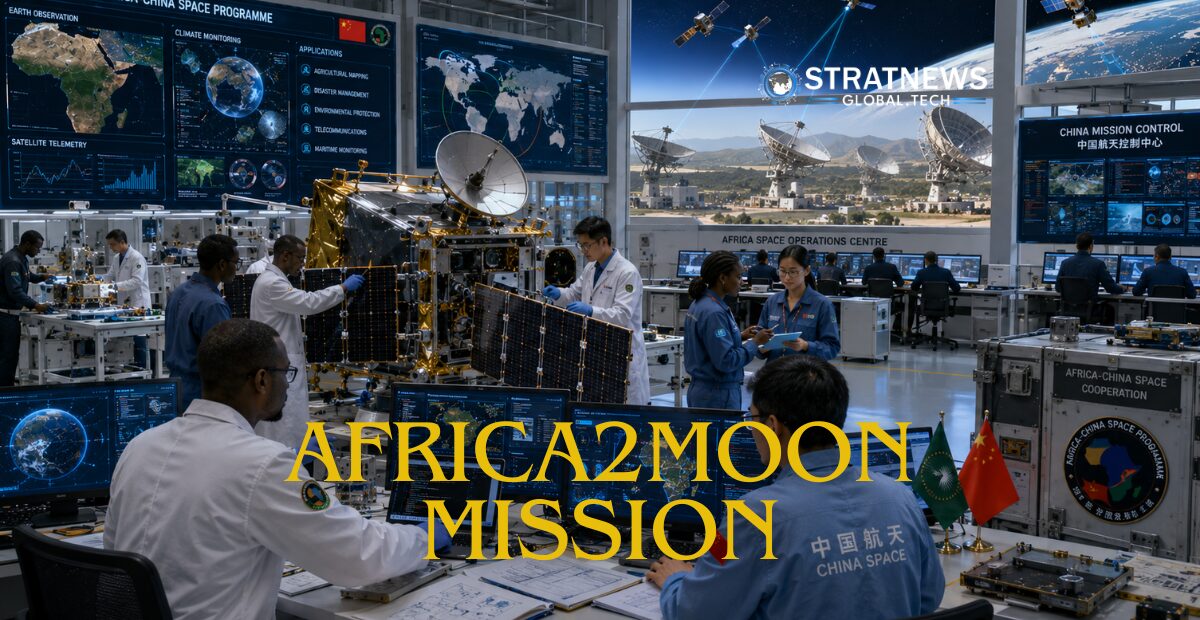
Balls on the Moon: China Set To Launch Africa’s First Lunar Science Mission in 2029
China’s planned Chang’e-8 lunar lander mission in 2029 could carry Africa’s first lunar science mission to the moon’s south polar region. The milestone would mark a significant step for African participation in deep-space exploration while advancing research into some of the universe’s oldest radio signals.
The Africa2Moon initiative will send three experimental probes known as the Bounced African Low Lunar Sphere, or BALLS. Together, the probes will demonstrate new technology while forming a small radio astronomy array on the lunar surface.
Africa2Moon Mission Aims To Study Ancient Cosmic Signals
Each BALLS probe features a spherical metal framework that encloses low-frequency radio telescope antennas. Once deployed, the three probes will operate together to detect extremely low-frequency radio emissions originating from some of the oldest and most distant regions of the universe.
Astronomers consider the moon’s far side the quietest radio environment near Earth. As a result, it offers an ideal location for observing faint cosmic signals without the interference created by Earth’s atmosphere and human-made radio transmissions.
According to Carla Mitchell, mission director of the Africa2Moon initiative and Africa Programme Manager at the South African Radio Astronomy Observatory (SARAO), the array will observe radio frequencies below 20 megahertz. These frequencies cannot be measured from Earth because the ionosphere distorts and blocks them.
Chang’e-8 Selected The Project As An International Payload
The Chinese National Space Administration selected the Africa2Moon project in April 2025 as one of the international payloads for the Chang’e-8 mission.
The BALLS array will serve as a technology demonstrator for future lunar science missions. In addition, it will test systems intended for a much larger Africa2Moon project that proposes deploying 55 antennas across the lunar far side.
Mitchell explained that the programme has progressed from early planning to working hardware after years of development. Speaking at the NASA Exploration Science Forum 2026, held at NASA’s Ames Research Center and organised by the NASA Solar System Exploration Research Virtual Institute, she reflected on the project’s journey.
She said that, as a child, she never believed space exploration was possible for people in Africa. Today, she leads a lunar mission presented before the international scientific community.
African Institutions Drive The Mission
SARAO, South Africa’s national radio astronomy facility, manages major scientific infrastructure, including MeerKAT and the country’s involvement in the Square Kilometre Array project. The organisation also supports research into pulsars, fast radio bursts, dark matter and dark energy.
The wider mission brings together the Foundation for Space Development Africa, SARAO, the South African National Space Agency, the National Institute for Theoretical and Computational Sciences, and institutions in Kenya, Ghana, Botswana and other African countries.
Meanwhile, engineering teams from Petrawell in Cape Town, the Aerospace Systems Research Institute at the University of KwaZulu-Natal, and the Electronic Systems Laboratory at Stellenbosch University manufactured the structural and functional BALLS models. The teams completed assembly in April 2026 before delivering the hardware to the Chang’e-8 mission team for testing.
How The BALLS Probes Will Operate On The Moon
After landing, the three probes will be positioned across the lunar surface to create a small radio astronomy array. They will transmit their observations to the Chinese lander, which will relay the information back to Earth for scientific analysis.
Each probe consists of a gyroscope-like spherical frame built from interlocking metal rings. Inside the structure sit two large triangular solar panels facing opposite directions, creating a tetrahedral internal arrangement while supplying power for the instruments.
Plans Already Extend Beyond The First Mission
The Africa2Moon team is already considering a second mission featuring 55 radio antennas on the moon’s far side. Mitchell said another launch opportunity would likely depend on continued cooperation with China.
She also noted that the future instruments would probably use a different design. Instead of travelling as fully assembled spheres, they would launch in a flattened configuration before deploying into spherical structures after arrival. The revised approach would help overcome spacecraft space limitations.
In addition, the deployment method would change. Rather than relying on robotic placement, the antennas would deploy directly from the lander. This system could spread the instruments more quickly across a wider area, improving the scientific value of the observations.
Mitchell said collaboration, education and hope remain essential for the future of African space science and technology.
Lunar science specialist Clive Neal praised the effort, noting that volunteers developed much of the project despite limited funding. He said the achievement demonstrates the inspirational power of space exploration and could transform how space science is viewed across Africa. Neal also said the wider lunar science community stands ready to provide support if required.

