

Close Menu
Stratnews GlobalStratnews Global
    Facebook X (Twitter) Instagram
    Trending
    • Atomic Clock Failure On IRNSS-1F Pushes India’s NavIC Navigation Constellation Below Operational Threshold
    • Ukraine Opens Battlefield Data For AI Drone Training
    • Data Centres Become Election Issue In France
    • Apple Slashes App Store Fees In China
    • Google Names London HQ ‘Platform 37’ After AlphaGo Move
    • Pentagon Allows Limited Use Of Anthropic AI
    • Why Venture Capital Is Suddenly Betting on Indian Deep Tech
    • UK Warns Social Media Firms Over Child Safety
    • Support Us
    Stratnews GlobalStratnews Global
    Write for Us
    Saturday, March 14
    • Space
    • Science
    • AI and Robotics
    • Industry News
    • Support Us
    Stratnews GlobalStratnews Global
    Home » Astronomers Track Rare Interstellar Comet Visiting Solar System

    Astronomers Track Rare Interstellar Comet Visiting Solar System

    Arushi PandeyBy Arushi PandeyJuly 4, 2025 Space No Comments3 Mins Read

    A Visitor from Beyond Our Solar System

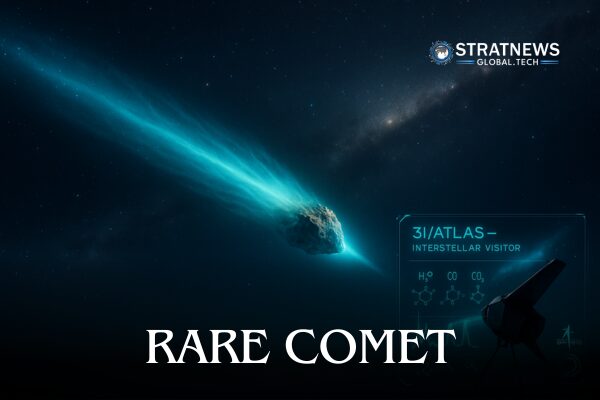
    Astronomers are observing a newly discovered comet that has entered our solar system from interstellar space. This is only the third time such an object has been detected. The comet, named 3I/ATLAS, was first seen on Tuesday by a telescope in Rio Hurtado, Chile. This telescope is part of the Asteroid Terrestrial-impact Last Alert System, known as ATLAS.
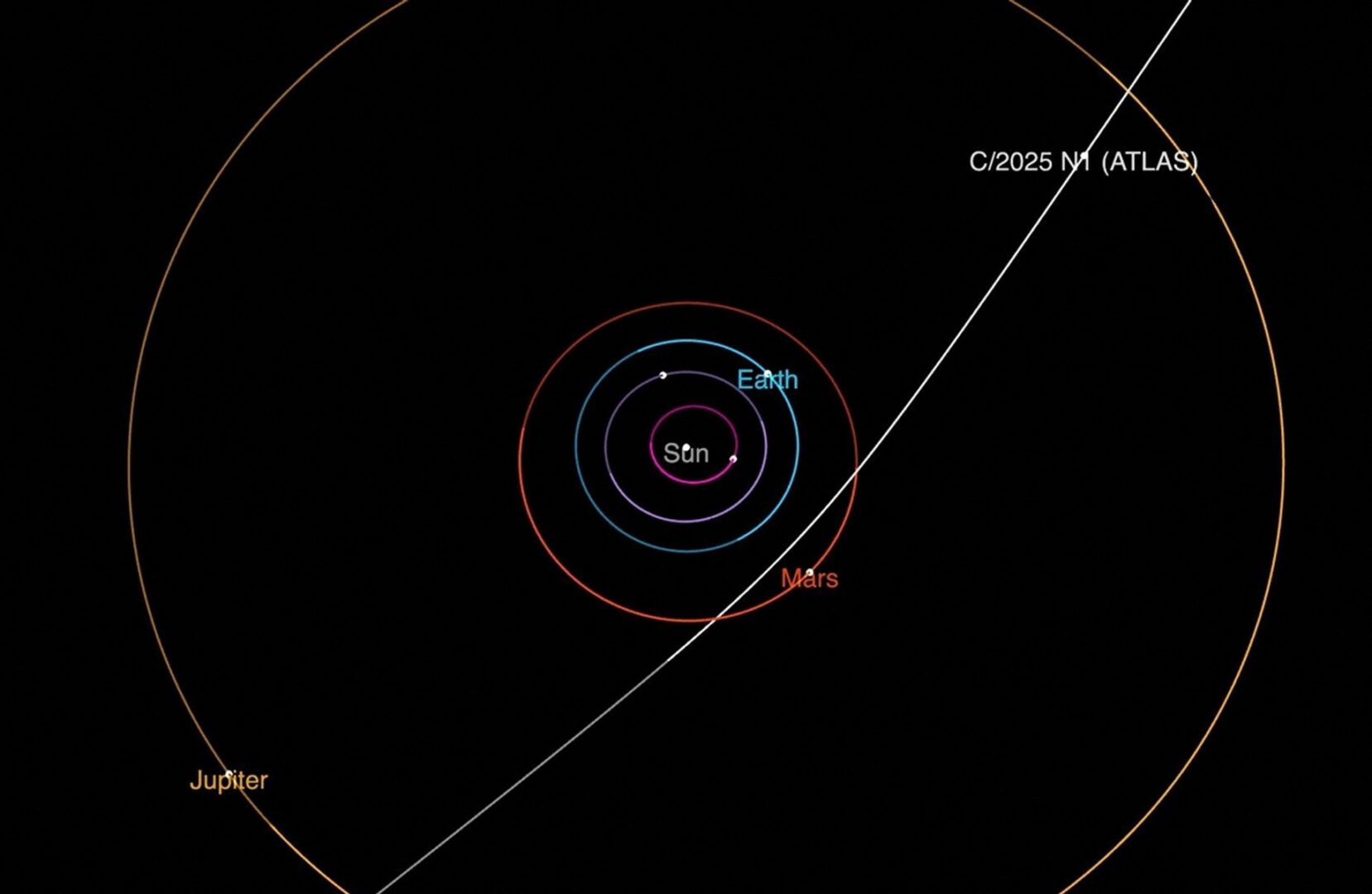
    Interstellar Comet 3I/ATLAS
    This undated diagram shows the trajectory of the interstellar comet 3I/ATLAS as it passes through the solar system, released by NASA on July 2, 2025. NASA/JPL-Caltech

    NASA confirmed the comet’s unusual path suggests it came from beyond our solar system. The object is travelling at about 37 miles (60 km) per second, moving towards us from the direction of the Milky Way’s centre. Currently, it is around 420 million miles (670 million km) from Earth.

    What We Know About Interstellar Comet 3I/ATLAS

    Scientists are working to learn more about the comet. According to Larry Denneau, an astronomer at the University of Hawaii, many observation efforts are now in progress using larger telescopes. These observations aim to discover the comet’s composition and structure.

    So far, astronomers know that 3I/ATLAS appears similar to the interstellar comet 2I/Borisov, found in 2019. However, 3I/ATLAS may be much larger, with an estimated size of about 10 km (6.2 miles) in diameter. Currently, the comet has a faint coma, which is a cloud of gas and dust surrounding its core. This coma, along with a tail, may become more visible as the comet moves closer to the sun.

    No Threat to Earth, but Much to Discover

    The comet poses no danger to Earth. It will never come closer than 150 million miles (240 million km) from our planet, which is about 1.5 times the distance between the Earth and the sun. At present, it is roughly 416 million miles (670 million km) from the sun. It is expected to reach its closest approach around 30 October, when it will come within 130 million miles (210 million km) of the sun, moving inside Mars’ orbit.

    Astronomers are eager to see how the comet will behave as it approaches the sun later this year. The ATLAS network, funded by NASA and operated by the University of Hawaii, uses five telescopes worldwide to scan the night sky continuously. The system aims to detect objects that could pose a threat to Earth while helping scientists track rare interstellar visitors like 3I/ATLAS.

    with inputs from Reuters

    Author

    • Arushi Pandey
      Arushi Pandey

      View all posts
    Featured
    Share. Facebook Twitter Pinterest LinkedIn Tumblr Email Reddit Telegram WhatsApp
    Arushi Pandey

      Keep Reading

      Atomic Clock Failure On IRNSS-1F Pushes India’s NavIC Navigation Constellation Below Operational Threshold

      Ukraine Opens Battlefield Data For AI Drone Training

      Data Centres Become Election Issue In France

      Apple Slashes App Store Fees In China

      Google Names London HQ ‘Platform 37’ After AlphaGo Move

      Pentagon Allows Limited Use Of Anthropic AI

      Add A Comment
      Leave A Reply Cancel Reply

      Anti Drone System (CUAS)
      Latest Posts

      Atomic Clock Failure On IRNSS-1F Pushes India’s NavIC Navigation Constellation Below Operational Threshold

      March 14, 2026

      Ukraine Opens Battlefield Data For AI Drone Training

      March 13, 2026

      Data Centres Become Election Issue In France

      March 13, 2026

      Apple Slashes App Store Fees In China

      March 13, 2026

      Google Names London HQ ‘Platform 37’ After AlphaGo Move

      March 12, 2026

      Pentagon Allows Limited Use Of Anthropic AI

      March 12, 2026

      Why Venture Capital Is Suddenly Betting on Indian Deep Tech

      March 12, 2026

      UK Warns Social Media Firms Over Child Safety

      March 12, 2026

      Age Check laws gain momentum as nations target teen access

      March 10, 2026

      Space Exercise Device for Astronaut Microgravity Training

      March 10, 2026

      Subscribe to News

      Get the latest sports news from NewsSite about world, sports and politics.

      • Astronomical Events
      • Space Missions
      • Industry News
      • Science
      StratNewsGlobal Tech
      Facebook X (Twitter) Instagram LinkedIn YouTube
      © 2026 StratNews Global, A unit of BharatShakti Communications LLP
      • About Us
      • Contributors
      • Copyright
      • Contact
      • Write for Us

      Type above and press Enter to search. Press Esc to cancel.