


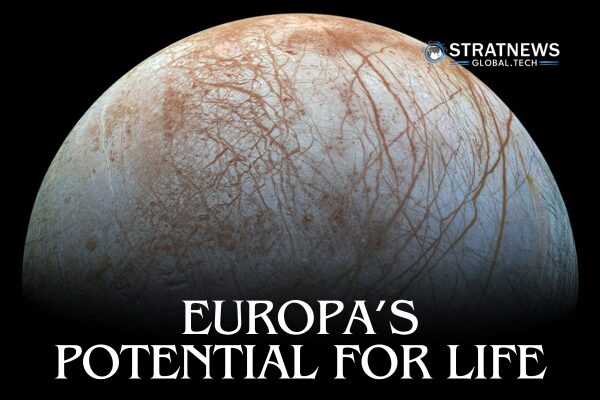
Study Questions Europa’s Potential for Hosting Life
Jupiter’s moon Europa has long been one of the most promising candidates in the search for extraterrestrial life, largely because scientists believe a vast ocean lies beneath its icy crust. However, a new study is now casting doubt on whether this frozen world possesses the conditions necessary to support life.
Strong Seafloor May Hinder Life-Sustaining Processes
The research focused on the potential for tectonic and volcanic activity at Europa’s ocean floor, both of which are vital on Earth for generating the chemical energy and nutrients needed for life. Using computer models, scientists found that Europa’s rocky seafloor is likely too rigid to permit such geological processes.
The study took into account factors such as Europa’s size, its internal composition, and the gravitational forces exerted by Jupiter, the largest planet in the solar system. The findings suggest that active faulting is rare or absent, making it unlikely that Europa’s seafloor can support the chemical reactions essential for sustaining life.
“On Earth, tectonic activity exposes fresh rock to water, producing chemicals such as methane that microbes can use,” explained planetary scientist Paul Byrne of Washington University in St. Louis, who led the study published in Nature Communications. “Without such activity, those reactions are harder to establish and sustain, making Europa’s seafloor a challenging environment for life.”
Lack of Geological Activity Reduces Habitability
Life on Earth may have first appeared near hydrothermal vents on the ocean floor, where heat and chemicals fuelled primitive ecosystems. Yet Europa seems to lack similar features.
“Based on our findings, the seafloor would probably not contain major tectonic landforms such as ridges or troughs. There would likely not be any underwater volcanoes or hydrothermal activity,” said study co-author Christian Klimczak of the University of Georgia. “Having said that, I hope I will stand corrected one day.”
Europa, with a diameter of about 1,940 miles (3,100 kilometres), is slightly smaller than Earth’s moon. Scientists estimate its icy crust is between 10 and 15 miles (15–25 kilometres) thick, floating above an ocean that could be up to 100 miles (150 kilometres) deep. Despite its small size, Europa may contain twice as much water as all of Earth’s oceans combined.
Europa Still Seen as a Promising Target
Byrne noted that three ingredients are crucial for life: liquid water, organic molecules, and an energy source. “Europa’s subsurface ocean satisfies the first requirement,” he said. “Organic chemicals have been identified on its icy surface, and tidal heating caused by Jupiter’s gravity provides the third.”
NASA’s Europa Clipper mission, launched in 2024, aims to assess whether Europa has conditions suitable for life. The spacecraft is expected to begin close flybys in 2031, collecting data on the moon’s atmosphere, ice shell, and subsurface ocean.
Although Jupiter’s tidal influence keeps Europa’s ocean from freezing, Byrne added that the effect weakens with distance. “There’s not nearly enough heat to deform the ocean floor tectonically,” he said. “So there probably isn’t the kind of volcanic activity we see on Io.”
While the study focused on Europa’s current state, Byrne suggested that it may once have been more geologically active. “Perhaps for a time that world was not just habitable but actually inhabited, before the conditions changed and the chemical energy for life ran out,” he said.
with inputs from Reuters