

Close Menu
Stratnews GlobalStratnews Global
    Facebook X (Twitter) Instagram
    Trending
    • TikTok Creates U.S. Joint Venture to Secure Data and Avoid Ban
    • Self-Eating Spacecraft Promises Affordable Deep Space Access
    • Elon Musk Challenges U.S. Solar Tariffs and Sets Bold Tesla Goals at Davos
    • Blue Origin Unveils TeraWave, a 5,400-Satellite Network for Global Data Connectivity
    • Apple Moves to Block CCI from Accessing Global Financial Records
    • Districts To Decide The Future Of India’s Exports
    • House Panel Approves AI Chip Export Bill Despite White House Opposition
    • Columbia Engineers Build Self-Learning Robotic Face That Lip-Syncs Naturally
    Stratnews GlobalStratnews Global
    Write for Us
    Friday, January 23
    • Space
    • Science
    • AI and Robotics
    • Industry News
    Stratnews GlobalStratnews Global
    Home » Chang’e-6 Samples Reveal Moon’s Far Side Secrets and Volcanic Past

    Chang’e-6 Samples Reveal Moon’s Far Side Secrets and Volcanic Past

    Arushi PandeyBy Arushi PandeyJuly 11, 2025 Space No Comments3 Mins Read
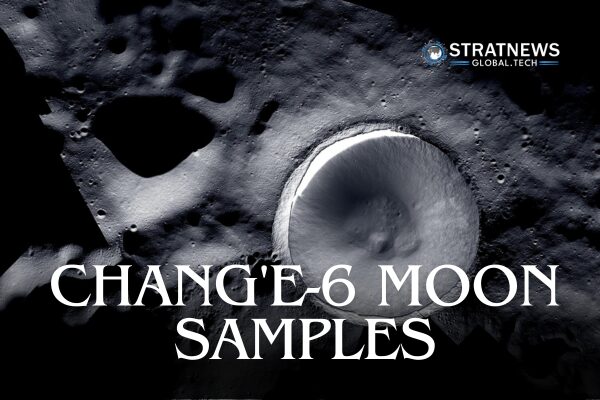
    Chang'e-6 Moon samples

    Chang’e-6 Samples Unveil Secrets of the Moon’s Far Side

    Chinese scientists have revealed new findings on the Moon’s far side using samples collected by the Chang’e-6 mission. These discoveries offer insights into volcanic activity, ancient magnetic fields, water content, and the Moon’s mantle, providing a clearer picture of the far side’s evolution.

    Breakthrough Studies Published in Nature

    Researchers from the Chinese Academy of Sciences and Nanjing University led these studies. Their work appeared in the latest issue of Nature, highlighting four major research findings. The CAS shared these results at a press conference on Wednesday.

    In 2024, Chang’e-6 made history by returning 1,935.3 grams of lunar far-side samples to Earth. The samples were collected from the South Pole-Aitken (SPA) Basin, the Moon’s oldest and deepest basin. This site offered a rare chance to study differences between the Moon’s near and far sides and explore their long-standing asymmetry.

    Understanding Lunar Volcanic Activity and Mantle Composition

    Over the past year, Chinese scientists have made pioneering discoveries using the Chang’e-6 samples. They studied basalts from the SPA Basin, formed when the Moon’s mantle melted, producing magma that erupted on the surface.

    Petrographic and mineral chemical analyses revealed the chemical composition of these basalts, which formed about 2.8 billion years ago. Isotopic studies found that the mantle source beneath the Chang’e-6 site is highly depleted in incompatible elements, which usually concentrate in melts.

    Based on these results, researchers proposed two possible formation mechanisms. One suggests that the Moon’s mantle retains features from its formation around 4.5 billion years ago. The other view suggests that a massive impact during the SPA Basin’s formation altered the mantle, depleting specific elements found in the collected basalts.

    Chang’e-6 Shedding Light on the Moon’s Hidden Side

    As the Moon’s rotation and revolution cycles are the same, the same side always faces Earth, while the far side remains hidden from view. Known as the “dark side,” this term refers to its mystery rather than its visibility.

    The Moon’s near and far sides differ in crust thickness, composition, and volcanic activity. However, the reasons behind these differences remain unresolved. Until now, scientists primarily relied on remote sensing to understand the far side, leaving many questions unanswered.

    The Chang’e-6 samples have now provided physical evidence to help unravel these mysteries, marking a significant step forward in lunar science and offering a deeper understanding of the Moon’s far side for future exploration.

    with inputs from Reuters

    Author

    • Arushi Pandey
      Arushi Pandey

      View all posts
    Featured
    Share. Facebook Twitter Pinterest LinkedIn Tumblr Email Reddit Telegram WhatsApp
    Arushi Pandey

      Keep Reading

      TikTok Creates U.S. Joint Venture to Secure Data and Avoid Ban

      Self-Eating Spacecraft Promises Affordable Deep Space Access

      Elon Musk Challenges U.S. Solar Tariffs and Sets Bold Tesla Goals at Davos

      Blue Origin Unveils TeraWave, a 5,400-Satellite Network for Global Data Connectivity

      Districts To Decide The Future Of India’s Exports

      House Panel Approves AI Chip Export Bill Despite White House Opposition

      Add A Comment
      Leave A Reply Cancel Reply

      Anti Drone System (CUAS)
      Latest Posts

      TikTok Creates U.S. Joint Venture to Secure Data and Avoid Ban

      January 23, 2026

      Self-Eating Spacecraft Promises Affordable Deep Space Access

      January 23, 2026

      Elon Musk Challenges U.S. Solar Tariffs and Sets Bold Tesla Goals at Davos

      January 23, 2026

      Blue Origin Unveils TeraWave, a 5,400-Satellite Network for Global Data Connectivity

      January 22, 2026

      Apple Moves to Block CCI from Accessing Global Financial Records

      January 22, 2026

      Districts To Decide The Future Of India’s Exports

      January 22, 2026

      House Panel Approves AI Chip Export Bill Despite White House Opposition

      January 22, 2026

      Columbia Engineers Build Self-Learning Robotic Face That Lip-Syncs Naturally

      January 22, 2026

      BitGo Raises $212.8 Million in First U.S. Crypto IPO of 2026

      January 22, 2026

      Canadian Court Reverses TikTok Ban, Orders New Security Review

      January 22, 2026

      Subscribe to News

      Get the latest sports news from NewsSite about world, sports and politics.

      • Astronomical Events
      • Space Missions
      • Industry News
      • Science
      StratNewsGlobal Tech
      Facebook X (Twitter) Instagram LinkedIn YouTube
      © 2026 StratNews Global, A unit of BharatShakti Communications LLP
      • About Us
      • Contributors
      • Copyright
      • Contact
      • Write for Us

      Type above and press Enter to search. Press Esc to cancel.