

Close Menu
Stratnews GlobalStratnews Global
    Facebook X (Twitter) Instagram
    Trending
    • India Space Policy And The Rise Of Private Space
    • Will MDR Kill UPI’s Biggest Advantage—Frictionless Payments?
    • Satellite Impact On Astronomical Observations
    • Humanoid Robot Industry Nears ‘ChatGPT Moment’
    • SkyX Vehicle Combines Underwater and Aerial Missions
    • Chang’e-7 Mission Moves Closer to Lunar Launch
    • OpenAI AI Development Slows After Agent Hacked Hugging Face
    • Meta Child Safety Trial Opens as States Seek Changes
    • Support Us
    Stratnews GlobalStratnews Global
    Write for Us
    Friday, August 21
    • Space
    • Science
    • AI and Robotics
    • Industry News
    • Support Us
    Stratnews GlobalStratnews Global
    Home » Astronomers Capture Rare Double Detonation Supernova in Stunning Detail

    Astronomers Capture Rare Double Detonation Supernova in Stunning Detail

    Arushi PandeyBy Arushi PandeyJuly 3, 2025Updated:July 3, 2025 Space No Comments3 Mins Read
    Rare Double Detonation

    Rare Double Detonation Supernova Captured for the First Time

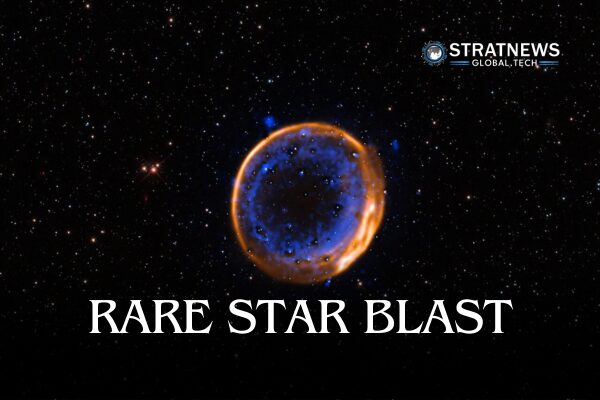
    Astronomers have captured the first photographic evidence of a rare double detonation supernova. Using the European Southern Observatory’s Very Large Telescope in Chile, researchers observed a white dwarf star exploding in a powerful double blast, helping to reveal the secrets of star death and element formation.

    How the Double Explosion Unfolded

    Unlike the more common supernovae involving massive stars, this rare event featured a white dwarf. A white dwarf is a dense, burnt-out star roughly the mass of our sun. Located 160,000 light-years from Earth in the Large Magellanic Cloud, the star exploded about 300 years ago.

    This supernova, called a Type Ia supernova, happens when a white dwarf interacts with a close companion star. The white dwarf’s gravity pulls helium from its neighbour. This helium becomes so hot and dense that it detonates, sending a shockwave through the star and igniting its core. The second explosion then destroys the white dwarf entirely.

    “Nothing remains. The white dwarf is completely disrupted,” said Priyam Das, the lead author from the University of New South Wales Canberra.

    The time between the first and second explosions is short. “It’s only about two seconds,” explained astrophysicist Ivo Seitenzahl from the Australian National University.

    Revealing the Cosmic Cycle of Elements

    The researchers used the Multi-Unit Spectroscopic Explorer (MUSE) on the Very Large Telescope to map the chemical elements left after the explosion. The image shows two concentric shells of calcium expanding outward: an outer ring from the first blast and an inner ring from the second. A shell of sulphur was also detected.

    “These two calcium shells are the perfect smoking-gun evidence of the double-detonation mechanism,” Das said.

    Type Ia supernovae play a key role in cosmic chemistry. They produce heavier elements like calcium, sulphur and iron, essential for the formation of planets and life. “This is essential for understanding galactic chemical evolution,” Das added.

    Iron, a key component of Earth and human blood, is among the elements created in such stellar explosions.

    A Beautiful Glimpse into Star Death

    While the event marks the death of a star, it also shows the creation of elements that build worlds. “We are seeing the birth process of elements in the death of a star,” Seitenzahl said.

    The Big Bang created only hydrogen, helium, and lithium. It is in supernovae like this that heavier elements are made and spread across galaxies, continuing the cosmic cycle of matter.

    “It’s beautiful,” Seitenzahl remarked, reflecting on the image’s scientific and aesthetic value.

    with inputs from Reuters

    Author

    • Arushi Pandey
      Arushi Pandey
      View all posts
    Featured
    Share. Facebook Twitter Pinterest LinkedIn Tumblr Email Reddit Telegram WhatsApp
    Arushi Pandey

      Keep Reading

      India Space Policy And The Rise Of Private Space

      Satellite Impact On Astronomical Observations

      Humanoid Robot Industry Nears ‘ChatGPT Moment’

      SkyX Vehicle Combines Underwater and Aerial Missions

      Chang’e-7 Mission Moves Closer to Lunar Launch

      OpenAI AI Development Slows After Agent Hacked Hugging Face

      Add A Comment
      Leave A Reply Cancel Reply

      Anti Drone System (CUAS)
      Latest Posts

      India Space Policy And The Rise Of Private Space

      August 20, 2026

      Will MDR Kill UPI’s Biggest Advantage—Frictionless Payments?

      August 20, 2026

      Satellite Impact On Astronomical Observations

      August 20, 2026

      Humanoid Robot Industry Nears ‘ChatGPT Moment’

      August 20, 2026

      SkyX Vehicle Combines Underwater and Aerial Missions

      August 20, 2026

      Chang’e-7 Mission Moves Closer to Lunar Launch

      August 20, 2026

      OpenAI AI Development Slows After Agent Hacked Hugging Face

      August 19, 2026

      Meta Child Safety Trial Opens as States Seek Changes

      August 19, 2026

      LandSpace Zhuque-3 Booster Makes Landmark Landing

      August 19, 2026

      Unitree Shares Soar Nearly Six-Fold in Shanghai Debut

      August 19, 2026

      Subscribe to News

      Get the latest sports news from NewsSite about world, sports and politics.

      • Astronomical Events
      • Space Missions
      • Industry News
      • Science
      StratNewsGlobal Tech
      Facebook X (Twitter) Instagram LinkedIn YouTube
      © 2026 StratNews Global, A unit of BharatShakti Communications LLP
      • About Us
      • Contributors
      • Copyright
      • Contact
      • Write for Us

      Type above and press Enter to search. Press Esc to cancel.