


‘Self-Eating’ Spacecraft Could Revolutionise Low-Cost Space Exploration
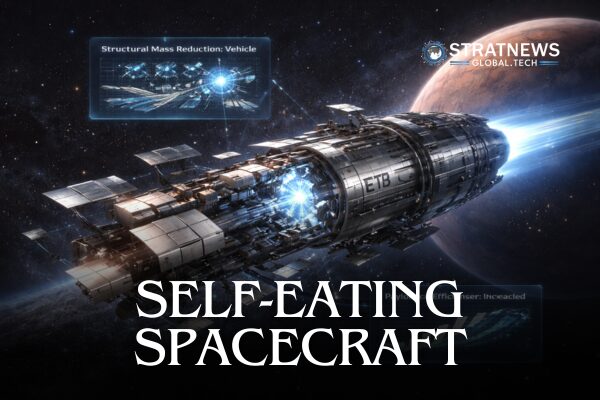
A new type of spacecraft that effectively consumes its own structure for fuel could make ambitious space missions more affordable, according to its developer. The design, known as the Economical Transfer Vehicle (ETV), uses a propulsion system that allows the craft to reduce its mass as it travels, freeing up weight for extra payloads or longer journeys.
Innovative Design Using Everyday Materials
Dr Sam Richards, founder of Meridian Space Command, explained that the spacecraft’s fuel tank is made from Nylon 6 polymer, similar to tubes found in hardware stores. “This tank is made out of polymer. It’s Nylon 6. These are similar tubes that you can buy from hardware stores, they’re sewage pipes,” Richards told Reuters.
The tank’s operation is remarkably simple. As a screw mechanism compresses the tank, internal pressure rises and pushes hydrogen peroxide through a superheating process. The heated gas then reacts with the Nylon 6 structure, which combusts to produce thrust.
“When you thrust, the length of this tank gets shorter and shorter until you’re left with a little stubby tank,” Richards said. “That means you don’t have an empty tank left over at the end of your propulsion.”
The Birth of the ‘Autophage’ Spacecraft
Richards described the design as “self-eating,” or autophage, from the Greek word for self-consuming. The ETV, he said, is designed to be inexpensive and efficient compared with conventional spacecraft systems. “We also call it the Economical Transfer Vehicle because it is actually extremely cheap in comparison to much more expensive, maybe more professional solutions,” he added.
The spacecraft is intended to be launched aboard commercial ride-sharing rockets into low Earth or Sun-Synchronous orbits, from where it can propel itself into higher or more distant orbits currently inaccessible to many smaller missions.
Expanding Access to Space
The ETV could be transformative for smaller organisations such as university teams, start-ups, and developing space agencies. “If you are a science mission or a university mission or a startup trying to do something for the first time, a developing space agency, for example, all of these missions end up costing too much and they’re not able to do it,” Richards said.
Developed in partnership with the Toulouse-based start-up Alpha Impulsion, the propulsion system also promises environmental benefits by reducing the amount of debris left in orbit.
Two early customers have already shown interest in the ETV. Space Kidz India plans to use it for a lunar orbit and rough-landing attempt, while the UK-led ELFEN mission aims to study solar wind effects on Earth’s magnetosphere from an orbit far beyond geostationary satellites.
The project, currently undergoing preliminary design review, is supported by funding from the UK Space Agency.
with inputs from Reuters