

Close Menu
Stratnews GlobalStratnews Global
    Facebook X (Twitter) Instagram
    Trending
    • Google’s New Haaland Easter Egg Goes Viral During FIFA 2026
    • OpenAI Unveils ChatGPT Work To Take On Anthropic’s AI Agent
    • Xi Orders Stronger Push In AI, Deep Space And Advanced Manufacturing
    • Australia Backs Gaganyaan With Cocos Tracking Station
    • How India Plans to Attract Trillions in Long-Term Global Capital
    • AI Productivity Gains Need Wider Inclusion
    • Meta’s AI Photo Tool Sparks Fresh Questions Over Consent
    • Elon Musk Unveils Grok 4.5 Ahead Of OpenAI’s GPT-5.6 Launch
    • Support Us
    Stratnews GlobalStratnews Global
    Write for Us
    Saturday, July 11
    • Space
    • Science
    • AI and Robotics
    • Industry News
    • Support Us
    Stratnews GlobalStratnews Global
    Home » China’s Shenzhou-20 Capsule Lands Safely After Debris Damage

    China’s Shenzhou-20 Capsule Lands Safely After Debris Damage

    ReshamBy ReshamJanuary 19, 2026 Space No Comments3 Mins Read
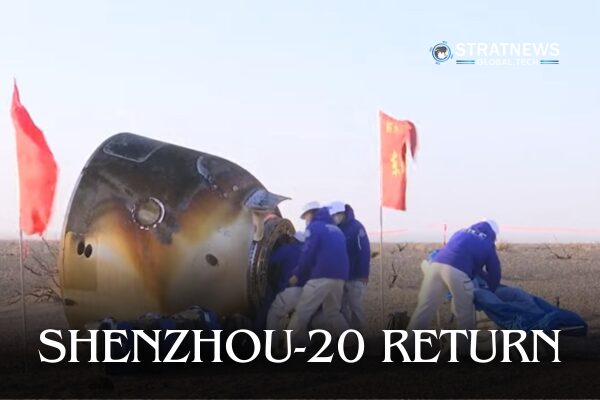
    Shenzhou-20 Return

    China’s Damaged Shenzhou-20 Capsule Returns Safely to Earth

    China’s first emergency space mission concluded successfully on Monday as the debris-damaged return capsule of the Shenzhou-20 spacecraft landed safely at the Dongfeng Landing Site in Inner Mongolia. The recovery marked the end of a complex and unprecedented operation, with ground teams overcoming severe weather and unique technical challenges to secure the unmanned capsule.

    Safe Landing After Debris Impact Incident

    The China Manned Space Agency (CMSA) confirmed that the capsule touched down at 09:34 local time, following its undocking from the Tiangong space station shortly after midnight in Beijing. The Shenzhou-20 mission, launched in April from the Jiuquan Satellite Launch Centre, had faced delays after a suspected space debris impact in early November caused minor cracks in the capsule’s viewport window.

    As a precaution, the CMSA decided to postpone its return and instead use an alternative spacecraft to bring the three astronauts of the Shenzhou-20 mission safely back to Earth. Despite the damage, the Shenzhou-20 capsule withstood extreme re-entry temperatures of several thousand degrees Celsius after on-orbit reinforcement and sealing work carried out by the Shenzhou-21 crew, who took over operations in November.

    Challenging Search and Recovery in Harsh Conditions

    Xu Peng, on-site commander at the Dongfeng Landing Site, described the recovery as one of the most demanding missions his team had faced. The unmanned landing, coupled with severe winter conditions and strong winds, required precise coordination and rapid response.

    “This is the first time the Dongfeng site has conducted a spaceship recovery in the coldest season of the year,” Xu said. “We made special cold-protection preparations to ensure both our personnel and equipment could perform effectively despite the freezing temperatures.”

    The absence of astronauts created additional challenges. Because the capsule was unmanned, no crew could manually detach the main parachute. Strong winds risked dragging the capsule across the landing area, forcing ground teams to reach it quickly to cut the parachute and stabilise the craft.

    New Recovery Techniques and Data Collection

    Ground teams introduced new recovery methods, employing drones and unmanned vehicles instead of helicopters to locate and secure the capsule. Xu explained that this hybrid approach improved response times and safety under extreme conditions.

    After touchdown, personnel immediately secured the damaged porthole to prevent further deterioration. Engineers will analyse the capsule’s condition to better understand the effects of debris impact and improve future spacecraft design.

    Although it carried no astronauts, the capsule transported several items from the Tiangong space station, including a spacesuit that had exceeded its operational lifespan after being used in about 20 spacewalks.

    The successful return marks another milestone for China’s crewed space programme, demonstrating its ability to handle in-orbit emergencies and execute precision recovery operations even under difficult circumstances.

    with inputs from Reuters

    Author

    • Resham
      Resham

      Research Associate at Interstellar.| China Scholar | China Social Media & Foreign Affairs|

      View all posts
    Featured
    Share. Facebook Twitter Pinterest LinkedIn Tumblr Email Reddit Telegram WhatsApp
    Resham
    • X (Twitter)

    Research Associate at Interstellar.| China Scholar | China Social Media & Foreign Affairs|

    Keep Reading

    Google’s New Haaland Easter Egg Goes Viral During FIFA 2026

    OpenAI Unveils ChatGPT Work To Take On Anthropic’s AI Agent

    Xi Orders Stronger Push In AI, Deep Space And Advanced Manufacturing

    Australia Backs Gaganyaan With Cocos Tracking Station

    AI Productivity Gains Need Wider Inclusion

    Meta’s AI Photo Tool Sparks Fresh Questions Over Consent

    Add A Comment
    Leave A Reply Cancel Reply

    Anti Drone System (CUAS)
    Latest Posts

    Google’s New Haaland Easter Egg Goes Viral During FIFA 2026

    July 10, 2026

    OpenAI Unveils ChatGPT Work To Take On Anthropic’s AI Agent

    July 10, 2026

    Xi Orders Stronger Push In AI, Deep Space And Advanced Manufacturing

    July 10, 2026

    Australia Backs Gaganyaan With Cocos Tracking Station

    July 9, 2026

    How India Plans to Attract Trillions in Long-Term Global Capital

    July 9, 2026

    AI Productivity Gains Need Wider Inclusion

    July 9, 2026

    Meta’s AI Photo Tool Sparks Fresh Questions Over Consent

    July 9, 2026

    Elon Musk Unveils Grok 4.5 Ahead Of OpenAI’s GPT-5.6 Launch

    July 9, 2026

    How China Used Drones And AI To Fight Typhoon Maysak

    July 9, 2026

    Mission Aagaman Signals Private Space Breakthrough

    July 9, 2026

    Subscribe to News

    Get the latest sports news from NewsSite about world, sports and politics.

    • Astronomical Events
    • Space Missions
    • Industry News
    • Science
    StratNewsGlobal Tech
    Facebook X (Twitter) Instagram LinkedIn YouTube
    © 2026 StratNews Global, A unit of BharatShakti Communications LLP
    • About Us
    • Contributors
    • Copyright
    • Contact
    • Write for Us

    Type above and press Enter to search. Press Esc to cancel.