

Close Menu
Stratnews GlobalStratnews Global
    Facebook X (Twitter) Instagram
    Trending
    • Bharat VISTAAR Launched In Rajasthan To Empower Farmers With AI Support
    • India AI Impact Summit Signals $200 Billion AI Investments Push
    • RailTel AI Healthcare Panel Discussions Spotlight Public Health Innovation in India
    • AI Impact Summit Inaugurated By Narendra Modi
    • Ireland Grok Investigation Targets X Over Data And AI Images
    • Costa Rica Megafauna Fossils Reveal Rare Pleistocene Discovery
    • India Drone Ecosystem Drives Public Service Transformation
    • Nexperia Loan Boosts Chip Output And Global Production Plans
    Stratnews GlobalStratnews Global
    Write for Us
    Wednesday, February 18
    • Space
    • Science
    • AI and Robotics
    • Industry News
    Stratnews GlobalStratnews Global
    Home » Shenzhou-21 Crew Advances Experiments and Safety Drills on Tiangong Station

    Shenzhou-21 Crew Advances Experiments and Safety Drills on Tiangong Station

    ReshamBy ReshamJanuary 12, 2026 Space No Comments2 Mins Read
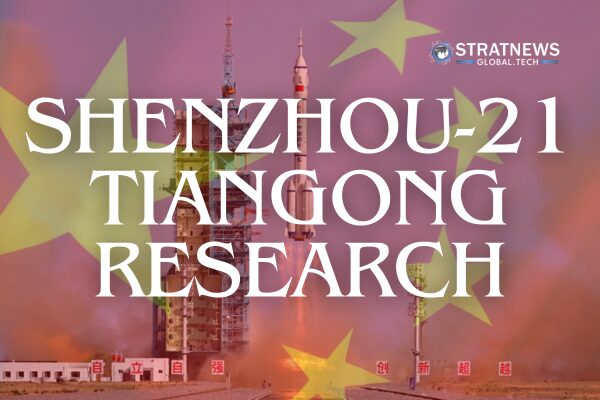
    Shenzhou-21 Tiangong

    Shenzhou-21 Crew Advances Scientific Research and Training on Tiangong Space Station

    The Shenzhou-21 astronauts have continued to make steady progress in scientific experiments and operational training aboard China’s Tiangong space station over the past week. The crew, composed of commander Zhang Lu and astronauts Wu Fei and Zhang Hongzhang, has now been in orbit for more than 70 days, focusing on scientific, technical, and emergency preparedness tasks.

    Strengthening Operational and Emergency Capabilities

    Last week, the crew carried out scheduled training for remotely operated rendezvous and docking procedures. Using specialised control handles, they practised precise adjustments to the spacecraft’s speed and orientation, ensuring readiness for future docking missions.

    The astronauts also participated in several emergency drills, including medical rescue exercises and an evacuation simulation designed to replicate a fire scenario within the station. These activities enhanced their familiarity with onboard medical equipment and reinforced their ability to respond effectively to potential emergencies in microgravity.

    Progress in Space Medicine and Materials Science

    Scientific work aboard Tiangong continued smoothly, with significant advances recorded in multiple research areas. In the field of space medicine, the crew used electroencephalogram (EEG) equipment in conjunction with virtual reality systems to study eye-brain coordination. The experiment seeks to identify how brain control signals change under microgravity conditions. Additional investigations explored microgravity’s effects on intuitive physics and cooperative coding mechanisms.

    In the domain of materials science, the astronauts conducted in-situ electrochemical optical experiments on lithium-ion batteries. These studies are expected to inform the design and performance of next-generation power systems for future space missions.

    Maintaining the Space Station’s Vital Systems

    Alongside their scientific work, the crew performed a series of maintenance and operational tasks. They replaced and serviced experimental modules, cleaned and exchanged samples in the containerless experiment chamber, and carried out detailed inspections of critical systems. Their checks on regenerative life support equipment and other station components ensured the continued safety and stability of Tiangong’s operation.

    The Shenzhou-21 mission remains a key step in China’s long-term effort to deepen its research capabilities in orbit and to prepare for extended crewed missions in low Earth orbit and beyond.

    with inputs from Reuters

    Author

    • Resham
      Resham

      Research Associate at Interstellar.| China Scholar | China Social Media & Foreign Affairs|

      View all posts
    Featured
    Share. Facebook Twitter Pinterest LinkedIn Tumblr Email Reddit Telegram WhatsApp
    Resham
    • X (Twitter)

    Research Associate at Interstellar.| China Scholar | China Social Media & Foreign Affairs|

    Keep Reading

    Bharat VISTAAR Launched In Rajasthan To Empower Farmers With AI Support

    India AI Impact Summit Signals $200 Billion AI Investments Push

    RailTel AI Healthcare Panel Discussions Spotlight Public Health Innovation in India

    AI Impact Summit Inaugurated By Narendra Modi

    Ireland Grok Investigation Targets X Over Data And AI Images

    Costa Rica Megafauna Fossils Reveal Rare Pleistocene Discovery

    Add A Comment
    Leave A Reply Cancel Reply

    Anti Drone System (CUAS)
    Latest Posts

    Bharat VISTAAR Launched In Rajasthan To Empower Farmers With AI Support

    February 18, 2026

    India AI Impact Summit Signals $200 Billion AI Investments Push

    February 17, 2026

    RailTel AI Healthcare Panel Discussions Spotlight Public Health Innovation in India

    February 17, 2026

    AI Impact Summit Inaugurated By Narendra Modi

    February 17, 2026

    Ireland Grok Investigation Targets X Over Data And AI Images

    February 17, 2026

    Costa Rica Megafauna Fossils Reveal Rare Pleistocene Discovery

    February 17, 2026

    India Drone Ecosystem Drives Public Service Transformation

    February 17, 2026

    Nexperia Loan Boosts Chip Output And Global Production Plans

    February 17, 2026

    SpaceX Drone Contest Sparks Race For Autonomous Swarm Technology

    February 17, 2026

    Britain Under 16 Social Media Ban And Online Safety Act Reform

    February 16, 2026

    Subscribe to News

    Get the latest sports news from NewsSite about world, sports and politics.

    • Astronomical Events
    • Space Missions
    • Industry News
    • Science
    StratNewsGlobal Tech
    Facebook X (Twitter) Instagram LinkedIn YouTube
    © 2026 StratNews Global, A unit of BharatShakti Communications LLP
    • About Us
    • Contributors
    • Copyright
    • Contact
    • Write for Us

    Type above and press Enter to search. Press Esc to cancel.