


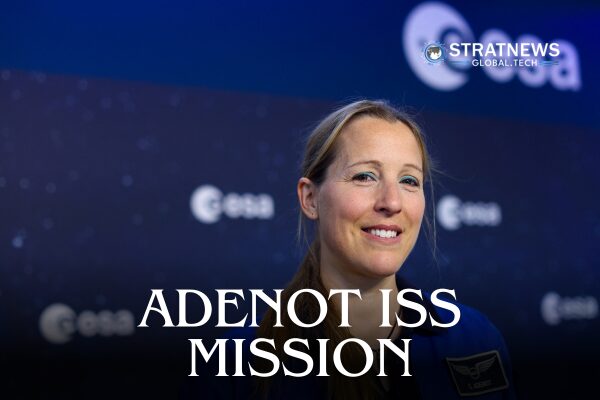
Sophie Adenot Ready for First Mission to International Space Station
ESA astronaut Sophie Adenot is preparing for her first journey to the International Space Station (ISS), with launch planned no earlier than 15 February. Before her departure, she made a final public appearance at the European Space Agency’s (ESA) European Astronaut Centre (EAC) in Cologne, Germany, where she was formally introduced by ESA’s Director of Human and Robotic Exploration, Daniel Neuenschwander.
Neuenschwander commended Adenot’s outstanding performance throughout her training. “From ESA’s basic training to the specific mission preparation, she has exceeded all expectations and earned respect as a diligent professional. And these are not just kind words, Sophie, these are facts,” he said.
‘εpsilon’ Mission: A Symbol of Unity and Purpose
Adenot has chosen the name ‘εpsilon’ for her maiden mission, symbolising how small yet meaningful efforts can combine to create significant achievements. She explained that the name reflects collaboration and the power of collective contributions.
“Being a French and European astronaut on board is an honour I carry with gratitude and humility. With this εpsilon mission, France and Europe are contributing to a global endeavour,” Adenot said. “Space exploration connects science, economy, technology, education, and diplomacy. It strengthens international cooperation and reminds us that progress is greatest when nations work together.”
A Career Built on Flight and Exploration
Adenot is both an aeronautics and space engineer and a skilled helicopter test pilot. To commemorate her upcoming mission and the deep connection between Earth and space, she planted an American sweetgum tree at ESA’s European Astronaut Centre in Cologne.
Science, Research, and Global Collaboration in Orbit
During the εpsilon mission, Adenot will carry out numerous tasks aboard the ISS. Her responsibilities include conducting European-led scientific experiments, supporting medical and biological research, and assisting with Earth observation studies. She will also contribute to station operations and maintenance, ensuring that Europe’s participation in the ISS continues to strengthen global cooperation in space exploration.
with inputs from Reuters