


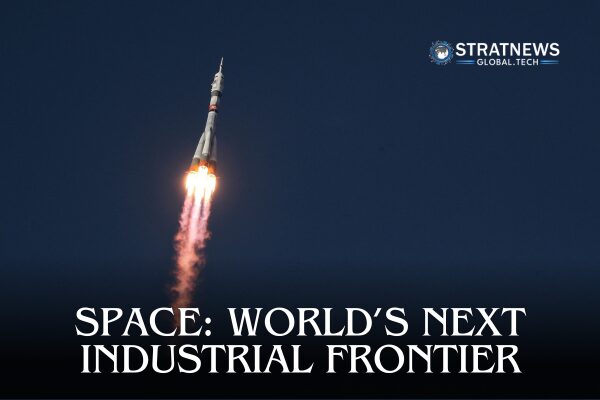
Space Emerges as the Next Great Industrial Economy
Shortly after Space Week in October, investment giant JP Morgan announced a $10 billion plan to fund industries vital to United States national security. Alongside areas such as nanomaterials, autonomous robotics and solar power, the firm placed special emphasis on spacecraft and launch technologies. The move signals that major financial institutions now view space as an investable frontier rather than a speculative pursuit.
Capital Markets Face a New Frontier
JP Morgan’s decision marks a turning point. It recognises that space is shifting from a niche scientific domain into a mature commercial sector. Yet, despite this acknowledgement, capital markets have not fully grasped the scale of transformation underway.
While technologies like artificial intelligence, quantum computing and nuclear fusion attract attention, these fields may take years to mature. In contrast, space is already generating sustained economic activity. Industry analysts project that the global space economy, currently worth over $600 billion annually, could surpass $1.8 trillion within the next decade.
Donald Moore, CEO of the Space Finance Company and lecturer at the University of Michigan, argues that “for the U.S. space market to prosper and grow to that full potential, it needs to have an equally mature capital structure, including the full range of venture capital, private equity, streamlined government contracts, debt capital and structured finance.”
An Executive Order on Ensuring U.S. Space Superiority reinforces this view. It outlines a plan to attract more than $50 billion in private investment by 2028, aiming to build a “vibrant commercial space economy through the power of American free enterprise.” However, a gap remains between policy ambition and the flow of private capital.
China Moves Ahead in the Space Race
While the United States refines its approach, China is advancing rapidly. Beijing treats space as a critical industrial base, projecting that the space economy could reach $10 trillion by 2050. Reusable rockets, once seen as a long-term goal, have become key to this ambition. Although SpaceX currently dominates global launches with an estimated 86 percent share, China’s reusable rocket technology is closing the gap, boasting similar levels of reliability.
China’s achievements include landing on the far side of the Moon, operating a Mars rover, building its own crewed space station, and deploying an artificial intelligence-powered satellite constellation. These milestones form part of a broader strategy aimed at transforming space into an engine of industrial growth.
Beijing also recognises space as a vast reservoir of resources. The Moon’s surface holds helium-3, a potential fuel for nuclear fusion and quantum computing. Meanwhile, asteroid mining could unlock access to platinum-group metals and rare Earth elements. China’s early investment in space refineries and extraction capabilities could further strengthen its dominance in strategic materials.
Financing the Future Industrial Base
Mining, however, is only the beginning. The true economic opportunity lies in space-based manufacturing. China is already testing inflatable Lunar factories for large-scale production, while U.S. firms such as Redwire, Varda and Axiom are pursuing early-stage in-space service assembly and manufacturing contracts. These efforts could enable production of purer pharmaceuticals, more advanced semiconductors and enormous orbital structures impossible to build on Earth.
In their book Space Shock: 18 Threats that Will Define Space Power, the authors estimate that the United States would need to invest between $335 billion and $620 billion over the next decade to secure leadership in the space economy. Achieving that goal will require coordinated action from investors, policymakers and financial institutions.
As space becomes a critical layer of industrial infrastructure, financing must evolve beyond venture capital. Debt finance, insurance markets and long-duration contracts—once essential to building rail and aviation industries—will be equally vital for space. Government anchor customers and blended public–private capital vehicles can accelerate this transition.
If the United States fails to adapt, China is poised to claim economic dominance in this emerging domain. The space economy has already doubled in size over the past decade, and by mid-century, it will be worth several trillion dollars. The question is not whether the space economy will expand, but who will lead it.