

Close Menu
Stratnews GlobalStratnews Global
    Facebook X (Twitter) Instagram
    Trending
    • Alibaba To Ban Employees From Using Anthropic’s Coding Tool
    • Meet The Robot That Walked Onto The FIFA World Cup Pitch
    • UN Chief Warns AI Is Outpacing Humanity
    • WhatsApp Username Feature: Anonymity Is A Weapon Of Mass Destruction
    • Embodied Intelligence Leads Beijing AI Showcase
    • India Questions Anonymous Messaging Features
    • Awais Ahmed: From Encyclopaedias to Space Startup
    • Can India Build Its Own EV Industrial Operating System?
    • Support Us
    Stratnews GlobalStratnews Global
    Write for Us
    Monday, July 6
    • Space
    • Science
    • AI and Robotics
    • Industry News
    • Support Us
    Stratnews GlobalStratnews Global
    Home » China’s Zhuque-3 Reusable Rocket Reaches Orbit Despite Failed Landing Attempt

    China’s Zhuque-3 Reusable Rocket Reaches Orbit Despite Failed Landing Attempt

    StratNewsGlobal Tech TeamBy StratNewsGlobal Tech TeamDecember 17, 2025Updated:December 17, 2025 Space No Comments3 Mins Read
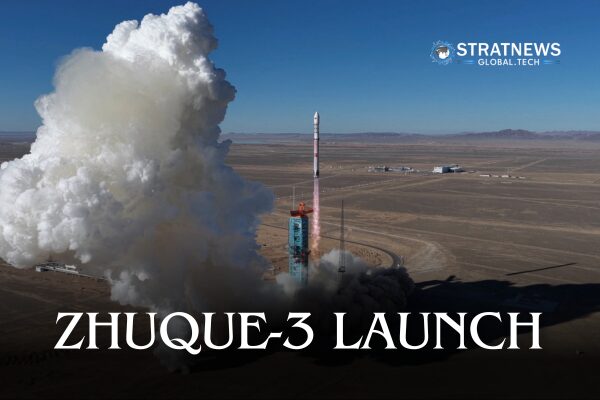
    Zhuque-3 Launch
    China’s Zhuque-3 Rocket Achieves Key Breakthrough Despite Landing Failure

    China’s Zhuque-3 reusable rocket achieved a significant milestone during its maiden flight, marking the country’s first attempt to recover an orbital stage of a carrier rocket. Although the final-stage recovery failed, the mission was hailed as a major breakthrough by Dai Zheng, commander in chief of the Zhuque-3 mission and CEO of LandSpace, the rocket’s developer.

    A Leap Forward in China’s Reusable Rocket Technology

    Developed independently by LandSpace, the Zhuque-3 is a large-capacity, low-cost, reusable liquid-fuel launch vehicle designed to deploy large satellite constellations. The rocket lifted off from the Dongfeng commercial space innovation pilot zone near the Jiuquan Satellite Launch Center in northwest China.

    After ignition, the first and second stages separated approximately 130 seconds into flight. The second stage successfully completed the orbital insertion, while the first stage initiated its planned return sequence. Despite this, an anomaly occurred during the recovery process, causing the booster to fail its soft landing attempt.

    “The first stage experienced abnormal combustion during recovery, preventing it from touching down safely,” Dai told China Central Television (CCTV) in Beijing. He added that an investigation is under way to determine the cause of the malfunction.

    Close to Success Despite Setback

    Dai explained that the launch served as an experimental mission rather than a guaranteed success. “From the outset, we knew this was exploratory,” he said. “Landing a rocket from supersonic speed to the ground intact is one of the hardest challenges in rocket control.”

    He noted that the rocket’s performance was impressive through most of its descent. After separation, Zhuque-3 completed a successful high-altitude ignition at around 80 kilometres, followed by a smooth aerodynamic glide phase. “From 40 kilometres down to three kilometres above ground, the aerodynamic control was flawless,” Dai said. However, the final braking ignition failed, causing the rocket to crash about 40 metres from the designated landing zone.

    A Successful Orbital Mission and Future Prospects

    Despite the landing failure, Dai emphasised that the rocket’s successful orbital insertion was a major achievement. “The key goal was to verify the rocket’s ability to reach the intended orbit,” he said. “That success demonstrates our readiness to provide launch services to satellite customers.”

    He also pointed out that reusability, while vital for reducing launch costs, is secondary to ensuring reliable payload delivery. “Our clients care about whether their satellites reach orbit, not whether the rocket can be reused,” Dai explained.

    This maiden flight carried only a dummy payload, serving as a proof of concept. For LandSpace, the success of the orbital phase marks a crucial step towards commercial operations and positions the Zhuque-3 as a strong contender in China’s growing private space industry.

    with inputs from Reuters

    Author

    • StratNewsGlobal Tech Team
      StratNewsGlobal Tech Team
      View all posts
    Featured
    Share. Facebook Twitter Pinterest LinkedIn Tumblr Email Reddit Telegram WhatsApp
    StratNewsGlobal Tech Team
    • Website

    Keep Reading

    Alibaba To Ban Employees From Using Anthropic’s Coding Tool

    Meet The Robot That Walked Onto The FIFA World Cup Pitch

    UN Chief Warns AI Is Outpacing Humanity

    WhatsApp Username Feature: Anonymity Is A Weapon Of Mass Destruction

    Embodied Intelligence Leads Beijing AI Showcase

    India Questions Anonymous Messaging Features

    Add A Comment
    Leave A Reply Cancel Reply

    Anti Drone System (CUAS)
    Latest Posts

    Alibaba To Ban Employees From Using Anthropic’s Coding Tool

    July 6, 2026

    Meet The Robot That Walked Onto The FIFA World Cup Pitch

    July 6, 2026

    UN Chief Warns AI Is Outpacing Humanity

    July 6, 2026

    WhatsApp Username Feature: Anonymity Is A Weapon Of Mass Destruction

    July 6, 2026

    Embodied Intelligence Leads Beijing AI Showcase

    July 3, 2026

    India Questions Anonymous Messaging Features

    July 3, 2026

    Awais Ahmed: From Encyclopaedias to Space Startup

    July 2, 2026

    Can India Build Its Own EV Industrial Operating System?

    July 2, 2026

    AI Fighter Jet: Flying Wedge Unveils FWD Supreme

    July 2, 2026

    Wayve Autonomous Driving AI Gains Investor Support

    July 2, 2026

    Subscribe to News

    Get the latest sports news from NewsSite about world, sports and politics.

    • Astronomical Events
    • Space Missions
    • Industry News
    • Science
    StratNewsGlobal Tech
    Facebook X (Twitter) Instagram LinkedIn YouTube
    © 2026 StratNews Global, A unit of BharatShakti Communications LLP
    • About Us
    • Contributors
    • Copyright
    • Contact
    • Write for Us

    Type above and press Enter to search. Press Esc to cancel.