


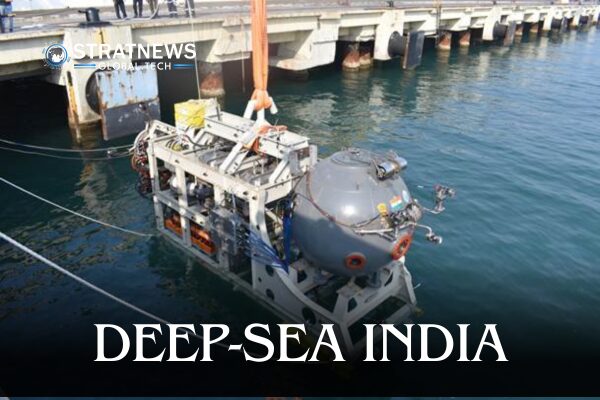
India is getting ready to drop 6,000 metres straight down into the deep ocean with its own, fully indigenous human submersible. The craft, called Matsya-6000, is set for its first sea trial off the Chennai coast early next year, placing India in an ultra-exclusive group of nations that can send humans into the abyss.
Until now, only the US, Russia, France, Japan, and China had this capability. India is about to join them with technology built at home.
First test dive: early 2026
Target depth: 6,000 m by 2027
Crew: Three Indian aquanauts
The project comes under the Deep Ocean Mission, and it aims to do something India has never done: put humans inside a titanium sphere and send them into a zone where pressure is 600 times greater than at sea level.
Two NIOT scientists including Ramesh Raju and Jatinder Pal Singh will take the first dive, piloting the 28-tonne sub to a training depth of 500 metres before the big descent.
NIOT Director Balaji Ramakrishnan says this mission is a leap far beyond what India has attempted with remotely operated vehicles.
“We have explored these depths with robots. Sending humans changes the whole game. Safety is our top priority.”
Self-Reliance Wasn’t a Slogan Here — It Was the Only Path
India tried twice to buy a deep-sea human submersible from abroad. Both times, advanced tech restrictions blocked the purchase.
So the Ministry of Earth Sciences decided to build the vessel themselves.
Only-in-India
ISRO developed a first-of-its-kind electron-beam welding facility to fuse the titanium sphere’s two hemispheres.
DRDO and CSIR provided deep-pressure materials, electronics and engineering expertise.
NIOT integrated all systems into a vehicle designed to survive the most hostile environment on Earth.
Ramakrishnan says the team realised India had more capability than people assumed.
Why This Mission Matters to India’s Future
The deep ocean is the Earth’s last huge unexplored frontier, darker than space, harder to reach, and full of untapped resources.
India already has exploration rights in a massive stretch of the Central Indian Ocean Basin containing minerals vital for: EV batteries; energy storage; and advanced electronics.
Putting humans, not just machines, at these depths gives India the precision and decision-making power that cameras and sensors can’t match.
Project Director Sathia Narayanan puts it simply: “No camera sees what a human eye sees at the ocean floor.”
A Submersible That Looks Like It Walked Out of a Sci-Fi Movie
Matsya-6000 is in the process of taking its final shape which includes:
- a 2.25-metre titanium sphere built to withstand 600 bar pressure
robotic arms for sample collection - high-power lights for pitch-black depths
imaging systems - emergency buoys and drop-weight systems
96 hours of life support if needed.
Every component is being certified by DNV, the world’s toughest marine safety authority, the same standard used for global deep-sea missions.
To prepare for the real dive, the Indian pilot team even travelled to 5,000 metres onboard the French sub Nautile, gaining hands-on experience with deep-ocean operations.
Next Year
The first shallow-water trial happens early next year: a 500-metre dive, roughly the depth naval submarines operate at.
Then comes the milestone manned dive in early 2026, paving the way for the full 6,000-metre descent in 2027.
Once that happens, India will not only explore the deepest parts of the ocean, it will do it with completely indigenous tech.
A new frontier is opening, and India is diving in headfirst.