


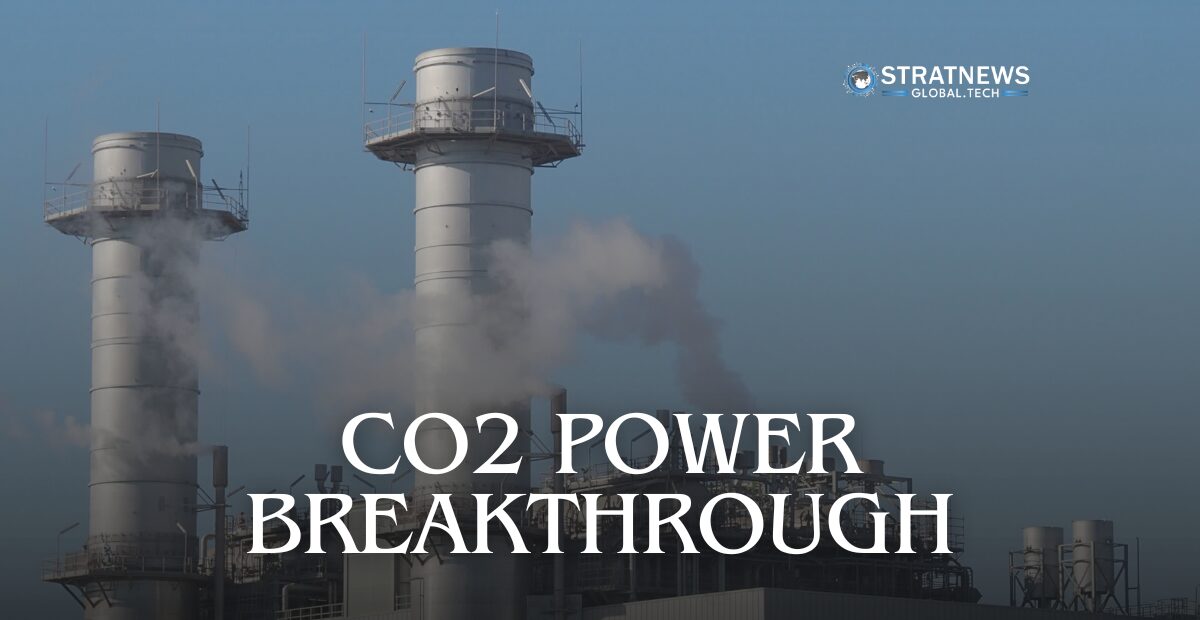
China’s Supercritical Carbon Dioxide Power Generation Technology Enters Commercial Operation
China has brought its homegrown supercritical carbon dioxide power generation technology into commercial operation, marking a significant milestone in advanced energy development. The world’s first commercial facility using the technology has now operated steadily for six months in Guizhou Province in southwest China.
Developed over 17 years by a team of Chinese scientists, the technology aims to improve energy efficiency while expanding applications across several industries. These include industrial waste heat recovery, solar thermal power generation and energy storage systems.
World’s First Commercial Facility Begins Stable Operations
Supercritical carbon dioxide has emerged as an alternative working medium for power generation. Instead of using steam in conventional power units, the technology employs supercritical carbon dioxide to achieve higher operating efficiency.
The world’s first commercial facility based on this approach is known as Chaotan One (Super Carbon-1). The project currently operates with two generating units and has maintained stable commercial performance for six months.
The development was led by a scientific team headed by Huang Yanping, chief scientist at China National Nuclear Corporation (CNNC). Huang said he first encountered the concept of supercritical carbon dioxide power generation 17 years ago, when many experts doubted its future.
According to Huang, early reactions were overwhelmingly negative, with many believing the technology would never become practical.
Years of Research Overcame Technical Barriers
The research team faced major scientific and engineering challenges throughout the project’s development. With limited theoretical foundations and almost no available data, the researchers built their own models and gathered information independently.
The team, whose average age was under 35, continued refining the technology despite repeated setbacks. Huang said their commitment to scientific research and long-term dedication kept the project moving forward.
Transitioning from laboratory research to a commercial-scale power plant required substantial investment, amounting to billions of yuan, alongside years of intensive engineering work.
Technical Setbacks Tested the Team
Zhao Xuebin, technical director of the Chaotan One Demonstration Project, said the first turbine tests produced results that differed significantly from the team’s calculations.
As a result, engineers abandoned their initial approach and repeated every inspection from the beginning. Zhao said the process placed considerable pressure on the entire team and tested both confidence and morale.
The challenges extended beyond technical calculations. Conditions at the project site proved far more demanding than those in the laboratory, while coordinating large-scale construction added further complexity.
At one stage, the turbine failed to start more than a dozen times, creating one of the project’s most difficult periods. Nevertheless, the team continued refining the system until a breakthrough finally came during a late-night test in 2025.
When the facility successfully generated electricity for the first time, team members celebrated the achievement with relief and emotion after years of persistence.
Higher Efficiency Opens New Applications
The successful demonstration represented a major advance in power generation efficiency, achieving an improvement of more than 85 percent.
Initially designed for industrial waste heat recovery in heavy industries, the technology is now expected to expand into wider applications. These include solar thermal power generation and energy storage systems, where higher efficiency could improve overall energy utilisation.
Huang said the project’s greatest contribution lies in providing a more efficient way to use energy. He added that the technology could strengthen energy security while helping meet the growing electricity demands driven by artificial intelligence by making primary energy resources go further.
With inputs from Reuters