


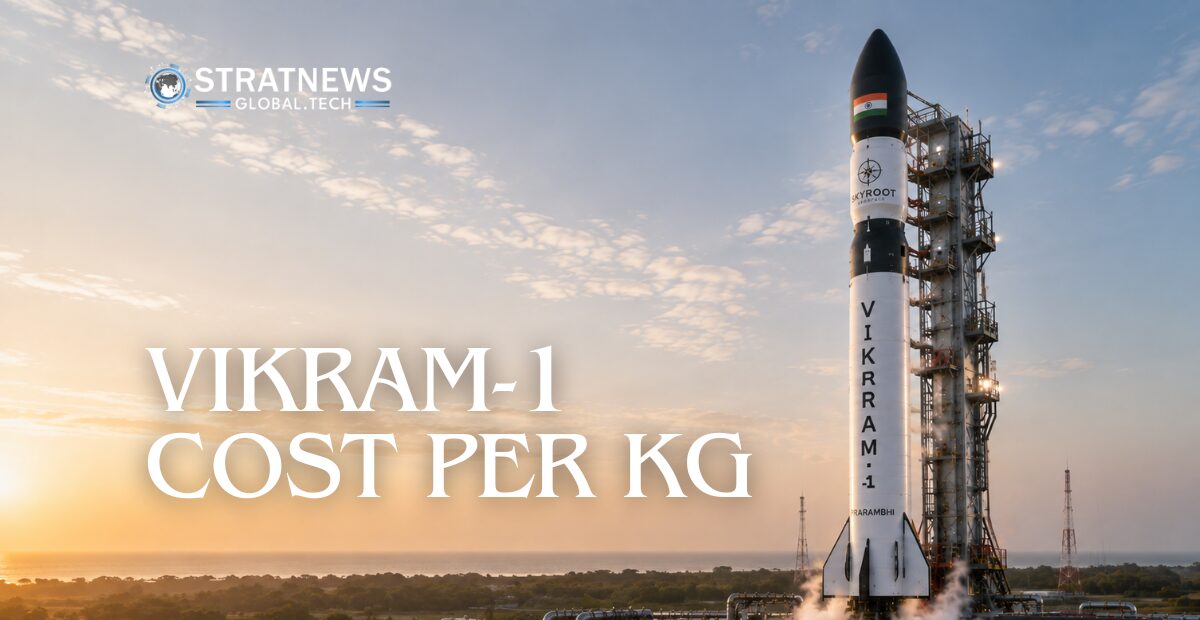
Vikram-1 Cost per Kilogram: Benchmarking Skyroot Against Global Launch Rivals
Skyroot Aerospace has not published an official price list for Vikram-1, the four-stage rocket that reached orbit from Sriharikota on July 18, 2026. Industry trackers estimate a dedicated launch costs $15 million to $20 million, which works out to roughly $43,000 to $57,000 per kilogram at the vehicle’s rated 350-kilogram capacity to low Earth orbit. That figure sits above, not below, Rocket Lab Electron’s benchmark rate today.
Cost-per-kilogram ($/kg) divides total launch price by maximum payload mass to a specific reference orbit, usually 500-kilometer sun-synchronous orbit. Procurement teams increasingly treat this figure as the primary comparison metric across small-lift vehicles, replacing the older habit of comparing total launch prices alone. A $20 million rocket carrying 1,000 kilograms beats a $10 million rocket carrying 300 kilograms on a per-kilogram basis, even though the smaller vehicle costs less upfront.
That distinction matters directly for Vikram-1 shoppers. Skyroot’s rocket carries 290 to 480 kilograms depending on orbit and configuration, a payload range close to Electron’s 300 kilograms and well below Firefly Alpha’s 1,030 kilograms. Comparing sticker prices alone would understate Alpha’s efficiency and overstate Vikram-1’s headline affordability. Skyroot has stated a long-term ambition to reach roughly $15,000 per kilogram as production scales toward one vehicle a month, a target that would undercut Electron but remains unproven against a single successful test flight.
India’s regulatory environment supports that ambition without yet closing the pricing gap. The GST Council exempted private satellite launch services from tax in 2023, and IN-SPACe has cut licensing timelines that once added months to mission planning. Those measures lower Skyroot’s cost base. They do not, on current public evidence, make Vikram-1 the cheapest dedicated small launcher on a per-kilogram basis in 2026.
The Competitive Landscape: Electron and Alpha Set the Benchmark
| Launch Vehicle | Payload (SSO) | Total Launch Cost | Est. Cost per Kg |
|---|---|---|---|
| Vikram-1 | 260kg – 290kg | $15M – $20M (est., unofficial) | ~$43,000 – $57,000 (est.) |
| Electron | 200kg | $7.5M | ~$22,000 – $30,000 |
| Firefly Alpha | 630kg | $15M – $17.6M | ~$14,500 |
| SSLV (ISRO) | 300kg | $3.1M – $3.7M | ~$10,300 – $12,300 |
Rocket Lab’s Electron has flown 88 times since 2017, giving it a maturity advantage no competitor can match. The vehicle lists near $7.5 million per launch and carries up to 320 kilograms to LEO, landing around $22,000 to $25,000 per kilogram by most public estimates, with some analysts citing figures as high as $30,000 for the small-sat premium tier.
Firefly Alpha undercuts Electron on a pure per-kilogram basis despite a higher total launch price. Alpha costs $15 million to $17.6 million and carries roughly 1,030 kilograms to LEO, landing near $14,500 per kilogram. That gap illustrates a structural pattern in small launch: larger dedicated vehicles spread fixed costs, such as range fees, ground operations, and mission control staffing, across more kilograms of payload, pulling the per-kilogram number down even when the sticker price climbs.
Skyroot co-founder and COO Naga Bharath Daka addressed this dynamic directly after Vikram-1 reached orbit, saying the company aims to be “the most cost-competitive launch vehicle” in the small-payload category, even before economies of scale take effect, according to remarks reported by CNBC. That statement targets a market position rather than confirms a current price advantage. Vikram-1’s 350-kilogram rated capacity sits closer to Electron than Alpha, which means Skyroot competes against the more expensive of the two Western benchmarks on a per-kilogram basis, not the cheaper one.
ISRO’s Small Satellite Launch Vehicle adds a fourth reference point. The government-built rocket costs an estimated $3.1 million to $3.7 million per launch and carries up to 300 kilograms to SSO, putting it near $10,300 to $12,300 per kilogram, below every private-sector figure in this comparison. Skyroot competes against that domestic benchmark too, particularly for Indian government and university payloads that could otherwise book an SSLV slot.
The Vikram-1 Economy: Manufacturing Efficiencies and Their Limits
Vikram-1’s cost case rests on manufacturing method rather than confirmed pricing. The airframe uses an all-carbon composite structure throughout, including the 10-meter first-stage casing, replacing the steel and aluminum alloys common in comparable rockets. Lighter structure raises payload fraction, the share of liftoff mass that reaches orbit as cargo, which improves the economics of every kilogram flown even before price enters the calculation.
The propulsion stack extends that approach. Four Raman-1 engines power the liquid-fueled fourth stage using a 3D-printed injector, cutting mass by roughly half compared with machined and welded alternatives. Skyroot has also ground-tested a vacuum-optimized Raman-2 variant, signaling the additive-manufacturing approach will extend to future upper-stage hardware rather than stopping at the current design.
Production speed compounds these material savings into operating expense reductions. A 3D-printed engine can be completed in days rather than the months a cast-and-welded unit requires, cutting the labor hours and inventory carrying costs charged against each vehicle. Skyroot has stated a target production rate of one Vikram-class rocket per month from its Hyderabad Infinity Campus, a cadence that would spread fixed manufacturing overhead across more units and should push per-unit costs down over time.
Global inflation in 2026 has raised input costs for Western manufacturers faster than for Indian ones. Aerospace-grade aluminum, specialty alloys, and skilled labor have all seen price increases in the United States and Europe, while India’s engineering wage base remains substantially lower even after accounting for recent growth. That labor cost gap supports Skyroot’s frugal engineering thesis structurally, but it applies to development and production cost, not automatically to the price a customer pays, since margin decisions sit with the company rather than its input costs.
None of these efficiencies has yet produced a published Vikram-1 rate card. Operators evaluating the vehicle today are pricing against Skyroot’s stated ambition and manufacturing logic, not a confirmed commercial contract history.
Dedicated Launch vs. SpaceX Transporter: The Premium Question
Dedicated Small-Launch describes a mission where one customer controls the schedule and orbital parameters, distinct from rideshare, where many customers share one rocket and accept a common orbit and launch date. Vikram-1, Electron, and Alpha all compete in the dedicated category. None competes directly against SpaceX’s Transporter rideshare missions, which serve a fundamentally different buyer.
Transporter pricing runs near $7,000 per kilogram for payloads beyond the program’s 50-kilogram minimum block, itself priced around $350,000. That rate sits well below every dedicated small-launch figure in this comparison, including Vikram-1’s estimated range. A satellite operator who can accept a fixed sun-synchronous orbit and a shared launch date on SpaceX’s schedule will almost always find rideshare cheaper per kilogram than any dedicated small launcher.
The premium buyers pay for dedicated launch buys something rideshare cannot: control. Novaspace’s India head, Surbhi Patni Dalmia, told IEEE Spectrum that operators needing a specific orbit and fast availability without a rideshare delay would find Skyroot “the preferred choice.” That framing applies equally to Electron and Alpha. Dedicated launch wins procurement decisions when timing, orbital inclination, or deployment sequencing cannot bend to a shared manifest, not when raw cost per kilogram is the only variable.
Vikram-1’s pitch inside that dedicated category rests on the Raman engine’s multiple-restart capability, which lets a single mission deploy several satellites into distinct orbits rather than dropping every payload at one altitude. That flexibility does not appear in a per-kilogram price comparison, but it changes the calculation for operators running multi-satellite deployment campaigns who would otherwise need several separate launches.
Final Verdict: Vikram-1’s Position for 2026-2030 Procurement
Vikram-1 enters the 2026-2030 procurement cycle as a technically proven but commercially unproven option. One successful orbital flight establishes reliability data no Indian private company had before July 2026. It does not establish a stable, published cost-per-kilogram rate that operators can budget against with confidence.
On current public evidence, Vikram-1 does not undercut Electron or Alpha on a strict per-kilogram basis. Its estimated $43,000 to $57,000 per kilogram sits above Electron’s $22,000 to $30,000 range and well above Alpha’s roughly $14,500. Operators drawn to Skyroot today are buying into a manufacturing thesis and a stated cost trajectory, not a confirmed discount.
That trajectory still deserves procurement attention. Skyroot’s carbon-composite airframe, 3D-printed propulsion, and monthly production target give it a credible path toward the $15,000-per-kilogram figure the company has floated, and India’s tax and regulatory environment offsets some of the gap in the meantime. Operators planning launches for 2028 and beyond should track Skyroot’s next several flights and its first published commercial rate card before committing manifest slots, treating Vikram-1 as a vehicle to watch rather than the cheapest option to book today.