


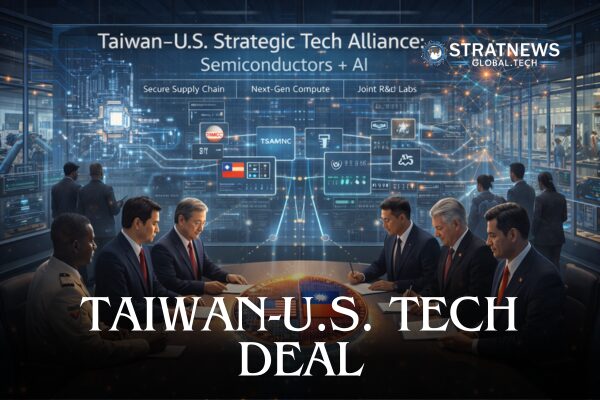
Taiwan plans to deepen technological cooperation with the United States through a “democratic” high-tech supply chain and a strategic partnership in artificial intelligence, following a new tariffs agreement signed last week. Taipei’s top negotiator, Vice Premier Cheng Li-chiun, said the deal strengthens Taiwan’s global reach rather than shifting its semiconductor industry abroad.
U.S. President Donald Trump has urged Taiwan, one of the world’s leading semiconductor producers, to increase investment in the United States, especially in AI-related chip manufacturing. Under the new deal, Taiwanese chipmakers such as TSMC will benefit from lower tariffs when expanding U.S. production. The tariff on most Taiwanese exports to the United States will drop from 20% to 15%, while semiconductor-related imports for U.S.-based operations will face reduced or zero tariffs.
Taiwanese firms are set to invest 250 billion dollars in U.S. semiconductor, energy and AI industries, with a further 250 billion dollars in credit guarantees to support continued investment.
Expanding Cooperation Without Weakening Taiwan’s Industry
Cheng emphasised that the agreement does not represent a hollowing out of Taiwan’s chip industry, which she described as the “sacred mountain protecting the country.” Instead, she framed it as a strategic extension of Taiwan’s technological strength abroad.
“This is not supply-chain relocation; rather, it is support for Taiwan’s high-tech industries to extend their strength abroad—through addition, and even multiplication—to expand a strong international footprint in the United States,” she told reporters in Taipei.
Under the arrangement, chipmakers expanding in the U.S. can import up to 2.5 times their new capacity in semiconductors and wafers tariff-free during the approved construction phase. Beyond that quota, preferential rates will still apply.
Securing Preferential Tariff Protection
Taiwan has also secured favourable treatment under future Section 232 measures, a U.S. national security investigation covering key imports such as chips and pharmaceuticals. Cheng noted that U.S. Commerce Secretary Howard Lutnick had suggested potential tariffs of up to 100% for companies that fail to build production facilities in the United States, although no final decision has been made.
“Regardless, under any future tariff scenario, we have ensured that the U.S. will grant Taiwan the most favourable treatment: zero tariffs within the quota and preferential tariffs even outside the quota,” Cheng said.
A Strategic Partnership for the AI Era
Cheng expressed optimism that the Taiwan-U.S. relationship would evolve from cooperation to leadership within the democratic world’s technological ecosystem. “In the past we said, ‘Taiwan can help’. We hope in the future it will be ‘Taiwan-U.S. can lead’, with both sides joining forces under the wave of AI to build a high-tech supply chain for the democratic camp,” she said.
The United States remains Taiwan’s key security and trade partner, despite the absence of formal diplomatic relations. The deal also underscores the geopolitical importance of Taiwan’s semiconductor industry as tensions persist with Beijing, which claims the self-governed island as its own and has not ruled out the use of force.
with inputs from Reuters
Author

Research Associate at Interstellar.| China Scholar | China Social Media & Foreign Affairs|
View all posts

