


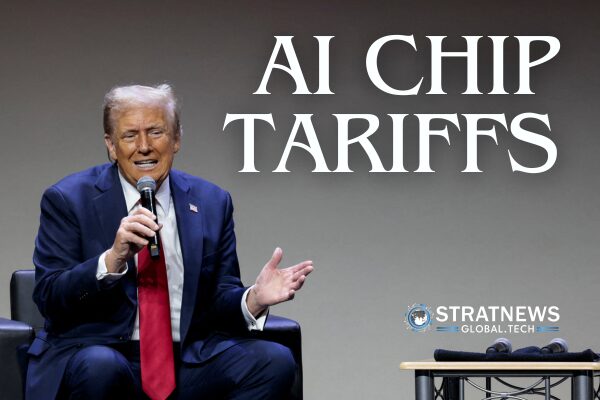
Trump Imposes 25% Tariff on Advanced AI Chips to Boost U.S. Semiconductor Production
U.S. President Donald Trump has imposed a 25% tariff on specific high-performance AI chips, including Nvidia’s H200 processor and AMD’s MI325X semiconductor. The move, announced on Wednesday under a new national security order, forms part of a wider strategy to strengthen domestic semiconductor production and reduce dependence on overseas suppliers, particularly in Taiwan.
The decision follows a nine-month investigation under Section 232 of the Trade Expansion Act of 1962. It targets a defined group of advanced semiconductors that meet strict performance standards, as well as devices containing them. The White House stated that the action aims to secure critical supply chains and promote U.S. chip manufacturing capacity.
Effort to Reduce Foreign Dependence
According to the proclamation, the United States currently produces only about 10% of the chips it consumes, making it heavily reliant on foreign suppliers. “This dependency poses a significant economic and national security risk,” the document stated.
A White House fact sheet clarified that the tariffs will remain narrowly focused. They will not apply to chips used in U.S. data centres, start-ups, non-data centre consumer products, civil industrial applications, or public sector operations. Commerce Secretary Howard Lutnick has been granted wide authority to apply further exemptions if needed.
Following the announcement, shares of Nvidia, AMD and Qualcomm traded slightly lower in after-hours trading.
Broader Trade Strategy and Previous Investigations
Trump’s decision builds on earlier actions aimed at curbing China’s influence in the semiconductor industry. In December, he announced plans to impose tariffs on Chinese semiconductor imports, accusing Beijing of pursuing “unreasonable” industrial dominance. That move, delayed until June 2027, followed a year-long Section 301 investigation initiated under former President Joe Biden into China’s exports of legacy chips.
Recent questions surrounding which products would be affected and how rates would be applied have now been partly answered. The current announcement signals a relatively cautious approach from the administration toward chip import duties, at least for the moment.
Complex Rules for China-Bound Shipments
The administration has also introduced new requirements for chips destined for China. These semiconductors, produced mainly in Taiwan, must now be routed through the United States for third-party testing before export. Upon entry into the U.S., they become subject to the new 25% tariff.
Nvidia has not commented on the measure, while AMD stated, “We comply with all U.S. export control laws and policies.”
Expanding Tariff Agenda
The latest action continues Trump’s broader tariff campaign aimed at revitalising American manufacturing. In September, he introduced sweeping duties, including a 100% tariff on branded pharmaceuticals and a 25% levy on heavy-duty trucks. Earlier, his administration launched investigations into the import of pharmaceuticals and semiconductors, citing national security concerns linked to dependence on foreign production.
Although major U.S. firms like Nvidia, AMD and Intel design many leading chips, the majority are fabricated overseas, primarily by Taiwan Semiconductor Manufacturing Co (TSMC). The company and the Semiconductor Industry Association have not yet issued comments on the new tariffs.
According to the White House, Trump may later extend the policy to cover a wider range of semiconductor imports. An annex to the order confirms that these tariffs will not overlap with other duties already applied under existing Section 232 orders and will exclude materials such as copper, aluminium and steel, as well as automotive components.
with inputs from Reuters

