


Close Menu
Stratnews GlobalStratnews Global
    Facebook X (Twitter) Instagram
    Trending
    • Taiwan Eyes Greater Chip Investment in Arizona to Deepen U.S. Ties
    • Microsoft Restores 365 Services After North America Outage
    • TikTok Creates U.S. Joint Venture to Secure Data and Avoid Ban
    • Self-Eating Spacecraft Promises Affordable Deep Space Access
    • Elon Musk Challenges U.S. Solar Tariffs and Sets Bold Tesla Goals at Davos
    • Blue Origin Unveils TeraWave, a 5,400-Satellite Network for Global Data Connectivity
    • Apple Moves to Block CCI from Accessing Global Financial Records
    • Districts To Decide The Future Of India’s Exports
    Stratnews GlobalStratnews Global
    Write for Us
    Friday, January 23
    • Space
    • Science
    • AI and Robotics
    • Industry News
    Stratnews GlobalStratnews Global
    Home » China’s LandSpace Launches Six Satellites Using Methane-Powered Rocket

    China’s LandSpace Launches Six Satellites Using Methane-Powered Rocket

    Kanika SharmaBy Kanika SharmaMay 17, 2025Updated:May 17, 2025 Space No Comments2 Mins Read
    Landspace Methane-Powered Rocket

    Private Firm Expands Use of Cleaner Fuel with Methane-Powered Rocket

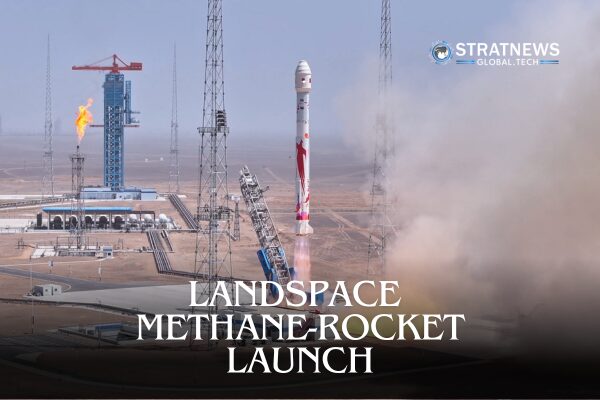
    China’s LandSpace Technology successfully launched six satellites into orbit on Saturday using its methane-powered rocket, the Zhuque-2E Y2. The launch took place at 12:12 p.m. local time from the Jiuquan Satellite Launch Center in northwest China. This marks the fifth mission in the Zhuque-2 series and highlights the startup’s growing focus on cleaner, cost-effective rocket fuels.

    Methane, combined with liquid oxygen, is considered safer, cleaner, and more affordable than traditional hydrocarbon fuels. These qualities make it ideal for use in reusable rockets—a major goal for LandSpace.

    Building Towards Reusable Launch Vehicles

    LandSpace became the first company globally to successfully launch a methane-liquid oxygen rocket in July 2023, ahead of US competitors like SpaceX and Blue Origin. The company has since been enhancing its rocket capabilities.

    Unlike its first methane-powered launch, which carried no satellites, the December 2023 mission successfully deployed three satellites. Saturday’s mission doubled that figure, putting six satellites into orbit, and demonstrated the rocket’s improved payload capacity.

    Reusable rockets, popularised by SpaceX, are seen as a key way to reduce the cost of space transport. LandSpace founder Zhang Changwu has confirmed that work on a reusable model is already underway, with a test launch expected in the second half of 2025.

    The latest Zhuque-2 model includes advancements that support this vision. For the first time, the rocket used supercooled methane and oxygen—both chilled below their boiling points—to increase thrust efficiency.

    LandSpace’s Rise in China’s Commercial Space Sector

    Founded in 2015 and based in Beijing, LandSpace is one of China’s earliest and most well-funded private space startups. The company emerged shortly after the Chinese government opened the commercial space sector to private investment in 2014.

    LandSpace has attracted backing from major investors, including HongShan (formerly Sequoia Capital China), Country Garden’s investment arm, and the state-backed China SME Development Fund. In December, the company raised 900 million yuan (about $120 million) from a fund focused on advanced manufacturing. In 2020, it secured 1.2 billion yuan (around $170 million) in funding.

    With increasing demand for satellite constellations as alternatives to Musk’s Starlink, LandSpace’s advancements position it as a strong player in China’s fast-growing space industry.

    with inputs from Reuters

    Author

    • Kanika Sharma
      Kanika Sharma

      View all posts
    Featured
    Share. Facebook Twitter Pinterest LinkedIn Tumblr Email Reddit Telegram WhatsApp
    Kanika Sharma
    Kanika Sharma

      Keep Reading

      Taiwan Eyes Greater Chip Investment in Arizona to Deepen U.S. Ties

      Microsoft Restores 365 Services After North America Outage

      TikTok Creates U.S. Joint Venture to Secure Data and Avoid Ban

      Self-Eating Spacecraft Promises Affordable Deep Space Access

      Elon Musk Challenges U.S. Solar Tariffs and Sets Bold Tesla Goals at Davos

      Blue Origin Unveils TeraWave, a 5,400-Satellite Network for Global Data Connectivity

      Add A Comment
      Leave A Reply Cancel Reply

      Anti Drone System (CUAS)
      Latest Posts

      Taiwan Eyes Greater Chip Investment in Arizona to Deepen U.S. Ties

      January 23, 2026

      Microsoft Restores 365 Services After North America Outage

      January 23, 2026

      TikTok Creates U.S. Joint Venture to Secure Data and Avoid Ban

      January 23, 2026

      Self-Eating Spacecraft Promises Affordable Deep Space Access

      January 23, 2026

      Elon Musk Challenges U.S. Solar Tariffs and Sets Bold Tesla Goals at Davos

      January 23, 2026

      Blue Origin Unveils TeraWave, a 5,400-Satellite Network for Global Data Connectivity

      January 22, 2026

      Apple Moves to Block CCI from Accessing Global Financial Records

      January 22, 2026

      Districts To Decide The Future Of India’s Exports

      January 22, 2026

      House Panel Approves AI Chip Export Bill Despite White House Opposition

      January 22, 2026

      Columbia Engineers Build Self-Learning Robotic Face That Lip-Syncs Naturally

      January 22, 2026

      Subscribe to News

      Get the latest sports news from NewsSite about world, sports and politics.

      • Astronomical Events
      • Space Missions
      • Industry News
      • Science
      StratNewsGlobal Tech
      Facebook X (Twitter) Instagram LinkedIn YouTube
      © 2026 StratNews Global, A unit of BharatShakti Communications LLP
      • About Us
      • Contributors
      • Copyright
      • Contact
      • Write for Us

      Type above and press Enter to search. Press Esc to cancel.