


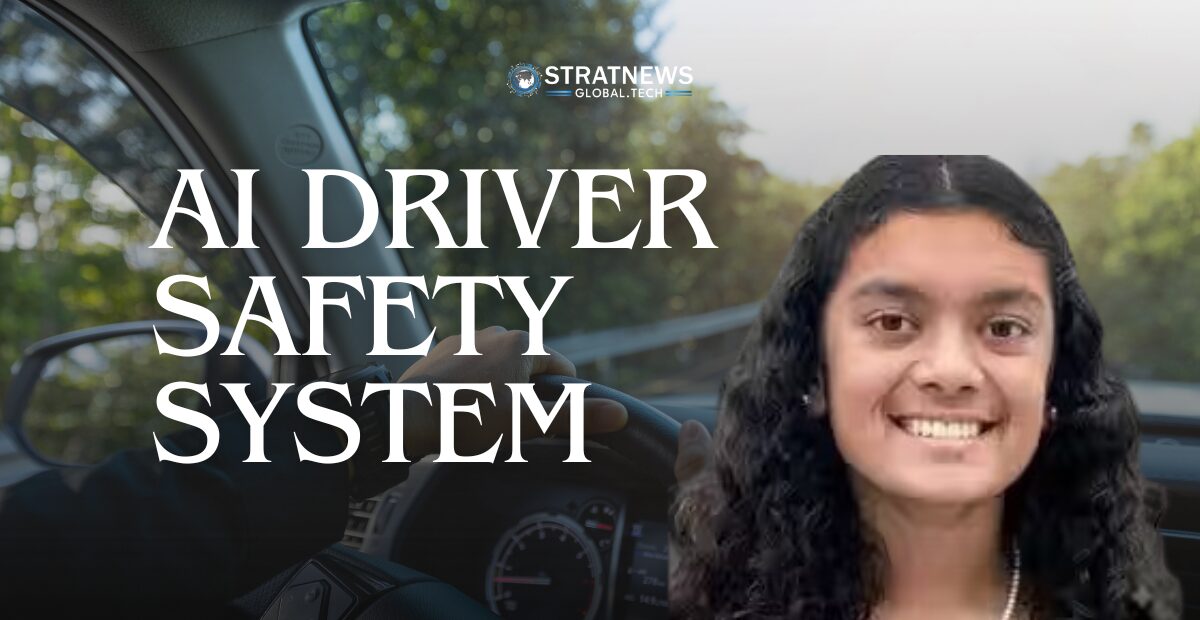
Indian-American Teen Sharvi Mahajan Develops AI System to Detect Driver Fatigue
Fourteen-year-old Indian-American student Sharvi Mahajan has been named among the 10 finalists in the 2026 3M Young Scientist Challenge after developing an artificial intelligence (AI)-powered system designed to detect driver fatigue before it leads to accidents.
Sharvi, an eighth-grade student at Bernardo Heights Middle School in San Diego, California, created NeuroDrive Alert, an electroencephalogram (EEG)-based machine learning system that identifies early signs of drowsiness and alerts drivers before they fall asleep.
The innovation has earned her a place in the prestigious science competition, where finalists will compete for the top prize of $25,000.
AI and EEG Power NeuroDrive Alert
NeuroDrive Alert combines electroencephalography (EEG) technology with machine learning to monitor brain activity in real time.
EEG measures the brain’s electrical signals through sensors placed on the scalp, while AI analyses the collected data to recognise patterns associated with fatigue. The system is specifically designed to detect microsleep—brief episodes of sleep that can last only a few seconds but can have serious consequences when a person is driving or operating machinery.
According to Sharvi, the technology could also be adapted for other situations where maintaining alertness is essential.
One of Five Indian-American Finalists
Sharvi is one of five Indian-American students to reach the final round of the 2026 3M Young Scientist Challenge.
The other finalists of Indian origin are Aaisha Asif from Florida, Raji Doshi from Connecticut, Arika Kundu from Minnesota and Naboshree Santra from Florida.
Speaking about her participation, Sharvi said she entered the competition to strengthen the real-world impact of her project while learning from experts in science and technology.
She said STEM has always been a major passion and described the competition as an opportunity to develop her ideas further while creating solutions that could benefit society.
Passion for Brain Science and Artificial Intelligence
Sharvi said she has long been fascinated by the human brain and believes EEG technology is one of the most significant inventions of the past century because it enables scientists to study brain activity without invasive procedures.
She noted that EEG can provide valuable insights into neurological disorders, sleep quality and attention span. The technology also plays an important role in developing brain-computer interfaces (BCIs), which can help people with physical disabilities communicate and improve their independence.
Looking ahead, Sharvi hopes to pursue a career that combines neuroscience and artificial intelligence. She aspires to become a computational neuroscientist or establish a technology company focused on brain science and AI.
Competition Continues Towards Grand Finale
The 3M Young Scientist Challenge, organised by 3M and Discovery Education, invites students in Grades 5 to 8 to develop innovative science-based solutions to real-world problems.
Over the coming months, each finalist will work alongside a 3M scientist to refine their project before presenting it at the final event, scheduled for October 12 and 13 at the 3M Innovation Center in St. Paul, Minnesota.
The winner of the competition will receive a prize of $25,000, recognising outstanding innovation and scientific achievement among young students.