


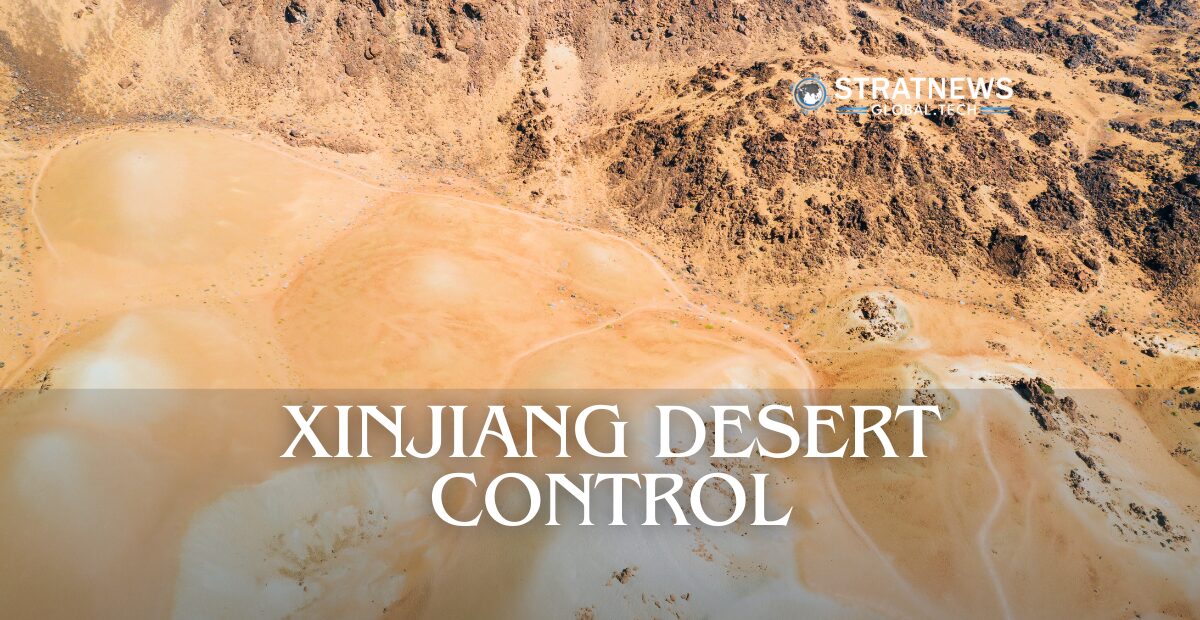
China has launched a new wave of anti-desertification projects in its western regions as authorities intensify efforts to protect farmland from worsening land degradation and climate pressures.
Last month, the Chinese Academy of Sciences’ Xinjiang Institute of Ecology and Geography began several new programmes focused on sand control, desertification prevention, and reducing wind erosion and soil salinity across Xinjiang.
According to Chinese media reports, the projects are aimed at strengthening an ecological barrier designed to shield agricultural land from expanding desert conditions.
China’s ‘Great Green Wall’ Expands
Xinjiang remains a major testing ground for China’s vast anti-desertification campaign, often referred to as the country’s “Great Green Wall”.
The decades-long initiative aims to slow the spread of deserts and prevent fertile land from deteriorating due to climate change, water stress and human activity.
A key focus of the latest campaign is the containment of the Taklamakan Desert, China’s largest desert and one of the world’s biggest shifting-sand deserts.
Authorities are now building a protective green belt around parts of the desert using drought-resistant vegetation combined with engineered sand barriers.
Volcanic Rock Technology Used In Desert Control
Part of the new initiative includes the introduction of six eco-friendly materials designed to stabilise sand and strengthen soil around desert edges.
Among the most notable are basalt fibre-based materials made from melted volcanic rock.
Researchers say the material can reinforce soil, reduce erosion and help prevent sand dunes from spreading into nearby farmland and infrastructure.
According to reports, the same basalt fibre technology had previously been tested during one of China’s most ambitious lunar missions.
In 2024, Chang’e 6 became the first mission to return samples from the far side of the moon.
A Chinese flag carried during the mission also drew attention because it was made using basalt fibre engineered to survive extreme temperature changes and intense ultraviolet radiation on the lunar surface.
According to Wuhan Textile University, which designed the flag, the material was specifically selected to preserve colour and structural strength under harsh conditions.
The fibre is produced by heating basalt rock to extremely high temperatures and drawing the molten material through microscopic nozzles.
Desert Technology Linked To China’s Space Ambitions
China’s desert-control material research is increasingly overlapping with its broader space ambitions.
China and Russia are jointly planning the International Lunar Research Station near the moon’s south pole by 2035, with some of the same material science research supporting both terrestrial and lunar applications.
In Xinjiang, authorities are also using fly ash — a waste product from coal-fired power plants — as part of construction materials for desert-control infrastructure.
Chinese researcher Pei Liang said the newly developed materials could improve desertification-control construction efficiency by 50% while reducing costs by around 30%.
Farmland Protection And Food Security
Large parts of Xinjiang are undergoing transformation as Beijing works to convert desert-affected and saline land into productive farmland.
The region is one of China’s key agricultural zones, but faces persistent challenges from wind erosion, water shortages and soil salinisation.
Another project led by Chinese researcher Xiao Huijie focuses on reducing wind-driven land degradation and controlling salt accumulation in southern Xinjiang, where maintaining soil productivity remains crucial for long-term farming.
The projects form part of China’s wider food security strategy as authorities seek to protect agricultural production amid rising environmental and climate pressures.

