


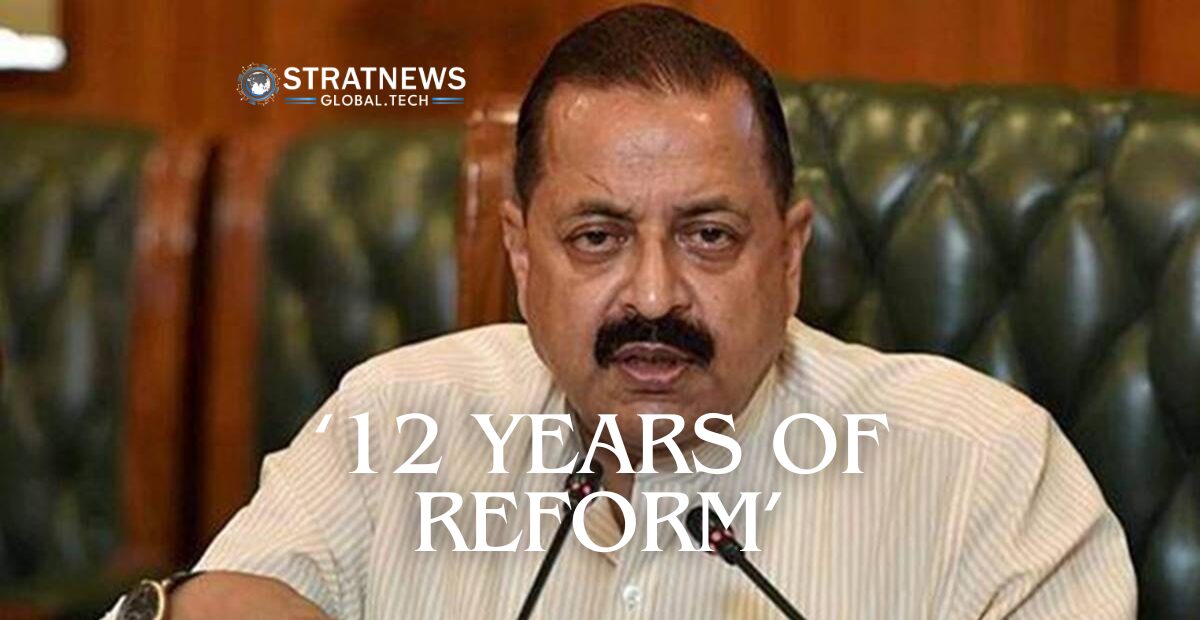
12 Years of Modi Government Have Created an Aspirational India, Says Dr Jitendra Singh
Twelve years of the Narendra Modi government have transformed India into a nation driven by aspiration, innovation and self-confidence, according to Union Minister Dr Jitendra Singh. Speaking to the media, he said governance reforms, technological progress and citizen-focused policies have fundamentally changed how Indians view opportunity and achievement. He also outlined the country’s future growth trajectory, noting that India’s space economy, currently valued at nearly $9 billion, is projected to expand to around $45 billion over the next seven to eight years as the nation advances towards its vision of becoming a developed country by 2047.
Governance Reforms Strengthened Merit and Trust
Reflecting on Prime Minister Narendra Modi’s 4,399 days in office as a continuously serving elected Prime Minister, Dr Jitendra Singh highlighted several reforms that he said reshaped public expectations. He described the introduction of self-attestation for official documents as a landmark decision that demonstrated trust in citizens, particularly young people.
Similarly, he pointed to the removal of interviews for several categories of government recruitment. According to the Minister, the move reduced opportunities for favouritism and discretionary decision-making while reinforcing merit-based selection. As a result, many young Indians gained confidence that hard work and ability could determine success rather than personal influence or recommendations.
Startup Growth Reflects Expanding Opportunities
Dr Jitendra Singh said India’s startup ecosystem has witnessed remarkable expansion over the past decade. He noted that the number of startups has grown from around 350 to 400 in 2014 to more than 2.3 lakh today, generating approximately 24 to 25 lakh jobs.
Furthermore, nearly half of these startups operate from Tier-II and Tier-III cities, highlighting the spread of entrepreneurial opportunities beyond major metropolitan centres. The Minister also observed that between 35 and 39 per cent of startups are led by women, reflecting increasing participation across sectors.
India’s space startup ecosystem has also expanded significantly. From a single-digit number of companies a few years ago, the sector now hosts around 400 startups. In addition, one startup has recently achieved unicorn status, demonstrating the growing maturity of the industry.
Space and Science Drive a New Mindset
According to Dr Jitendra Singh, the most significant achievement of the past 12 years has been a shift in national mindset. He argued that a new culture of aspiration has emerged, encouraging individuals from all backgrounds to believe they can succeed.
This transformation, he said, is evident in the increasing number of civil services toppers emerging from smaller towns and non-metropolitan regions. Technology, transparency and fair competition have helped democratise opportunities and expand access to success.
The Minister also linked this change to India’s scientific achievements. He said missions such as Chandrayaan have strengthened public engagement with science and innovation. Moreover, government support for scientific research has encouraged a culture that accepts setbacks as part of the journey towards discovery and progress.
Opening Strategic Sectors to Private Participation
Dr Jitendra Singh highlighted the opening of the space sector and parts of the nuclear ecosystem to private participation as a major policy shift. These sectors had traditionally remained restricted, but they are now increasingly connected with industry, entrepreneurs and startups.
He said the decision has expanded career opportunities, accelerated innovation and aligned India’s scientific and technological ecosystem with global standards. At the same time, initiatives aimed at building a developed India have encouraged institutions to benchmark performance against international measures rather than domestic comparisons alone.
The Minister also emphasised improvements in welfare delivery, stating that benefits under government schemes are being distributed without discrimination, thereby strengthening trust in governance systems.
Looking ahead, Dr Jitendra Singh said India’s development journey will depend on stronger public-private partnerships, greater participation from women and youth, and continued growth in emerging sectors such as space, nuclear energy and quantum technologies. He maintained that the ultimate objective is to create an empowered and aspirational society capable of contributing to the vision of a developed India by 2047.
With inputs from PIB