


India Space Sector: Opportunities, Challenges And The Path Ahead
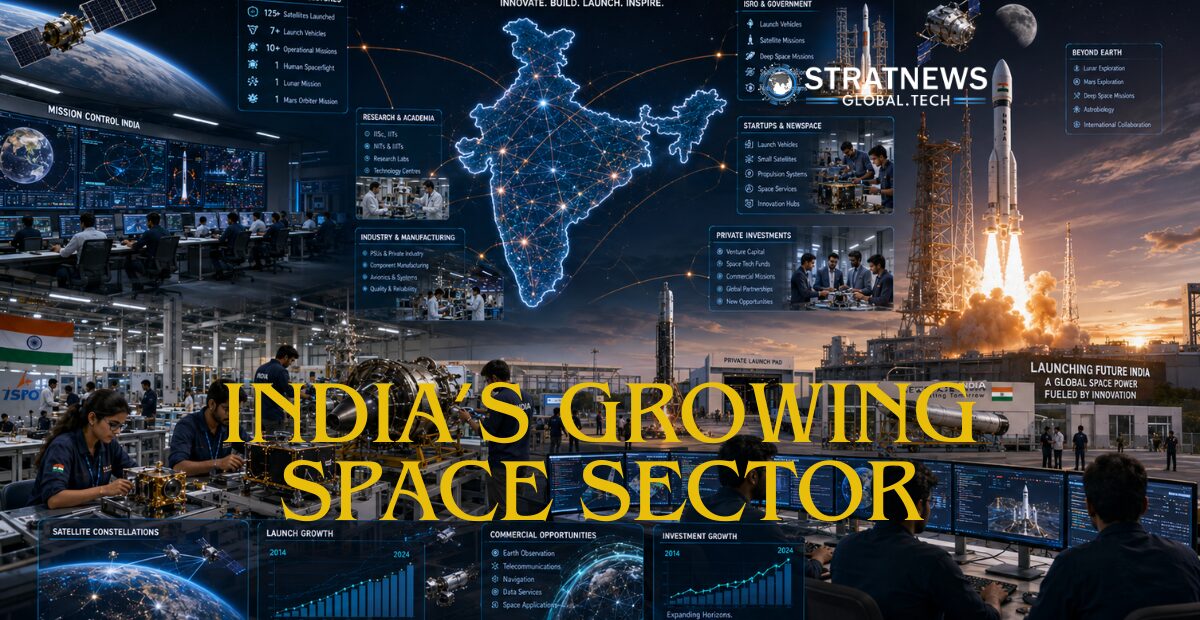
India’s space ecosystem, led by the Indian Space Research Organisation (ISRO), has progressed from a developmental initiative into a strategic and commercial domain. Today, India stands among the few nations with end-to-end space capabilities. Although the country achieved several landmark missions and once commanded a significant share of the global small-satellite launch market, recent operational setbacks and structural constraints have exposed critical vulnerabilities. As space increasingly supports navigation, communication, disaster management, economic growth and national security, strengthening India’s space sector has become a national priority.
Current Developments In India’s Space Sector
India continues to advance its human spaceflight ambitions through the Gaganyaan programme. ISRO is preparing for the G1 mission, the first uncrewed orbital test flight, which will carry the humanoid robot Vyommitra to validate life-support systems and simulate human functions in space. Meanwhile, the first crewed mission remains targeted for 2027 and will carry four Indian astronauts to Low Earth Orbit.
At the same time, ISRO is pursuing next-generation launch capabilities. The development of the Next Generation Launch Vehicle aims to enable significantly higher payload capacities while supporting future reusable launch technologies. Furthermore, the new launch facility at Kulasekarapattinam is expected to strengthen private-sector participation and improve launch accessibility.
Commercial activity is also gaining momentum. India’s space economy is projected to expand substantially by 2033, driven by private investment in satellite manufacturing, launch services and downstream applications. Organisations such as NewSpace India Ltd and emerging private firms are increasingly securing international opportunities and demonstrating commercial viability.
National security has become another major focus area. India is working towards deploying a large constellation of surveillance and remote-sensing satellites to improve situational awareness and strengthen border, maritime and strategic monitoring capabilities. Simultaneously, the Defence Space Agency continues to support the integration of space-based assets into defence operations.
Private-sector participation has expanded rapidly under the regulatory framework established by IN-SPACe. New initiatives such as Satellite Bus as a Service are reducing entry barriers and encouraging innovation. The growth of space start-ups across launch systems, propulsion technologies, Earth observation and analytics reflects the sector’s increasing maturity.
India is also laying the foundation for the Bharatiya Antariksh Station, which aims to establish a permanent sovereign presence in orbit by 2035. The programme focuses on critical technologies such as docking systems and module integration while preparing for future research and exploration missions.
Key Challenges Facing The India Space Sector
Despite notable achievements, several challenges continue to hinder progress.
Launch reliability remains a concern following recent mission failures, which have affected India’s standing in the competitive global launch market. Reliability has become a decisive factor for commercial customers, making consistent performance essential.
India also faces structural limitations because launch operations remain heavily dependent on the Satish Dhawan Space Centre. This concentration restricts launch flexibility and increases vulnerability to operational disruptions.
Navigation sovereignty presents another challenge. The operational status of the NavIC constellation requires continuous strengthening to ensure dependable coverage for both civilian and strategic applications.
Delays in securing orbital slots and spectrum rights at the International Telecommunication Union could create long-term disadvantages. Since orbital positions are finite, delayed filings may result in irreversible strategic losses.
Military space capabilities also require further development. Current institutional arrangements remain limited compared with major space powers. Moreover, dependence on foreign intelligence, surveillance and reconnaissance data during critical situations exposes vulnerabilities in national security planning.
Space Situational Awareness capabilities need expansion as orbital congestion increases. Growing debris risks threaten satellites and future projects such as the Bharatiya Antariksh Station. In addition, dependence on imported space-grade electronics and specialised materials continues to expose the sector to supply-chain disruptions.
Although reforms have opened the sector to private participation, implementation challenges persist. Limited launch access, uncertain demand signals and constrained financing continue to restrict large-scale private-sector growth.
Measures Needed To Strengthen The India Space Sector
India must adopt a comprehensive approach to address these challenges.
First, launch reliability should become a central priority through stronger testing frameworks, continuous system improvements and higher launch frequency. A dedicated mechanism to support launch continuity after failures would help sustain momentum.
Second, India should accelerate the development of multiple launch sites to reduce dependence on a single facility. Distributed infrastructure would improve resilience and enable rapid-response launch capabilities when required.
Third, the country must secure orbital slots and spectrum resources more aggressively through coordinated institutional action. Protecting these assets is essential for future space expansion.
Strengthening NavIC through satellite replenishment, wider adoption and integration into strategic systems will enhance navigation sovereignty. Similarly, establishing a fully empowered Space Command could improve military space coordination and operational effectiveness.
India should also prioritise indigenous intelligence, surveillance and communication capabilities while reducing dependence on foreign providers. Enhanced satellite resilience, stronger cybersecurity measures and expanded Space Situational Awareness networks will further protect national assets.
Finally, commercial growth must align with strategic objectives. Long-term government procurement commitments, export support mechanisms and stronger downstream demand can help create a sustainable and globally competitive private space ecosystem.
The Way Forward
Over the next decade, India’s space ambitions must evolve from individual mission success to comprehensive ecosystem development. Greater private-sector participation, enhanced launch infrastructure, stronger military integration and improved data sovereignty will be essential. With focused execution, institutional accountability and sustained investment, India can strengthen strategic autonomy, expand economic opportunities and secure a leading position in the increasingly contested space domain.