


ISRO Achieves Major Milestone With Successful Semi-Cryogenic Engine Hot Test
The Indian Space Research Organisation (ISRO) has successfully completed a hot test of the Semi-Cryogenic Engine Power Head Test Article (PHTA), marking a significant step in the indigenous development of its next-generation launch vehicle propulsion system.
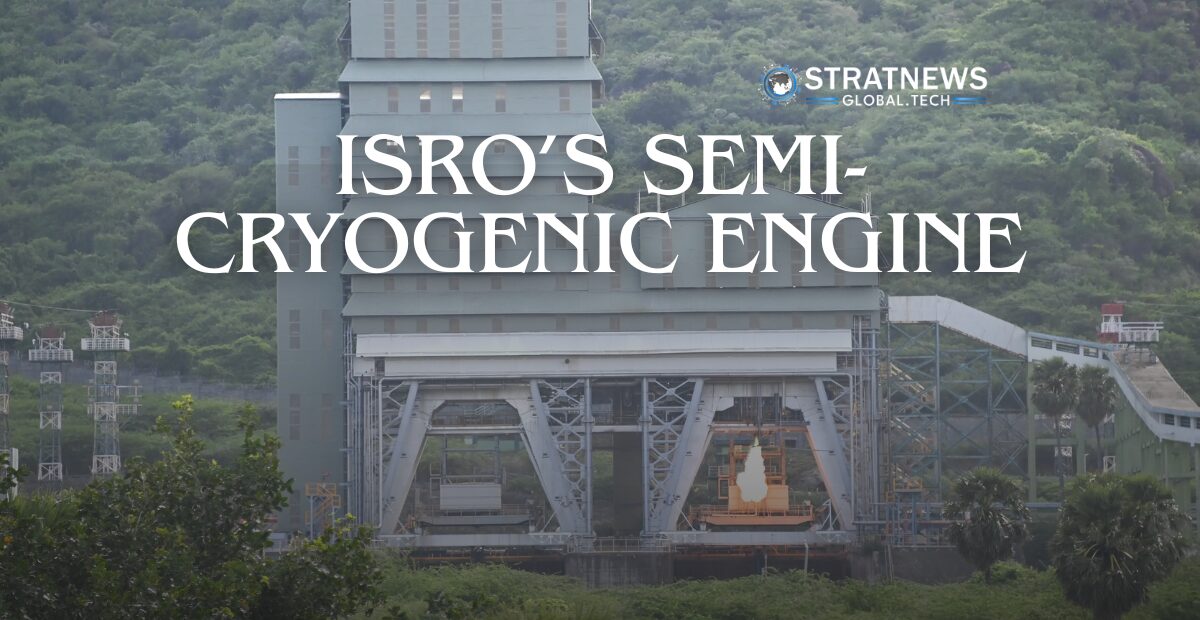
The test was conducted on 24 June 2026 at the ISRO Propulsion Complex (IPRC) in Mahendragiri, Tamil Nadu. During the trial, the Power Head Test Article successfully operated at a thrust level of 175 tonnes, representing 88 per cent of the engine’s intended full thrust capability.
High-Thrust Engine Test Meets Objectives
The Power Head Test Article incorporates all major engine systems except the thrust chamber and serves as a critical platform for validating engine performance before full-engine testing.
This was the eighth hot test in the ongoing PHTA development programme. The primary objectives included studying the engine build-up sequence following pre-burner ignition and demonstrating stable steady-state operation at a significantly higher thrust level.
Earlier tests had successfully validated performance at 94 tonnes, or 47 per cent thrust, and 120 tonnes, equivalent to 60 per cent thrust. The latest trial marked the first successful operation at 175 tonnes of thrust.
During the test, the engine’s main turbopumps also demonstrated reliable operation while delivering outlet pressures of 400 bar and 500 bar, meeting the planned performance targets.
Confidence Grows Ahead of Full-Power Testing
According to ISRO, the test progressed exactly as predicted, with all engine parameters remaining within expected limits throughout the operation.
The successful demonstration provides sufficient confidence to proceed towards validating steady-state performance at the engine’s full design thrust of 200 tonnes, or 100 per cent capacity.
The achievement represents a major milestone in India’s efforts to develop an indigenous semi-cryogenic rocket engine capable of powering future heavy-lift launch vehicles.
Boosting LVM3 Payload Capacity
The Semi-Cryogenic Propulsion Stage, designated SC120, will be powered by the 2,000 kN-class SE2000 engine. ISRO is developing the stage to replace the existing L110 core stage used on the LVM3 launch vehicle.
The upgrade is expected to substantially increase the rocket’s payload capacity while improving operational efficiency.
Unlike conventional propulsion systems, the semi-cryogenic stage uses cleaner, non-toxic propellants consisting of liquid oxygen (LOX) and purified kerosene, known as Isrosene. This combination offers improved performance and greater efficiency for future launch missions.
ISRO said the integration of the Semi-Cryogenic Propulsion Stage alongside an uprated cryogenic upper stage represents a significant advancement in its long-term roadmap to enhance the payload capability of the LVM3 launch vehicle and strengthen India’s space transportation capabilities.
With inputs from ISRO