


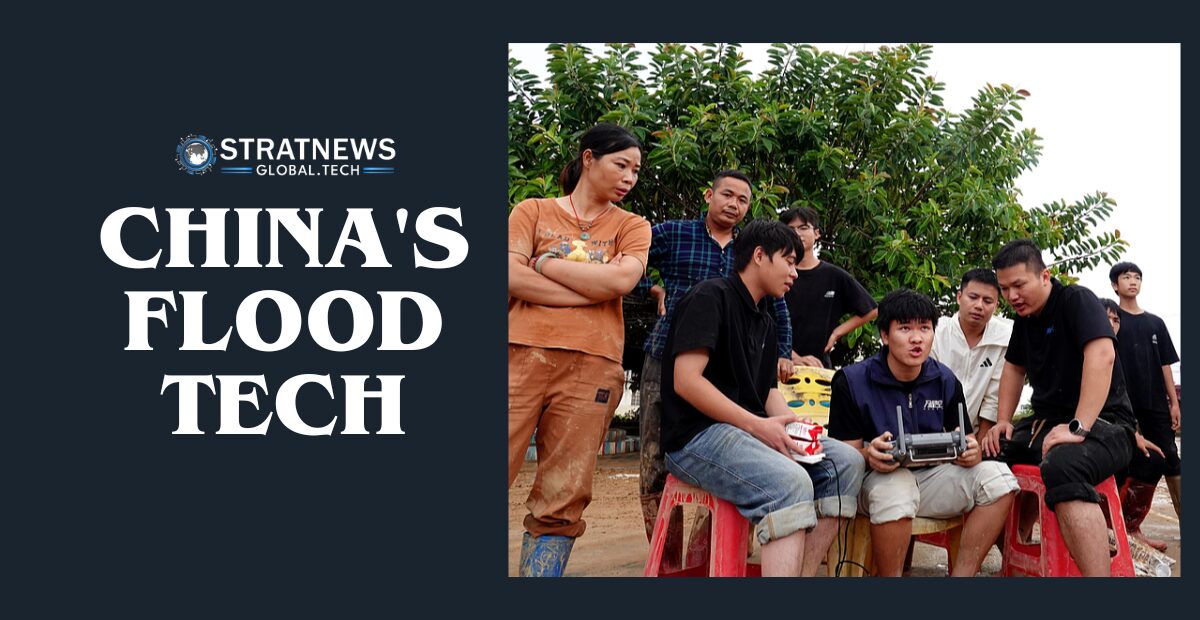
As Typhoon Maysak battered southern China, the country’s emergency response showcased how drones, artificial intelligence and advanced unmanned aircraft are increasingly becoming central to disaster management.
Maysak, the 10th typhoon of the year and the first to make landfall in China in 2026, struck the southern island province of Hainan on July 3 before moving inland and unleashing torrential rain across the Guangxi Zhuang Autonomous Region.
The resulting floods affected more than 375,000 people, forcing the evacuation of at least 130,000 residents as record-breaking rainfall inundated cities and towns.
Heavy-Lift Drones Rescue Stranded Residents
One of the worst-hit areas was Yunbiao Town in Hengzhou County, where floodwaters submerged the entire town and left more than 15,000 people stranded.
With roads rendered impassable, conventional rescue vehicles could not reach those trapped by the rising waters.
A specialised drone rescue team travelled more than 1,700 kilometres over 18 hours to reach the disaster zone.
The team deployed two heavy-lift drones with wingspans exceeding three metres and the ability to carry up to 100 kilograms, alongside three reconnaissance drones used to assess conditions from the air.
Using drones equipped with rescue ropes, responders lifted two stranded residents from the rooftop of a flooded building before transferring them safely to inflatable rescue boats.
Wing Loong UAVs Restore Communications
As floodwaters cut off mobile networks in several areas, China’s Ministry of Emergency Management deployed two Wing Loong unmanned aerial vehicles (UAVs) to restore emergency communications.
The aircraft flew continuously over the affected region, temporarily re-establishing mobile phone coverage for communities isolated by the floods and enabling residents to contact relatives and emergency services.
The ministry also dispatched a large-scale rescue force comprising 1,372 firefighters and emergency personnel, 270 rescue vehicles, 140 boats, and 350 specialised rescue workers equipped for flood operations.
To support recovery efforts, the central government allocated 100 million yuan (approximately US$14.7 million) for emergency restoration and reconstruction.
AI Helps Predict Flood Risks
Artificial intelligence also played a key role in managing the disaster.
The China Southern Power Grid deployed an integrated “power + meteorology + AI” system to monitor Typhoon Maysak’s path, rainfall intensity and the potential impact on critical electricity infrastructure.
The platform continuously analysed weather data, issued early warnings and recommended maintenance strategies to field teams, allowing operators to better protect power networks before the worst of the storm arrived.
Meanwhile, China’s Ministry of Water Resources used satellites, ground-based weather radar and digital flood simulation models to monitor rainfall, track river levels and predict how floodwaters could spread.
The technology enabled authorities to identify high-risk areas more quickly and issue earlier flood warnings to local governments and residents.
Technology Takes Centre Stage
As Maysak continues to bring heavy rainfall to parts of southern and central China, authorities remain on high alert for further flooding.
The disaster has also highlighted China’s growing reliance on advanced technologies from heavy-lift rescue drones and Wing Loong UAVs to AI-powered forecasting systems to improve emergency response, protect critical infrastructure and save lives during extreme weather events.

