


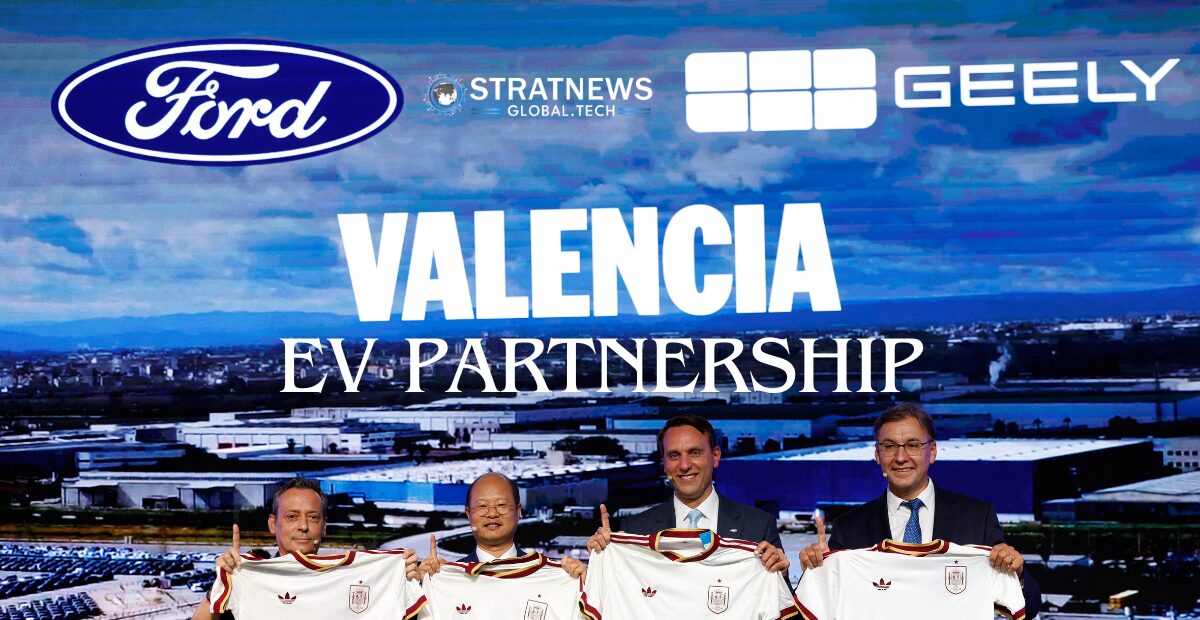
Geely Auto and Ford Partner to Build Electric SUVs at Spain Plant
Geely Auto and Ford have announced a new partnership to manufacture electric vehicles in Spain, marking a significant step in the Chinese automaker’s European expansion. Under the agreement, Geely will build two electric SUVs at Ford’s Valencia factory, while the two companies will jointly develop a new crossover model. The move comes as Chinese carmakers accelerate efforts to establish local production ahead of expected European Union rules favouring vehicles with higher local content.
The collaboration also provides Ford with an opportunity to make better use of its underutilised manufacturing capacity in Europe while strengthening its competitiveness in a rapidly changing electric vehicle market.
Joint Venture to Begin Production in 2028
The partnership will operate through a joint venture in which Ford will hold a 66% stake and Geely Auto will own the remaining 34%.
Production of the first Geely-branded electric SUVs at Ford’s Valencia plant is scheduled to begin in 2028. Ford confirmed that employees at the facility will transition to the new joint venture, and the workforce is expected to expand as production increases.
Geely Senior Vice President Victor Yang said the company has no plans to bring workers from China, adding that the project will rely on local employees and expertise.
Ford’s European head, Jim Baumbick, said the company aims to maximise the use of the Valencia facility as production ramps up.
Geely’s First European Manufacturing Base
The Valencia factory will become Geely Auto’s first production facility in Europe.
Yang told Reuters that the first electric SUV to be produced at the Spanish plant will be the EX5, which is already available in European markets. Meanwhile, the second Geely electric SUV remains under development.
In addition, Ford and Geely will jointly develop a crossover SUV that will be offered with multiple powertrains, including a fully electric version, a plug-in hybrid and an extended-range electric vehicle. Production of the jointly developed model is also expected to begin in 2028.
Yang said Geely’s localisation strategy depends on working with experienced manufacturing partners that possess the necessary expertise to support production in Europe.
Partnership Reflects Changing European Market
The agreement follows months of discussions between the two companies and builds on a longstanding relationship that began when Geely acquired Volvo Cars from Ford in 2010.
However, the partnership has drawn criticism in the United States. Representative John Moolenaar, chair of the U.S. House of Representatives’ bipartisan select committee focused on China, argued that the deal could strengthen China’s position in the European automotive market while Chinese automakers continue to face restrictions in the United States.
Ford defended the agreement, saying Europe’s automotive landscape has changed rapidly and that manufacturers must become more efficient to compete with Chinese and other global rivals. Following the announcement, Ford shares fell 2%.
Local Production Gains Importance
The partnership comes as Chinese automakers seek manufacturing capacity in Europe ahead of anticipated European Union legislation that is expected to introduce “Made in Europe” local-content requirements for electric vehicles.
Spain has emerged as a preferred destination because it is Europe’s second-largest vehicle manufacturing country after Germany and offers relatively lower labour and energy costs.
Several Chinese automakers are pursuing similar strategies. BYD has identified Spain as a potential manufacturing location, while Leapmotor plans to produce an electric SUV at Stellantis’ Zaragoza factory. Premium Chinese brand Hongqi has also held discussions with Stellantis about manufacturing vehicles at one of its Spanish plants.
Labour unions welcomed the agreement cautiously, stressing that long-term success will depend on creating local jobs, developing domestic suppliers and retaining technology within Spain.
Ford Seeks Better Use of Valencia Factory
The partnership also helps Ford address declining production volumes in Europe.
A decade ago, Ford ranked as Europe’s fourth-largest automaker, selling more than one million vehicles annually. Last year, its sales fell to just over 426,000 vehicles, placing it eighth in the regional market.
Currently, the Valencia plant manufactures only the Kuga SUV despite having an annual production capacity of around 500,000 vehicles. According to GlobalData, the factory operated at only 26% of its capacity in 2025.
Ford also plans to begin production of the Bronco SUV at the Valencia facility in 2028. Baumbick said there are no fixed limits on how much of the plant’s capacity Geely may use under the partnership.
With inputs from Reuters

