


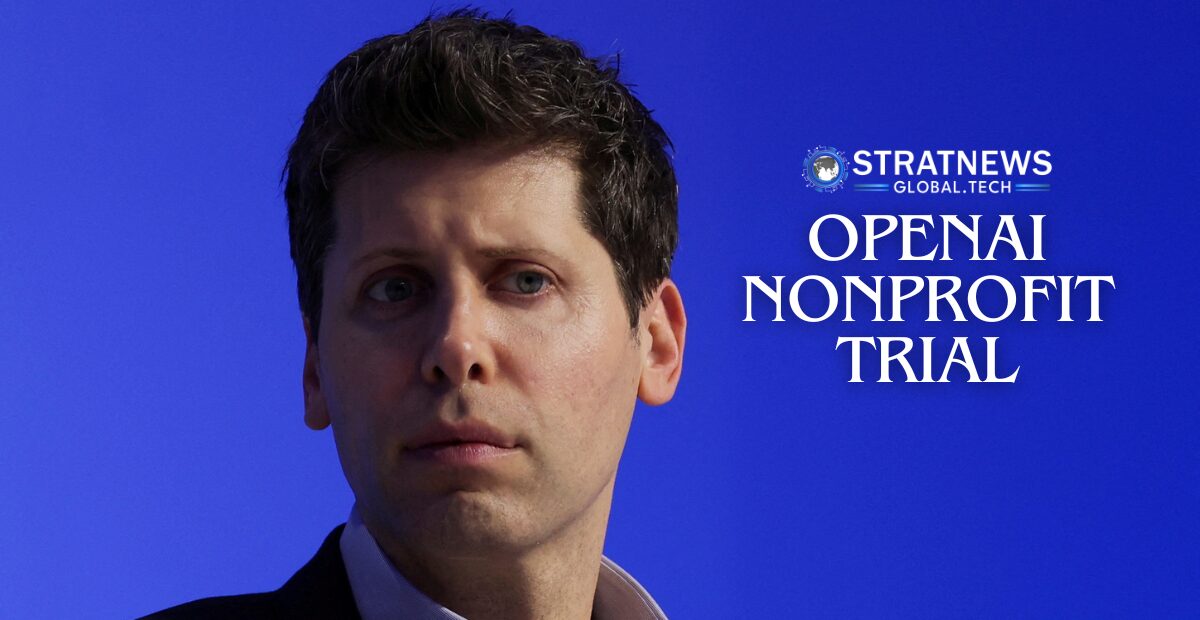
Concerns surrounding the risks of artificial intelligence have dominated a high-profile U.S. trial involving OpenAI co-founders Elon Musk and Sam Altman, even as the legal dispute itself focuses on the company’s corporate structure rather than the technology.
The case centres on OpenAI’s founding in 2015 as a nonprofit organisation before its later transition into a for-profit venture. Musk filed the lawsuit in August 2024, accusing Altman of abandoning commitments to preserve OpenAI’s original nonprofit mission.
Musk is seeking 150 billion dollars in damages and has called for the removal of Altman and Greg Brockman, another OpenAI co-founder and the company’s president. In response, Altman accused Musk of attempting to weaken the ChatGPT maker to benefit his own artificial intelligence company, xAI.
Trial Focuses On OpenAI Restructuring
During the second week of proceedings in Oakland, California, Brockman revealed that his stake in OpenAI is now valued at nearly 30 billion dollars. He also faced questions regarding his financial connections to Altman and the company’s profit-sharing structure.
Musk’s attorney, Marc Toberoff, argued that OpenAI’s restructuring heavily favoured profit participants over the nonprofit arm.
“In 2024, they decided to increase the share of all the other profit participants, including employees like Greg Brockman and we presume to be Sam Altman in the future by 20 percent annually. The chance of the nonprofit ever receiving that residual slice is almost non-existent,” Toberoff said.
However, OpenAI’s legal team defended the company’s evolution into a for-profit structure. Attorney William Savitt stated that the restructuring enabled OpenAI to create significant value that would not otherwise have been possible.
“It’s an enormous, absolute amount of value that’s been created for the nonprofit — 200 billion dollars and counting,” Savitt said during the trial.
Protesters Raise Artificial Intelligence Concerns
Outside the courthouse, activist group StopAI staged a mock funeral to draw attention to concerns over artificial intelligence. Protesters cited children they claimed were harmed through interactions with ChatGPT and warned about potential job losses linked to AI technologies.
Phoebe Thomas Sorgen, one of the organisers, expressed support for Musk’s case despite broader concerns about artificial intelligence.
“I actually hope that Musk wins. And if he does win, because that’s going to help dampen OpenAI, which is far ahead of xAI,” Sorgen said.
The demonstration highlighted growing public anxiety over the rapid expansion of AI systems and the influence of major technology companies.
Testimony Revisits OpenAI’s Early Years
According to Brockman’s testimony, Musk invested around 40 million dollars in OpenAI and previously served on the company’s board. Brockman claimed Musk became frustrated after other members rejected his attempts to gain control of the organisation.
OpenAI also argued that Musk had prior knowledge of plans to establish a for-profit structure. During testimony, references were made to a 2017 document outlining restructuring proposals.
Ahmed Banafa, author of “Artificial Intelligence in Operations”, said Musk’s defence may face challenges because of those earlier discussions.
“Another damaging moment is there was actually a document in 2017, which outlined the restructuring and mentioning for-profit structure,” Banafa said.
Banafa also questioned Musk’s argument that the lawsuit aims to protect OpenAI’s nonprofit mission. He noted that the outcome of the case could influence how startups and technology firms structure their organisations in the future.
Altman is expected to testify within the coming weeks before the trial concludes. Afterwards, a nine-member jury will issue an advisory verdict, although the judge will ultimately decide liability and determine whether damages or remedies should be imposed.
With inputs from Reuters