


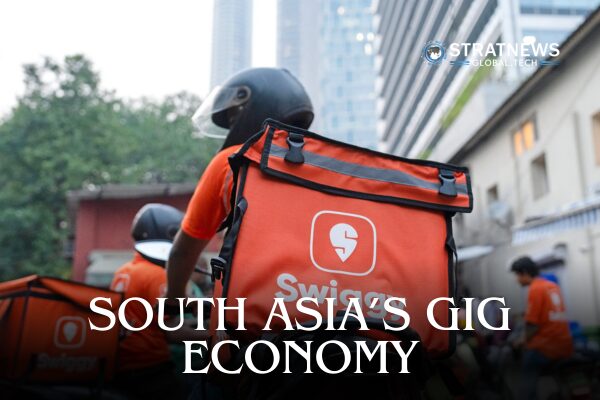
“I belong to a good family. It’s just that life took an unexpected diversion after Covid…” So begins the story of Radha Vallabh Sharma in Vandana Vasudevan’s compelling OTP Please—a tale not just of one man, but of millions swept up in South Asia’s accelerating gig and convenience economy.
As Vasudevan stitches together the voices of online buyers, sellers, and gig workers across the region, the daily act of ordering from an app is stripped of its frictionless sheen, revealing layers of dependence—and anxiety—that now define work and post-pandemic consumption.
The world of “quick” deliveries is both liberating and fraught. Whether it’s food, groceries, or gadgets, the stories in OTP Please capture the reality beneath the 10-minute delivery promise. Behaviours are changing: families no longer stock up for the month, impulse purchases rise, and households order in fragmented ways. The broader economy is quietly shifting. For many urban residents, near-instant fulfilment brings convenience at the cost of traditional routines and financial discipline, as both macro and microeconomic patterns are disrupted.
The phenomenon is far from unique to India. While Swiggy and Zomato dominate at home, Nepal’s Fasto, Pathao Food, and Foodmandu, Bangladesh’s Foodpanda and Chaldal, Pakistan’s Daraz and Markaz, and Sri Lanka’s Quickee and PickMe Food—all locally built, entrepreneur-driven platforms—mirror this region-wide move toward hyper-convenience. At their core lies the gig worker, whose life and prospects form the backbone of Vasudevan’s book and the new economy alike.
Sajith Pai, VC at Blume Ventures, captures this transformation succinctly: “What Information Technology was to the middle class before, the gig economy is now to the lower middle class.” The scale of this shift is underscored by a study from the V.V. Giri National Labour Institute, which projects the number of gig workers in India will soar from 3 million in 2020 to about 23 million by 2030.
Yet convenience has its costs. For many, gig work begins as a stopgap, a temporary solution until something better emerges. But as the book reveals, years often pass with little skill-building or upward mobility. Delivery workers frequently remain stuck in the same roles. The promise of flexibility is increasingly overshadowed by the reality of precariousness.
Governments are beginning to respond. Rajasthan became India’s first state to introduce a welfare act for gig workers. Karnataka has also moved to legislate protections for this growing workforce, recognising how indispensable—and vulnerable—gig workers have become in the modern economy.
Santosh Desai, MD & CEO of FutureBrands, frames this larger cultural shift as an era of “frictionless thinking.” The digital economy, he observes, is chasing a future in which “there is no gap between fulfillment and desire,” as society transitions from active participation to passive consumption, acted upon by the algorithms and platforms that now shape everyday life.

