


Close Menu
Stratnews GlobalStratnews Global
    Facebook X (Twitter) Instagram
    Trending
    • IN-SPACe Authorisation Becomes India’s Trust Badge
    • ISRO Heritage Builds Trust for India’s Space Startups
    • Space Startups Drive India’s New Space Economy
    • Ukraine Long-Range Strikes Hit Russian Sites
    • Cl0p Data Theft Claims Target Nearly 50 Companies
    • SMIC Wafer Prices Rise As AI Demand Drives Growth
    • Vikram-1 Launch Cost Advantage & Global Pricing
    • Vikram-1 Orbital Rocket: Specs, Mission And Market Outlook
    • Support Us
    Stratnews GlobalStratnews Global
    Write for Us
    Monday, August 17
    • Space
    • Science
    • AI and Robotics
    • Industry News
    • Support Us
    Stratnews GlobalStratnews Global
    Home » IN-SPACe Authorisation Becomes India’s Trust Badge

    IN-SPACe Authorisation Becomes India’s Trust Badge

    Aditya LenkaBy Aditya LenkaAugust 17, 2026 India in Space No Comments6 Mins Read
    IN-SPACe Authorisation

    Beyond Compliance: Why IN-SPACe Authorization is India’s Newest Global Trust Badge

    For six decades, ISRO held near-total control over Indian space activity. That changed after the 2020 Cabinet reforms opened the sector to private players, and it changed again with the Indian Space Policy 2023, which drew a formal line between government research and commercial execution. ISRO now concentrates on frontier R&D, deep-space missions, and national capability building. Non-Government Entities (NGEs) — startups and corporations alike — lead commercial missions, satellite builds, and launch services.

    That division produced a fast-growing private sector: over 440 registered space startups today, up from fewer than ten six years ago. Growth alone does not win contracts abroad, though. A foreign buyer evaluating an unfamiliar Indian vendor needs a signal that the company meets government-grade technical and security standards before it commits budget. Authorization from the Indian National Space Promotion and Authorisation Centre (IN-SPACe) — the autonomous nodal agency that reviews and supervises private space activity — increasingly serves that function. It tells a buyer the startup already passed formal government scrutiny, not just internal quality checks.

    Treating that authorization as marketing material, not paperwork, is now a live strategic option for Indian space companies pursuing international B2B contracts.

    Much of that credibility traces back to ISRO. Startups routinely cite ISRO facility access, engineering pedigree, and decades of mission heritage when they pitch overseas clients, and NewSpace India Limited (NSIL), ISRO’s commercial arm, formalizes part of that relationship. NSIL has signed 118 technology-transfer agreements, moving 83 ISRO-developed technologies — from mini-satellite buses to laser gyros — into private hands. A buyer in Singapore or Munich cannot inspect an Indian factory floor directly, but a technology-transfer record from ISRO, paired with IN-SPACe authorization, gives that buyer two independent reference points instead of one marketing claim.

    IN-SPACe’s core value proposition rests on a single-window mechanism. Before the 2020 reforms, a private company pursuing space activity faced scattered approvals across defense, telecom, and space departments, each with its own timeline and paperwork. IN-SPACe consolidates that into one application and one authorizing body. Fewer approval stops translate directly into shorter time-to-market, a metric that matters as much to an investor as to a customer.

    That compression is not cosmetic. IN-SPACe screens each applicant against national security requirements and technical feasibility standards before granting authorization, so approval doubles as an independent audit. For a startup courting a foreign satellite operator or defense-adjacent client, showing a completed IN-SPACe review shortens the buyer’s own due-diligence cycle. The buyer no longer has to take the startup’s technical claims on faith; the regulator already tested them.

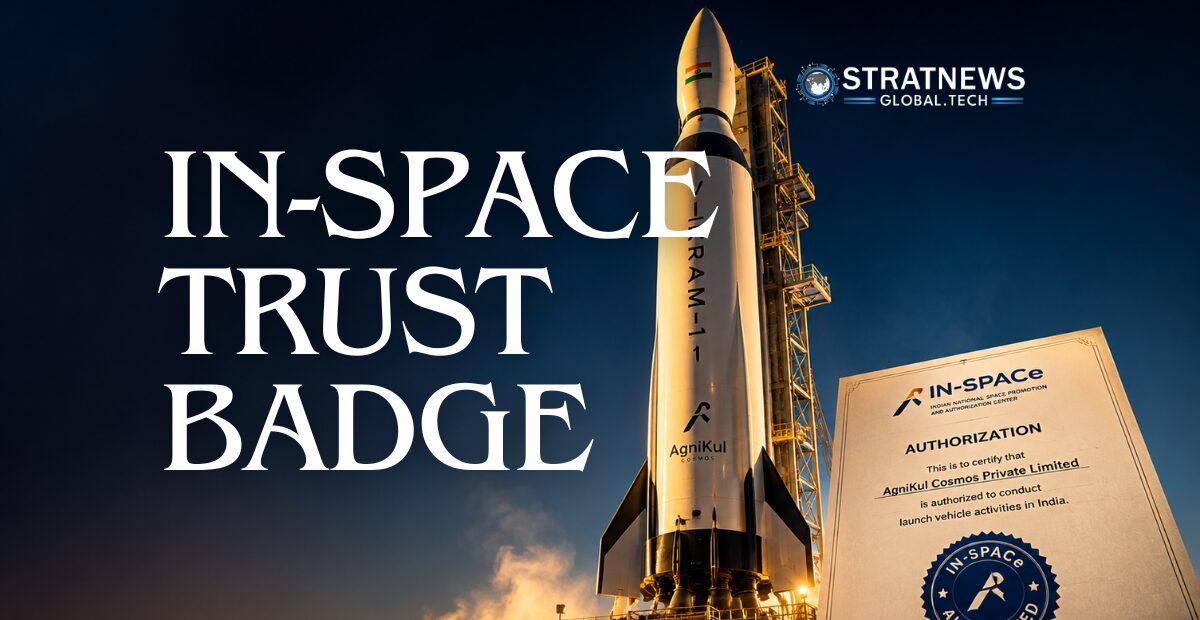
    By mid-2026, IN-SPACe had granted 113 authorisations to 52 non-government entities, 18 of them startups, spanning satellite operations, payload work, and launch services. A separate briefing from IN-SPACe leadership in July put the cumulative count at 130 authorisations against more than 800 applications received since the sector opened, evidence that scrutiny, not blanket approval, drives the numbers. Named startups in the authorized group include Agnikul Cosmos, Skyroot Aerospace, Dhruva Space, Digantara, GalaxEye, and PixxelSpace India.

    Skyroot’s trajectory shows how authorization milestones and capital tend to move together. The company raised $27.5 million in October 2023 at a $519 million valuation, then $60 million in May 2026 at roughly $1.1 billion, making it India’s first spacetech unicorn. That round closed weeks before Vikram-1 reached orbit on July 18, 2026, becoming the first privately built Indian rocket to do so. Co-founder Pawan Kumar Chandana said the round reflected confidence from some of the world’s most respected investors, arriving as the company prepared its maiden orbital flight. Formal authorization, in other words, tends to precede — not follow — a startup’s biggest funding rounds, functioning as a de-risking signal investors read closely.

    Global standards alignment reinforces that signal. India’s FDI policy sets differentiated caps by activity: 100% automatic-route investment for satellite components and subsystems, 74% for satellite manufacturing and data operations, and 49% for launch vehicles and spaceports given their dual-use sensitivity. Each threshold maps to a distinct trust argument a startup can make to a different type of buyer.

    Activity SegmentFDI Route (Automatic)Strategic Marketing Value
    Satellites/Data74%Global Data Sovereignty
    Launch Vehicles49%Infrastructure Reliability
    Components/Subsystems100%Supply Chain Integration

    A satellite-data company can point to the 74% cap and argue its ownership structure keeps sensitive data governance largely in Indian hands, a point that matters to government and defense-linked clients. A launch-vehicle company can point to the 49% ceiling as evidence its national-security review runs deeper, which speaks directly to infrastructure reliability. A components manufacturer sitting at 100% can market itself as a plug-in supplier for global satellite primes with no ownership friction at all. None of these arguments require inventing new claims; they translate existing regulation into language a procurement officer already understands.

    Startups that want to turn compliance into a brand asset should treat authorization as a milestone worth publicizing, the same way they publicize funding rounds or launch dates. A press note timed to an IN-SPACe grant, paired with the specific activity category approved, gives international partners a concrete, verifiable claim rather than a vague assurance of quality. Referencing NSIL technology-transfer agreements by name and technology area does the same work for engineering credibility.

    The pattern extends into contract negotiations directly. Sales teams pitching non-Indian clients can cite the applicable FDI cap for their segment as a governance data point, not a regulatory footnote, since it tells the buyer exactly how ownership and control are structured. Documenting the single-window timeline — from application to authorization — gives prospective partners a benchmark for how quickly the company can scale new capacity or add a new payload class.

    India’s space economy is on a trajectory toward $40 billion to $45 billion within a decade, with government officials citing a target of 8% to 10% of the global space economy by 2030. Reaching that share depends on authorized startups converting single approvals into repeat international contracts. IN-SPACe authorization will not replace a strong product or a track record. It gives Indian space companies something rarer in a young industry: a government-verified reference point that international buyers can check before they sign.

    Author

    • Aditya Lenka
      Aditya Lenka

      A multi-faceted professional with a diverse range of skills and experiences. He currently works as a Producer, Digital Marketer, and Journalist for several well-known media outlets, namely StratNewsGlobal, BharatShakti, and Interstellar. With a passion for storytelling and a keen eye for detail, Aditya has covered a wide range of topics and events across India, bringing a unique perspective to his work.

      When he's not busy producing content, Aditya enjoys exploring new places and cuisines, having traveled extensively throughout India. He's also an avid writer and poet, often penning his thoughts and musings in his free time. And when he wants to unwind and relax, Aditya spends time with his two loyal companions, Zorro and Pablo, his beloved dogs.

      Aditya's dynamic personality and varied interests make him a unique individual, always eager to learn and experience new things.

      View all posts
    Featured India Industry Space
    Share. Facebook Twitter Pinterest LinkedIn Tumblr Email Reddit Telegram WhatsApp
    Aditya Lenka
    Aditya Lenka

      A multi-faceted professional with a diverse range of skills and experiences. He currently works as a Producer, Digital Marketer, and Journalist for several well-known media outlets, namely StratNewsGlobal, BharatShakti, and Interstellar. With a passion for storytelling and a keen eye for detail, Aditya has covered a wide range of topics and events across India, bringing a unique perspective to his work.When he's not busy producing content, Aditya enjoys exploring new places and cuisines, having traveled extensively throughout India. He's also an avid writer and poet, often penning his thoughts and musings in his free time. And when he wants to unwind and relax, Aditya spends time with his two loyal companions, Zorro and Pablo, his beloved dogs.Aditya's dynamic personality and varied interests make him a unique individual, always eager to learn and experience new things.

      Keep Reading

      ISRO Heritage Builds Trust for India’s Space Startups

      Space Startups Drive India’s New Space Economy

      Ukraine Long-Range Strikes Hit Russian Sites

      Cl0p Data Theft Claims Target Nearly 50 Companies

      SMIC Wafer Prices Rise As AI Demand Drives Growth

      Vikram-1 Launch Cost Advantage & Global Pricing

      Add A Comment
      Leave A Reply Cancel Reply

      Anti Drone System (CUAS)
      Latest Posts

      IN-SPACe Authorisation Becomes India’s Trust Badge

      August 17, 2026

      ISRO Heritage Builds Trust for India’s Space Startups

      August 17, 2026

      Space Startups Drive India’s New Space Economy

      August 17, 2026

      Ukraine Long-Range Strikes Hit Russian Sites

      August 17, 2026

      Cl0p Data Theft Claims Target Nearly 50 Companies

      August 14, 2026

      SMIC Wafer Prices Rise As AI Demand Drives Growth

      August 14, 2026

      Vikram-1 Launch Cost Advantage & Global Pricing

      August 14, 2026

      Vikram-1 Orbital Rocket: Specs, Mission And Market Outlook

      August 14, 2026

      Vikram-1 Cost Per Kilogram Vs Global Launch Rivals

      August 14, 2026

      Apple China AI Model Developed With Alibaba Support

      August 14, 2026

      Subscribe to News

      Get the latest sports news from NewsSite about world, sports and politics.

      • Astronomical Events
      • Space Missions
      • Industry News
      • Science
      StratNewsGlobal Tech
      Facebook X (Twitter) Instagram LinkedIn YouTube
      © 2026 StratNews Global, A unit of BharatShakti Communications LLP
      • About Us
      • Contributors
      • Copyright
      • Contact
      • Write for Us

      Type above and press Enter to search. Press Esc to cancel.