


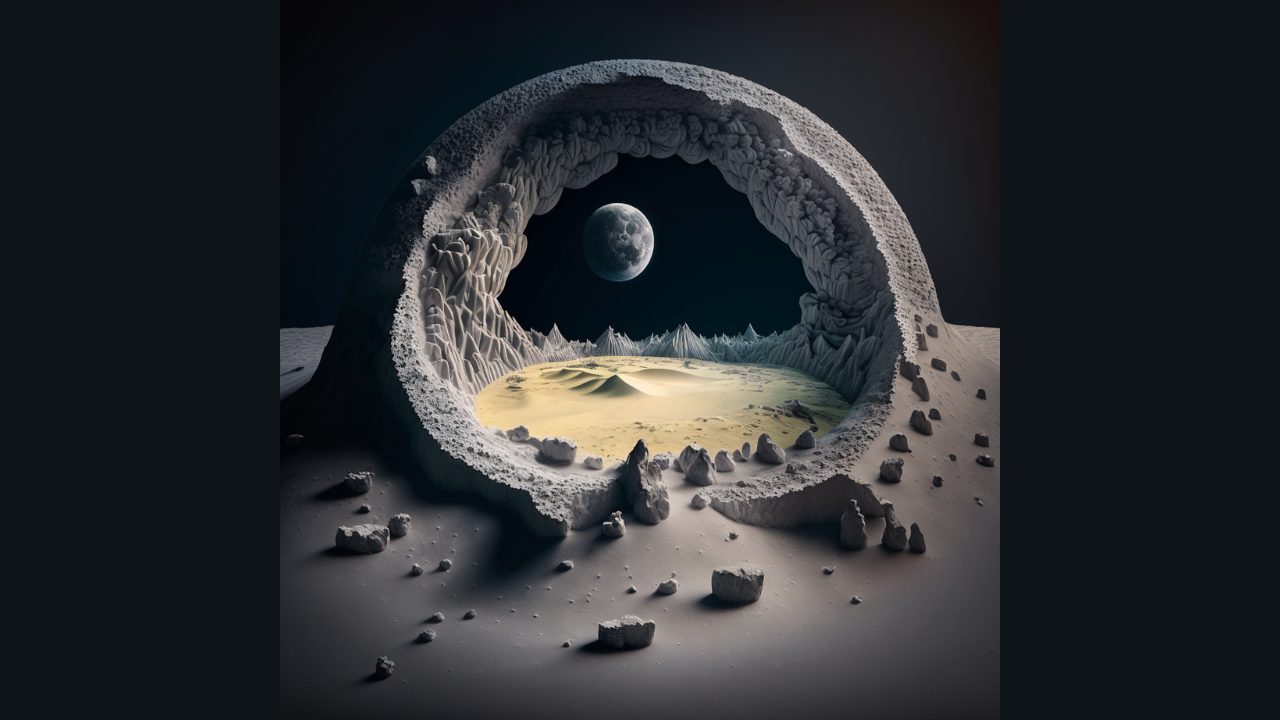
It is no secret that the Moon has captivated humanity since time immemorial. Often dubbed the most romantic object in the night sky, the Moon has been a subject of folklore and adventures across cultures. It is also no secret that several artists and organisations have proposed creating artwork on the moon over the years. There are many uniquely creative and exciting aspects to it.
Let’s imagine for a moment how priceless a work of art would be if made from a piece of the Moon. It isn’t easy to quantify in terms of value. What about using the lunar environment as the ultimate time capsule for long-term art preservation?
The unique environment and the possibility of long-term preservation (The Moon has no atmosphere, hence no erosion or contamination) of its surface have led some to see it as a canvas for creative expression. Let us read on about some of these exciting ideas:
- In 1969, a tiny ceramic wafer with artwork on it created by six different artists, including Andy Warhol and Robert Rauschenberg, was covertly attached to the leg of the lunar module that was used for the Apollo 12 mission. Some believe this structure, known today as the “Moon Museum,” was the first artwork ever created on the moon.
- Another exciting project called upon a group of artists, scientists, and engineers from various fields to work on the MoonArk project. This is a unique initiative that has the goal of creating a time capsule of human civilisation on the moon. The structure consists of four rooms, each with a fantastic collection of knowledge, music, and forms of artistic expression.
- The Moon Arts Project is a group of artists and scientists from Japan that has proposed constructing a sculpture on the moon that would be viewable from Earth. The sculpture would be made up of a collection of mirrors set up in a circular arrangement, and its purpose would be to reflect sunlight down to Earth.
And finally, The Lunar Orbiter Heritage Site is a project that has been proposed to create a protected area on the moon’s surface to preserve historical artifacts related to lunar exploration.
The production of artwork on the moon poses several one-of-a-kind difficulties, such as the harsh climate and the absence of an atmosphere, yet, it also allows creative expression and the preservation of cultural traditions. As space exploration spreads, we will likely witness more initiatives and suggestions for artwork placed on the moon and other celestial bodies. Some scientists and artists have created works of art out of lunar regolith (which refers to the loose soil and rocks that cover the moon’s surface). Promoting artwork created from the lunar regolith may have many advantages for a nation like India. For instance, making art from lunar regolith to advance space education might help develop interest and spark enthusiasm in space art education, particularly among younger people. This could encourage more people to pursue space careers beyond the conventional STEM (science, technology, engineering, and mathematics) disciplines, especially where fine arts meet material sciences. Developing the technology required to harvest, process, and alter lunar regolith requires more advanced technical and scientific expertise.
As India sets its presence on the Moon in the 21st century, our technological capability and space economic activities should graduate into creating artwork from the lunar regolith. Lunar regolith can allow artists to experiment with new materials and methods and contribute to expanding Indian soft power globally.
An example from history would be the pieces of the Moon retrieved by the Apollo missions that the then U.S President Richard Nixon gifted as a gift of goodwill to 135 countries worldwide. This event marked an essential exchange of space advocacy and diplomacy. Additionally, promoting lunar artwork can facilitate the interchange of cultural ideas and the appreciation of various artistic manifestations.
To encourage international collaboration, the production of artwork using lunar regolith will call upon the participation of scientists, engineers, and artists from nations all around the world. This can foster international collaboration, mutual comprehension, and the exchange of information and resources.
India’s lunar exploration spacecraft could be designed to bring lunar materials back to the Earth for making new artwork or make the artwork in situ on the Moon. Such artistic attempts could provide a significant opportunity to herald a new-age renaissance that spans all cultures, borders, races, and nationalities. The Indian ethos of “Vasudhaiva Kutumbakam”, or “the whole world is one family”, can be appropriately transmogrified into a global phenomenon that could one day usher in the wind of change towards ensuring human unity. Promoting creative expressions from space can inspire future generations and improve humanity’s understanding and appreciation of the universe.
(The author is a space economy and technology scholar. Views are personal.)