


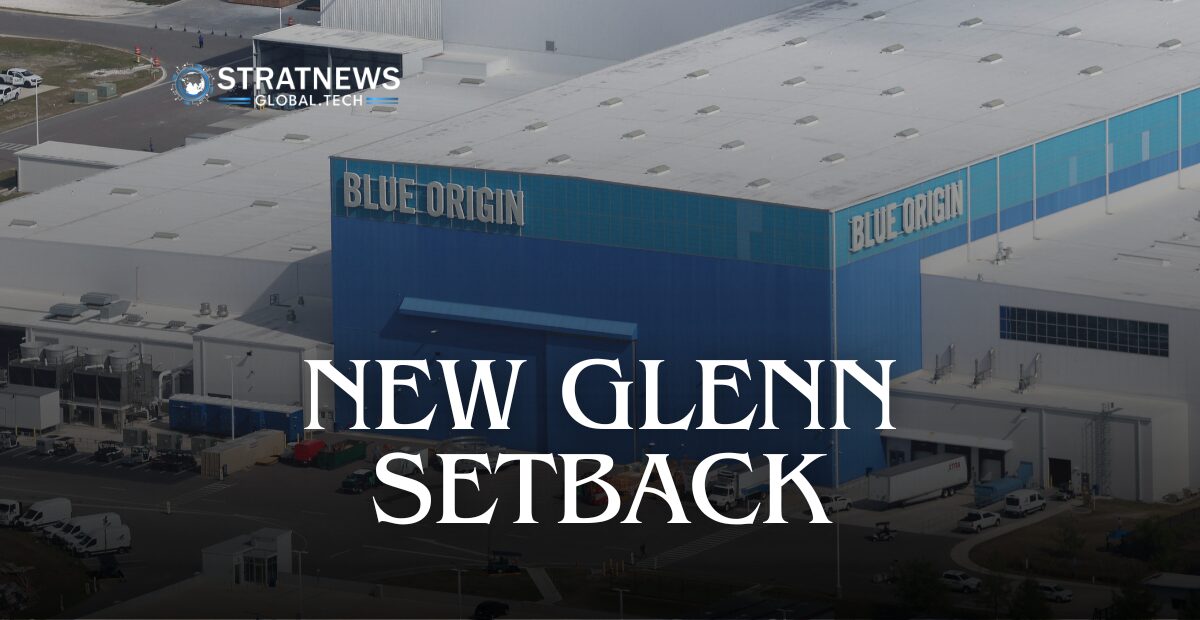
Blue Origin Targets New Glenn Return After Launch Pad Explosion
Blue Origin plans to return its New Glenn rocket to flight before the end of the year despite a recent explosion that damaged the company’s only launch pad and created fresh challenges for its space launch ambitions.
Chief executive Dave Limp confirmed the timeline days after a New Glenn rocket exploded during a ground test at Cape Canaveral, Florida. The incident caused significant damage to launch infrastructure but resulted in no injuries and no loss of customer payloads.
Launch Pad Damage Under Assessment
Blue Origin engineers have been inspecting the damage since the explosion, which occurred during a routine hot-fire test. The procedure involves igniting a rocket’s engines while it remains secured to the launch pad as part of pre-launch preparations.
The company has not disclosed what caused the explosion and continues to investigate the incident.
According to Limp, several critical components at the launch complex escaped major damage. He said key fuel storage tanks remained intact, a fortunate outcome given the lengthy replacement times such infrastructure would require.
In addition, rocket boosters intended for future missions appear to be undamaged. However, the launch pad’s main support tower sustained damage and will require repairs before flights can resume.
Major Setback For New Glenn Programme
The explosion represents one of the most serious failures in Blue Origin’s history since the company was founded by Jeff Bezos in 2000.
The incident not only affects the New Glenn rocket itself but also temporarily sidelines the company’s sole launch facility for the vehicle. As a result, Blue Origin faces another delay at a time when it is already under pressure to increase launch frequency.
The setback follows a mission failure during New Glenn’s third flight in April, adding to concerns about the pace of the programme’s development.
Blue Origin has been working to establish New Glenn as a major competitor in the commercial launch market, where SpaceX currently dominates global launch activity.
Amazon Satellite Plans Face Delays
The rocket that exploded was preparing to launch 48 internet satellites for Amazon, one of Blue Origin’s most important commercial customers.
Amazon is racing to expand its satellite broadband network as it seeks to compete with SpaceX’s Starlink constellation. Any prolonged disruption to New Glenn’s launch schedule could complicate those plans.
Nevertheless, Amazon maintains access to several launch providers. The company has agreements with United Launch Alliance and Arianespace in addition to Blue Origin.
Recently, a United Launch Alliance Atlas V rocket successfully launched 29 Amazon low-Earth-orbit satellites, helping advance the broader deployment effort.
Learning From Previous Industry Setbacks
Limp declined to speculate about the cause of the explosion while the investigation remains ongoing.
The incident has drawn comparisons with a 2016 Falcon 9 explosion suffered by SpaceX during a fuel-loading operation ahead of a hot-fire test. SpaceX returned Falcon 9 to service approximately four months after that accident.
Blue Origin’s own history also includes previous setbacks. In 2022, an uncrewed New Shepard mission experienced a structural failure involving the rocket’s engine nozzle. Following an extensive investigation and regulatory review, the vehicle remained grounded for more than a year.
Earlier this year, Limp paused the New Shepard programme and redirected personnel and resources towards New Glenn and the company’s Blue Moon lunar lander project for NASA.
Both programmes face demanding schedules. Blue Origin had planned to launch an early version of its Blue Moon lander aboard New Glenn later this year. The success of repair efforts and the ongoing investigation will now play a crucial role in determining whether those ambitions remain on track.
With inputs from Reuters