


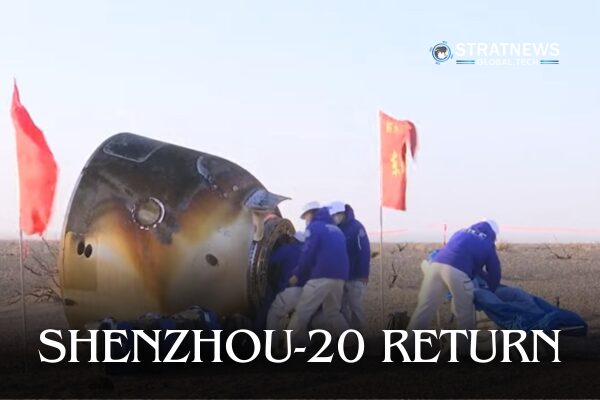
China’s Damaged Shenzhou-20 Capsule Returns Safely to Earth
China’s first emergency space mission concluded successfully on Monday as the debris-damaged return capsule of the Shenzhou-20 spacecraft landed safely at the Dongfeng Landing Site in Inner Mongolia. The recovery marked the end of a complex and unprecedented operation, with ground teams overcoming severe weather and unique technical challenges to secure the unmanned capsule.
Safe Landing After Debris Impact Incident
The China Manned Space Agency (CMSA) confirmed that the capsule touched down at 09:34 local time, following its undocking from the Tiangong space station shortly after midnight in Beijing. The Shenzhou-20 mission, launched in April from the Jiuquan Satellite Launch Centre, had faced delays after a suspected space debris impact in early November caused minor cracks in the capsule’s viewport window.
As a precaution, the CMSA decided to postpone its return and instead use an alternative spacecraft to bring the three astronauts of the Shenzhou-20 mission safely back to Earth. Despite the damage, the Shenzhou-20 capsule withstood extreme re-entry temperatures of several thousand degrees Celsius after on-orbit reinforcement and sealing work carried out by the Shenzhou-21 crew, who took over operations in November.
Challenging Search and Recovery in Harsh Conditions
Xu Peng, on-site commander at the Dongfeng Landing Site, described the recovery as one of the most demanding missions his team had faced. The unmanned landing, coupled with severe winter conditions and strong winds, required precise coordination and rapid response.
“This is the first time the Dongfeng site has conducted a spaceship recovery in the coldest season of the year,” Xu said. “We made special cold-protection preparations to ensure both our personnel and equipment could perform effectively despite the freezing temperatures.”
The absence of astronauts created additional challenges. Because the capsule was unmanned, no crew could manually detach the main parachute. Strong winds risked dragging the capsule across the landing area, forcing ground teams to reach it quickly to cut the parachute and stabilise the craft.
New Recovery Techniques and Data Collection
Ground teams introduced new recovery methods, employing drones and unmanned vehicles instead of helicopters to locate and secure the capsule. Xu explained that this hybrid approach improved response times and safety under extreme conditions.
After touchdown, personnel immediately secured the damaged porthole to prevent further deterioration. Engineers will analyse the capsule’s condition to better understand the effects of debris impact and improve future spacecraft design.
Although it carried no astronauts, the capsule transported several items from the Tiangong space station, including a spacesuit that had exceeded its operational lifespan after being used in about 20 spacewalks.
The successful return marks another milestone for China’s crewed space programme, demonstrating its ability to handle in-orbit emergencies and execute precision recovery operations even under difficult circumstances.
with inputs from Reuters

