


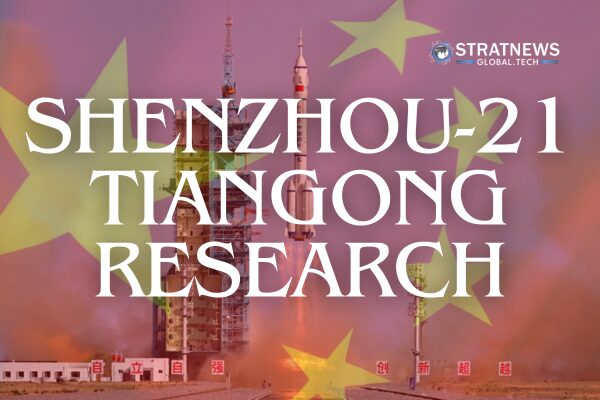
Shenzhou-21 Crew Advances Scientific Research and Training on Tiangong Space Station
The Shenzhou-21 astronauts have continued to make steady progress in scientific experiments and operational training aboard China’s Tiangong space station over the past week. The crew, composed of commander Zhang Lu and astronauts Wu Fei and Zhang Hongzhang, has now been in orbit for more than 70 days, focusing on scientific, technical, and emergency preparedness tasks.
Strengthening Operational and Emergency Capabilities
Last week, the crew carried out scheduled training for remotely operated rendezvous and docking procedures. Using specialised control handles, they practised precise adjustments to the spacecraft’s speed and orientation, ensuring readiness for future docking missions.
The astronauts also participated in several emergency drills, including medical rescue exercises and an evacuation simulation designed to replicate a fire scenario within the station. These activities enhanced their familiarity with onboard medical equipment and reinforced their ability to respond effectively to potential emergencies in microgravity.
Progress in Space Medicine and Materials Science
Scientific work aboard Tiangong continued smoothly, with significant advances recorded in multiple research areas. In the field of space medicine, the crew used electroencephalogram (EEG) equipment in conjunction with virtual reality systems to study eye-brain coordination. The experiment seeks to identify how brain control signals change under microgravity conditions. Additional investigations explored microgravity’s effects on intuitive physics and cooperative coding mechanisms.
In the domain of materials science, the astronauts conducted in-situ electrochemical optical experiments on lithium-ion batteries. These studies are expected to inform the design and performance of next-generation power systems for future space missions.
Maintaining the Space Station’s Vital Systems
Alongside their scientific work, the crew performed a series of maintenance and operational tasks. They replaced and serviced experimental modules, cleaned and exchanged samples in the containerless experiment chamber, and carried out detailed inspections of critical systems. Their checks on regenerative life support equipment and other station components ensured the continued safety and stability of Tiangong’s operation.
The Shenzhou-21 mission remains a key step in China’s long-term effort to deepen its research capabilities in orbit and to prepare for extended crewed missions in low Earth orbit and beyond.
with inputs from Reuters

