


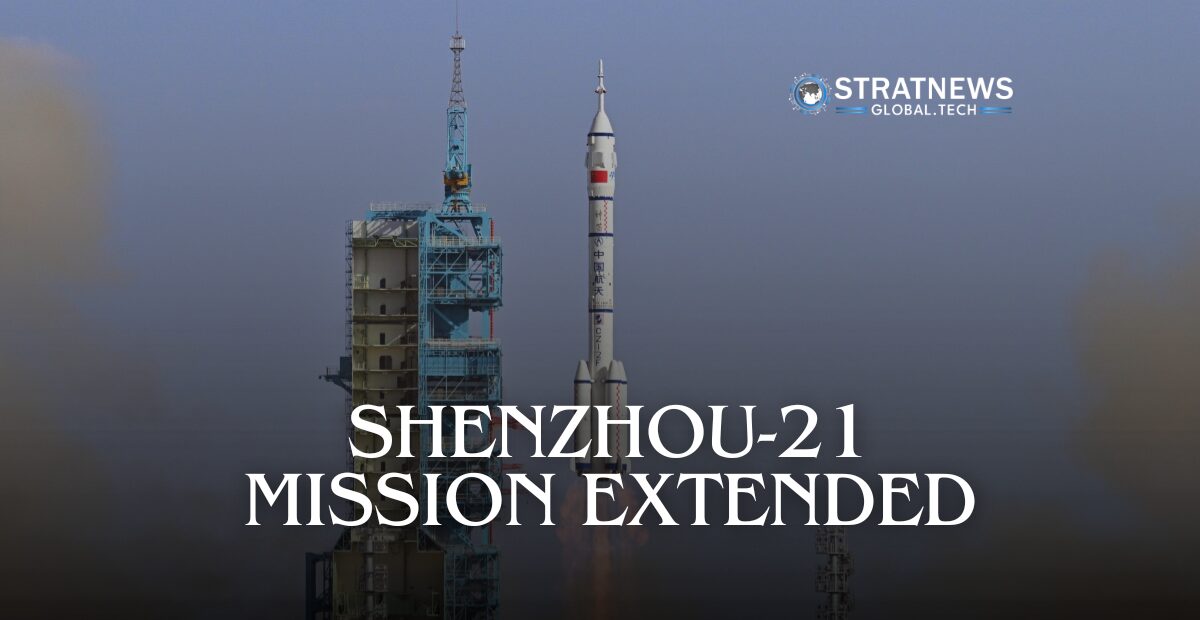
China Extends Shenzhou-21 Mission by One Month
China’s Shenzhou-21 astronaut crew will remain in space for an additional month following a decision by the China Manned Space Engineering Office. The country’s state broadcaster reported the extension after authorities assessed mission requirements and astronaut conditions.
The Shenzhou-21 spacecraft launched on October 31 from the Jiuquan Satellite Launch Centre in northwest China. It travelled aboard a Long March-2F rocket, carrying three astronauts assigned to a mission originally scheduled to last six months.
The crew includes Zhang Hongzhang, Wu Fei, and Commander Zhang Lu. Wu Fei is recognised as the youngest Chinese astronaut to be sent into space. At the time of launch, the astronauts were aged 39, 32, and 48 respectively. Zhang Lu previously flew on the Shenzhou-15 mission in 2022, bringing valuable experience to the current operation.
Crew Performance and Mission Progress
The trio have now spent more than five months in orbit and continue to maintain stable physical and operational conditions. According to official reports, they are living and working effectively aboard the space station.
During their mission, the astronauts have carried out several critical tasks. They have worked closely with the station’s robotic arm and ground-based researchers to complete technical operations. These include installing space debris protection devices and conducting detailed inspections of extravehicular equipment and facilities.
Moreover, the crew’s ability to perform complex assignments in orbit demonstrates the growing sophistication of China’s human spaceflight programme. Their progress reflects both technical preparedness and strong coordination between astronauts and mission control teams.
Extension Aims to Advance Long-Term Space Capabilities
Initially, the Shenzhou-21 crew were expected to return to Earth around April after completing their six-month rotation. However, the revised plan extends their stay by approximately one month, although authorities have not confirmed an exact return date.
The extension serves a specific scientific purpose. Officials stated that the additional time in orbit will help verify technologies related to long-duration human spaceflight. As a result, the mission will provide further insight into sustaining astronauts in space for extended periods.
In addition, the crew will continue conducting scientific and technological experiments throughout the extended phase of the mission. These activities are expected to contribute valuable data for future missions and long-term space station operations.
China’s decision highlights its ongoing efforts to strengthen capabilities in human space exploration. By extending the Shenzhou-21 mission, the programme aims to deepen its understanding of long-term habitation and operational efficiency in orbit.
With inputs from Reuters

