


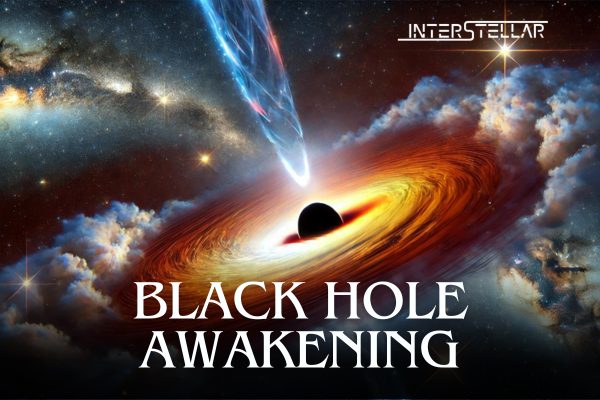
Scientists Witness Supermassive Black Hole Awakening in Distant Galaxy
Milky Way’s Quiet Giant
At the core of our Milky Way galaxy lies Sagittarius A* (Sgr A*), a supermassive black hole with a mass four million times that of our sun. Often described as a “gentle giant” due to its current quiescent state, Sgr A* might one day become highly active.
First Real-Time Observation of Black Hole Awakening
Researchers have recently observed, in real time, a dramatic brightening at the centre of another galaxy. This event is likely caused by a supermassive black hole awakening from dormancy and beginning to consume nearby material. This marks the first time this awakening process has been observed as it happens.
Tracking the Events in SDSS1335+0728
Using Earth-based and orbiting telescopes, scientists tracked these events in the galaxy SDSS1335+0728, located about 360 million light-years from Earth in the constellation Virgo. To put this distance into perspective, one light year is about 5.9 trillion miles (9.5 trillion km).
The Nature of Supermassive Black Holes
Supermassive black holes, with masses millions to billions of times that of our sun, exist at the centre of many galaxies. The supermassive black hole in SDSS1335+0728 has a mass approximately one million times that of our sun. These objects possess such intense gravity that not even light can escape, leading to extremely violent environments where they shred stars and consume any surrounding material.
Formation of an Accretion Disk
Researchers noted the formation of a spinning disk of diffuse material around the supermassive black hole in SDSS1335+0728. This accretion disk radiates energy at very high temperatures, sometimes outshining the entire galaxy. Such bright, compact regions powered by supermassive black holes are known as “active galactic nuclei.”
Significance of Active Galactic Nuclei
Active galactic nuclei emit vast amounts of energy across various wavelengths, from radio to gamma rays, making them among the universe’s most luminous objects. Studying these nuclei is crucial for understanding galaxy evolution and the physics of supermassive black holes, according to astrophysicist Paula Sanchez Saez of the European Southern Observatory in Germany.
SDSS1335+0728’s Galactic Activity
This galaxy, approximately 52,000 light-years in diameter with a mass equivalent to about 10 billion sun-sized stars, has shown a significant increase in luminosity since 2019. Although supermassive black holes sometimes emit high-energy particle jets, no such jet has been detected in this instance.
Unanswered Questions
The exact cause of this supermassive black hole’s activation remains unknown. Astrophysicist and study co-author Lorena Hernandez Garcia of the University of Valparaiso in Chile mentioned that galaxies undergo various phases of activity and non-activity throughout their lifetimes. An event like a star falling into the black hole might trigger such activation.
Future Possibilities for Sgr A*
While Sagittarius A* is currently dormant, it could potentially awaken similarly in the future. However, given our distance of 26,000 light-years from Sgr A*, any significant changes are unlikely to affect us directly, reassures Hernandez.