

Close Menu
Stratnews GlobalStratnews Global
    Facebook X (Twitter) Instagram
    Trending
    • Google And Sea Partner To Develop AI Tools For E Commerce And Gaming
    • Microsoft Says ICE Not Using Its Technology For Mass Surveillance
    • Telegram Denies Russian Allegation Of Encryption Breach
    • Bill Gates Exit Deepens India AI Impact Summit Crisis
    • India AI Summit Robot Controversy Triggers Political Backlash
    • Instagram Youth Mental Health Trial Puts Mark Zuckerberg In Court
    • Telegram Military Messages Exposed To Foreign Intelligence Claims
    • AI Scientific Discovery Era Heralded By Demis Hassabis
    Stratnews GlobalStratnews Global
    Write for Us
    Thursday, February 19
    • Space
    • Science
    • AI and Robotics
    • Industry News
    Stratnews GlobalStratnews Global
    Home » China Uses Solar Energy to Reclaim Land from Encroaching Deserts

    China Uses Solar Energy to Reclaim Land from Encroaching Deserts

    ReshamBy ReshamSeptember 23, 2025 World No Comments2 Mins Read
    China Solar

    China Deploys Solar Panels in Long Battle Against Desert Expansion

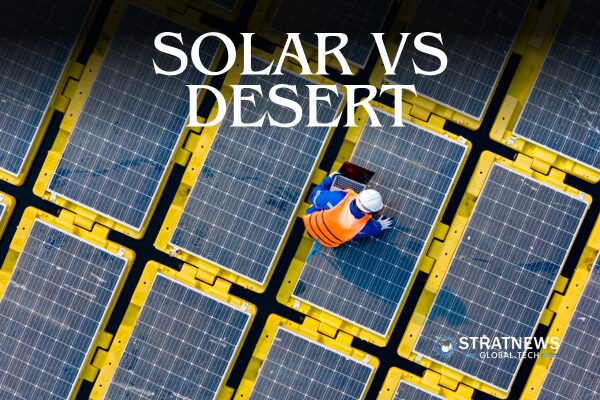
    In northern China’s arid landscapes, solar panels are doing more than generating electricity—they’re helping to stop the spread of deserts. At a vast solar farm near Yinchuan in Ningxia, thousands of solar panels cast shade over goji berry bushes, shielding the dry land below from the harsh sun.

    The 1-gigawatt facility is part of a broader effort using solar power to fight desertification across China’s northern and western regions. The project is led by Ningxia Baofeng Energy Group, a major player in the coal chemical sector. According to Liu Yuanguan, the company’s vice chairperson, Baofeng plans to develop 30 GW of solar capacity, some of which will support anti-desertification work.

    Combining Shade and Shrubs to Restore Land

    “The panels act like tiny umbrellas,” Liu explained during a government-led tour of the site. “They provide shade that helps reduce water evaporation from the soil.”

    This solar-shading technique helps hardy plants survive in harsh climates. Barriers placed around the solar fields reduce wind speed and help keep the sand in place. Local authorities estimate it can take up to five years before the land shows signs of recovery.

    Though these solar desert projects represent a small part of China’s massive solar expansion, their role is growing. In September, the country included solar development in an update to its long-standing “Three Norths” shelterbelt programme, which began in 1978 and runs until 2050.

    Ambitious Plans to Reclaim the Sands

    China’s plan aims to install 253 GW of solar between 2025 and 2030, covering an area of 7,000 square kilometres—roughly four times the size of Greater London. This initiative is designed to rehabilitate dryland while also protecting arable farmland. In 2023, China introduced rules banning the installation of solar panels on productive farmland, shifting focus to desert regions.

    Despite these efforts, progress remains slow. Desertified land accounted for 26.8% of China’s territory in 2024, only slightly down from 27.2% a decade earlier.

    At Baijitan nature reserve, which is located several hours from Baofeng’s facility, around 800 square kilometres of desert have been reclaimed over the decades. However, officials acknowledge that the goal is not to eliminate deserts entirely.

    “This is a long and difficult battle,” said Wang Xiaoling, the reserve’s director. “We aim to minimise damage rather than erase the desert completely.”

    with inputs from Reuters

    Author

    • Resham
      Resham

      Research Associate at Interstellar.| China Scholar | China Social Media & Foreign Affairs|

      View all posts
    Featured
    Share. Facebook Twitter Pinterest LinkedIn Tumblr Email Reddit Telegram WhatsApp
    Resham
    • X (Twitter)

    Research Associate at Interstellar.| China Scholar | China Social Media & Foreign Affairs|

    Keep Reading

    Google And Sea Partner To Develop AI Tools For E Commerce And Gaming

    Microsoft Says ICE Not Using Its Technology For Mass Surveillance

    Telegram Denies Russian Allegation Of Encryption Breach

    Bill Gates Exit Deepens India AI Impact Summit Crisis

    India AI Summit Robot Controversy Triggers Political Backlash

    Instagram Youth Mental Health Trial Puts Mark Zuckerberg In Court

    Add A Comment
    Leave A Reply Cancel Reply

    Anti Drone System (CUAS)
    Latest Posts

    Google And Sea Partner To Develop AI Tools For E Commerce And Gaming

    February 19, 2026

    Microsoft Says ICE Not Using Its Technology For Mass Surveillance

    February 19, 2026

    Telegram Denies Russian Allegation Of Encryption Breach

    February 19, 2026

    Bill Gates Exit Deepens India AI Impact Summit Crisis

    February 19, 2026

    India AI Summit Robot Controversy Triggers Political Backlash

    February 18, 2026

    Instagram Youth Mental Health Trial Puts Mark Zuckerberg In Court

    February 18, 2026

    Telegram Military Messages Exposed To Foreign Intelligence Claims

    February 18, 2026

    AI Scientific Discovery Era Heralded By Demis Hassabis

    February 18, 2026

    China Nuclear Test Allegation Raises Fresh Arms Control Concerns

    February 18, 2026

    YouTube Recommendation System Outage Disrupts Global Access

    February 18, 2026

    Subscribe to News

    Get the latest sports news from NewsSite about world, sports and politics.

    • Astronomical Events
    • Space Missions
    • Industry News
    • Science
    StratNewsGlobal Tech
    Facebook X (Twitter) Instagram LinkedIn YouTube
    © 2026 StratNews Global, A unit of BharatShakti Communications LLP
    • About Us
    • Contributors
    • Copyright
    • Contact
    • Write for Us

    Type above and press Enter to search. Press Esc to cancel.