


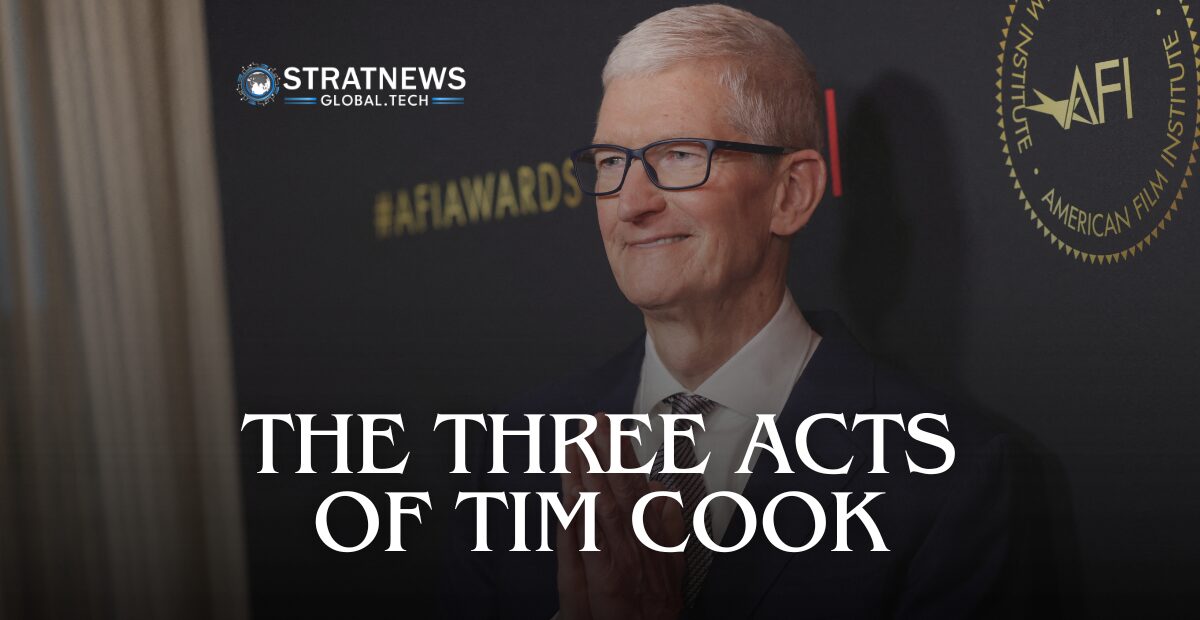
As the markets drew to a close on Monday (April 20), Apple Inc. had a flurry of releases—not hardware or software-related, but something that stands to define the next decade or more of the company’s trajectory.
Posted through Apple’s Newsroom, on their new Instagram handle, and through multiple media outlets, the announcement came through that Tim Cook (the immediate successor to the mercurial co-Founder Late Steve Jobs) would transition to Executive Chairman on September 1, 2026. John Ternus, an Apple veteran of 25 years and the current Senior Vice President (SVP) of Hardware, would succeed him.
Whilst many would shrug this off as a “routine leadership announcement,” the impact runs deeper; it is the end of one of the most profitable decade and a half (Cook took over in 2011 – 15 years to be exact) in corporate history. Under Tim Cook, Apple has gone from being a $350 billion dollar “David” to a $4.11 trillion “Goliath”.
Following Steve Jobs was no mean feat; the late Co-Founder and CEO of Apple was credited with leading one of the most phenomenal turnarounds in modern corporate history, and he had a stage presence that is yet to be matched 15 years after his demise.
To look at Tim Cook’s tenure and the absence of a “moonshot” product would be a great disservice and demonstrates a lack of understanding of Apple. Instead, one needs to look at the manufacturing efficiency giant that Cook has transformed Apple into.
Act 1: The Immediate Post-Jobs Era
When he (Cook) took over the role of CEO in August 2011 (he had held that role while Steve Jobs took medical leave), the media narrative was grim. Cook lacked the flamboyance of his predecessor and was seen as a supply chain guy rather than a product design guy. Little did the world know that if Steve envisioned the iPad or any other Apple product, Tim Cook could build it at scale and at an accessible price for the target consumer. Critics continued to argue that Apple would lose its soul, etc.
During this phase, one can argue that Cook set in motion the biggest pivots for the company. He understood early that hardware saturation would be a reality and that upgrade cycles would lengthen as products matured. He aggressively started building the “Services” vertical—iCloud, Apple Music, the App Store, Apple TV, etc.—creating a high-margin, recurring revenue stream that is today almost the size of a Fortune company itself (Apple’s Services revenue last quarter was $30 billion, with the full 2025 fiscal revenue for Services touching $109 billion).
Early in his tenure, Cook made it amply clear that he would abide by Steve Jobs’ last advice: “never ask what Steve would do”. This was made clear when Cook restored employee contribution matching for charitable contributions.
The launch of the Apple Watch also cemented the notion that the “Apple of Cook” would be different from the “Apple of Jobs”. Cook has consistently maintained that he would best want Apple to be remembered for its contribution to healthcare.
The final piece of Act 1 of Cook would be Apple’s commitment to the environment and “Vision 2030,” which envisioned carbon neutrality across their entire supply chain.
Act 2: The Supply Chain Savant
As mentioned above, if Steve Jobs was the visionary behind Apple’s product line, Tim Cook was the one who could bring the product to reality through his prowess in supply chain and manufacturing. Cook fundamentally viewed accumulating inventory as an “evil”. It is Cook who is credited with reducing Apple’s inventory from months to just days. I have even heard someone say that Apple turns over its entire inventory in just three days (based on the last quarter, Apple sells roughly one million iPhones a day). This lean inventory management remains Apple’s biggest competitive advantage.
This relentless focus on the supply chain also allowed “The Cook Doctrine” to become a reality: the belief that Apple needed to own and control the primary technologies behind its products. The ultimate culmination of this belief was the seamless transition Apple made from Intel CPUs to their own custom silicon (the M series processors in the Mac and iPad, the A series processors in the iPhone, the S series in the watch, and the H series in their headphones). Five years after the launch of the M series processors, these remain ahead of the competition in performance and efficiency.
It is also during Act 2 that one can say that Apple was on the valuation riot. Apple was the first company to reach a $1 trillion valuation (also the first to reach $2 trillion and $3 trillion respectively).
Act 3: The Diplomat
This would be Cook’s final act, one that saw him not only as the CEO of Apple but also that of a diplomat. Cook was one of the few CEOs who was able to handle Trump 1.0 well, navigating around erratic tariffs and even securing a waiver for Apple. Cook and his lieutenants have also been turning on the charm offensive in India, leveraging the PLI scheme under the Modi Govt to decouple and derisk Apple’s dangerously unilateral dependence on China for almost all of its manufacturing. At the risk of inviting the wrath of trolls, it would be safe to say that it is thanks in major part to Apple (and Cook) that India has achieved $50 billion of iPhone exports at the end of 2025, which is roughly 25% of the global iPhone output.
Another milestone reached in early 2026 was the export of Indian-made high-value components such as housing and circuit boards from Apple’s India vendors (Tata Electronics and Foxconn). These were exported FROM INDIA TO CHINA to feed the global production line.
Back home, his delicate balancing act with Trump 2.0 doesn’t seem to have gone down well with the detractors of the administration. Despite a $1 million donation to the inauguration (in his personal capacity, NOT as the CEO of Apple), relations between Trump and Cook reached a low when he (Cook) skipped a high-profile presidential visit to West Asia, prompting a threat of 25% tariffs on Non-US manufactured iPhones (the US does not manufacture iPhones even today, despite multiple assurances).
Cook has consistently maintained that real change can be achieved by having a seat at the table. For his detractors, it doesn’t cut ice, but as a CEO of a company whose valuation rivals the GDP of many large European economies, he knows his fiduciary duties too well.
The Ternus Transition
After navigating the post-Jobs era, addressing concerns about Apple’s ability to innovate with delightful products and navigate a fractured global polity, the transition from a supply chain savant to a product-focussed leader now seems appropriate. John Ternus has led hardware engineering for many of the modern Apple products many of us love or aspire to own. Cook’s transition to Executive Chairman allows him to focus on handling the current and future leaders of the world and dealing with their temper tantrums, whilst allowing Ternus to continue focusing on the product and launching products that in Cook’s own words “surprise and delight our customers” and navigate the challenges posed by AI.
On the environment, Cook has consistently maintained “we need to leave the planet in a better place than what we found it in”.
He certainly does leave an Apple that’s in a much better shape.
Rohan Bhade is a Mariner by profession with over two decades of experience in the maritime and technology sectors and an interest in geopolitics, supply chain efficiencies, and strategic leadership.

