


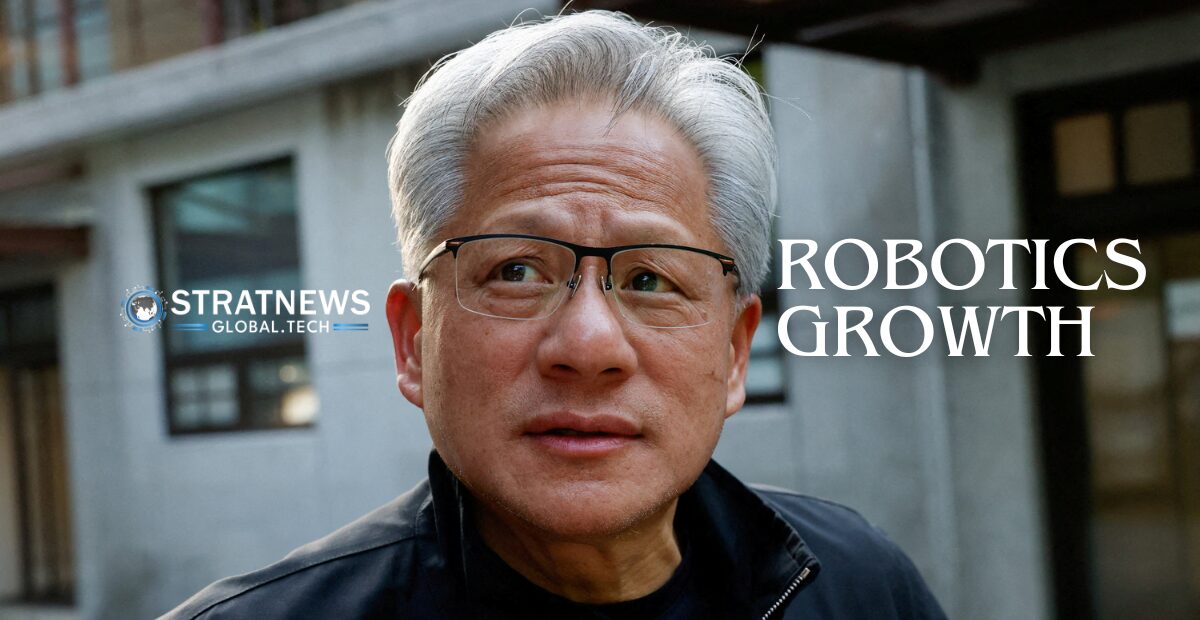
Nvidia CEO Jensen Huang Sees Robotics As South Korea’s Next Growth Engine
Nvidia Chief Executive Jensen Huang said robotics could become South Korea’s next major growth sector as he arrived in the country for his second visit in seven months. His comments highlighted expanding cooperation with South Korean companies not only in semiconductors but also in robotics and artificial intelligence-driven manufacturing.
South Korea remains one of Asia’s leading manufacturing centres, producing semiconductors, consumer electronics, automobiles and ships on a global scale. After arriving at Gimpo International Airport from Taiwan, Huang told reporters that advances in artificial intelligence and robotics would increasingly shape the future of chip production.
He said South Korea’s manufacturing strength creates an opportunity to apply robotics and physical AI technologies across industrial operations. Huang added that Nvidia sees significant potential to work more closely with local semiconductor companies as these technologies evolve.
Meetings With Major Korean Companies
During his visit, Huang said he planned to meet executives from Hyundai Motor, LG, SK Hynix, Samsung Electronics and Naver.
When asked whether he had brought gifts for South Korea, Huang responded that he had brought substantial business opportunities instead. He also hinted at additional announcements, saying he had “some surprises”.
His visit reflects Nvidia’s growing engagement with South Korean technology and manufacturing leaders as demand for AI infrastructure continues to rise worldwide.
Esports Visit And Industry Dinner
One of Huang’s first stops in Seoul was an internet café, where he met esports players, including Lee Sang-hyeok, better known as “Faker”. Huang’s daughter, Madison Huang, joined the visit while wearing the uniform of the prominent T1 esports team.
Later in the evening, Huang attended a Korean barbecue dinner with LG Group Chairman Koo Kwang-mo, SK Group Chairman Chey Tae-won and Naver founder Lee Hae-jin.
Speaking during the gathering, Huang praised the performance of Nvidia’s partners, including Samsung, SK Hynix, Naver and Hyundai Motor. He said the companies had enjoyed a strong year but stressed that future opportunities remained substantial. He also noted that Nvidia’s upcoming products would require significant amounts of memory chips.
Huang distributed bags of chocolate-coated corn chips labelled “HBM Chips”, a reference to the high-bandwidth memory technology supplied by SK Hynix for Nvidia’s AI systems. The gesture prompted enthusiastic chants of “HBM” from attendees.
Memory Demand And Future Expansion
Huang recently stated that Samsung, SK Hynix and Micron had all qualified to supply HBM4 memory for Nvidia’s Vera Rubin AI platform. According to Huang, all three suppliers are already in production and are competing to support the new system.
Samsung Electronics and SK Hynix together account for roughly 70% of the memory chips used in artificial intelligence processors such as those developed by Nvidia.
Addressing questions about reports that Nvidia might reduce SOCAMM capacity in the Vera Rubin platform, Huang acknowledged that memory supply remains constrained. However, he said the company is carefully managing memory usage across its systems.
Huang also revealed that Nvidia has begun recruiting employees for its research and development centre in Seoul.
The Nvidia chief is also scheduled to throw the ceremonial first pitch at a baseball game and appear on a television talk show during his stay in South Korea.
With inputs from Reuters