


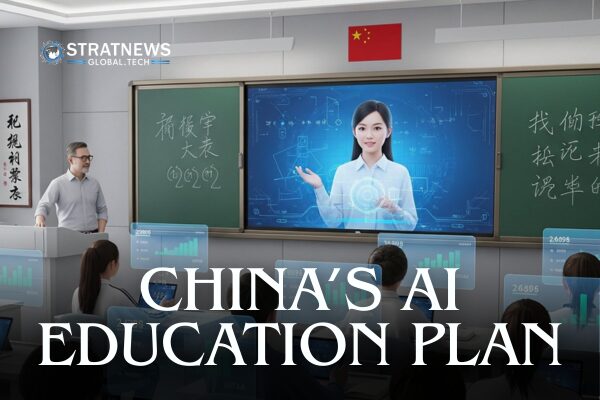
China has unveiled an ambitious action plan to build a comprehensive artificial intelligence (AI) literacy system spanning all levels of education and lifelong learning, as part of efforts to integrate AI deeply into the country’s education framework.
The “AI + Education Action Plan”, jointly issued by five central government departments led by the Ministry of Education of China, aims to accelerate the popularisation of AI education, reshape teaching models, and develop a future-oriented education system, officials said at a press conference on Friday.
Equal Access to AI Learning
“We will build a general AI literacy system for all stages of education and for the whole of society,” said Zhou Dawang, director of the ministry’s Department of Science, Technology and Informatization. He emphasised that the plan seeks to ensure equal access to AI learning opportunities for all citizens.
AI in Schools and Classrooms
At the primary and secondary level, the plan calls for integrating AI education into local curricula nationwide, encouraging interdisciplinary teaching, and expanding AI learning through after-school programmes and study tours. It also proposes strengthening AI demonstration schools and supporting rural and remote institutions through national digital platforms.
Universities to Make AI Core Subject
In higher education, universities will be required to introduce AI as a basic public course and develop subject-specific teaching materials. The plan also encourages interdisciplinary programmes, the redesign of traditional disciplines, and the creation of new majors aligned with AI-driven industrial transformation.
Focus on Skills and Industry Needs
For vocational education, the policy promotes embedding AI into traditional industry-related programmes to train a workforce capable of adapting to rapid technological change.
In lifelong learning, the government aims to provide high-quality resources such as micro-courses and certifications to help individuals upgrade their skills and improve employment prospects.
Teachers to Be Trained in AI
The plan also sets new expectations for educators. A national AI literacy standard for teachers will be introduced, along with tiered training and assessment systems. AI knowledge will also be incorporated into teacher qualification exams and certification processes.
Universities and Cities Already Adapting
Fudan University has already introduced more than 100 AI-related courses, enrolling over 13,000 students, according to its president Jin Li. The university has also launched 41 dual-degree programmes combining AI with other disciplines, including a pilot programme offering a PhD in a specific field alongside a master’s degree in AI.
In Beijing, every primary and secondary school student now receives at least eight hours of AI instruction annually, said Li Yi, director of the municipal education commission. The city has also created an “AI education lecturer team” bringing experts from academia and industry into classrooms.
By the end of 2025, AI adoption across schools in Beijing had reached 87.7%, he added.
In Shenzhen, schools have already achieved full coverage of AI education. Yao Xiaoying, a primary school principal, said all students at her school have been receiving at least one AI lesson per month since 2021.
Balancing Technology and Critical Thinking
“We teach children how to use large language models to solve problems, and more importantly, how to think critically — to question whether AI’s answers are correct and verify information,” Yao said. She added that the goal is to ensure students retain human qualities such as critical thinking, creativity and collaboration in an increasingly AI-driven world.

