


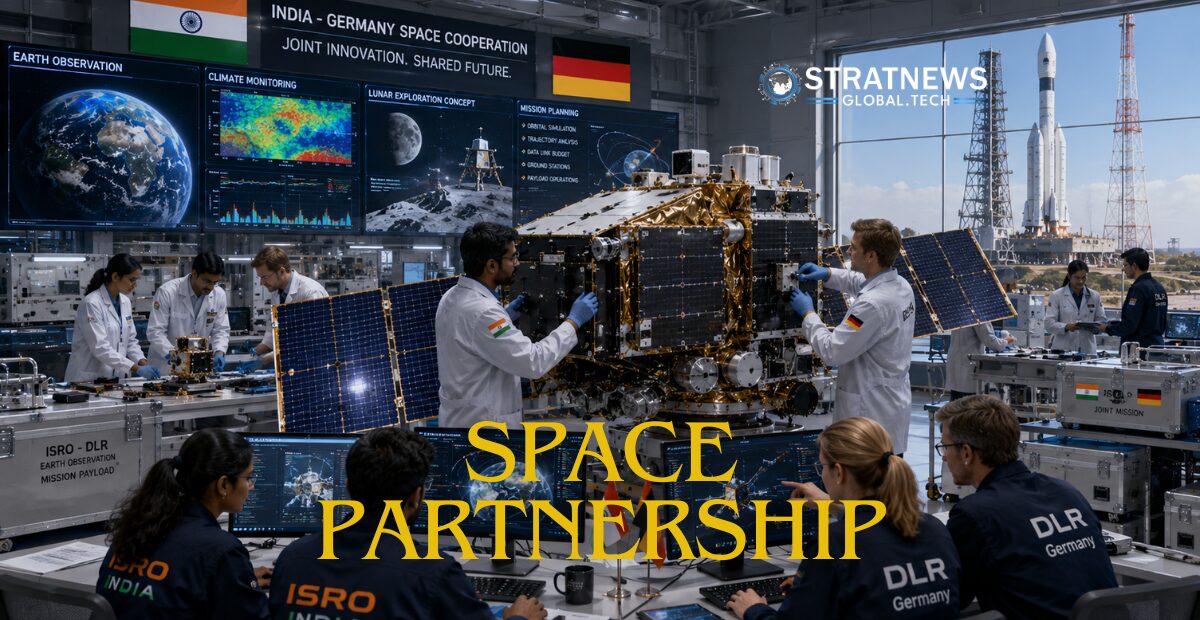
As India and Germany deepen their strategic partnership across technology, trade and innovation, space cooperation is rapidly emerging as a promising new pillar of engagement. The growing thrust was highlighted during the ongoing visit of Mario Voigt, Minister-President of the German state of Thuringia, who expressed strong interest in expanding collaboration with India’s space sector, including the Indian Space Research Organisation (ISRO).
Voigt’s six-day visit to India comes at a significant moment in bilateral relations. Following progress on the EU-India Free Trade Agreement and a renewed focus on critical technologies, German states are increasingly seeking direct partnerships with Indian institutions and industries. For Thuringia, a state known for its advanced engineering, optics and space-related technologies, India represents a natural partner.
In an exclusive conversation, Voigt underlined Thuringia’s growing importance in Europe’s space ecosystem.
“Thuringia is mission-critical for the new advancement when it comes to space,” he said. “For example, the navigation system for the Artemis II mission to the Moon has come from the state of Thuringia.”
The German state has established itself as a centre for advanced electronics, aerospace engineering and quantum technologies. According to Voigt, these capabilities position Thuringia as a valuable partner for future international space missions.
“We are specifically designated when it comes to quantum communications between satellites and between stations on Earth,” he noted. “These are two critical components in these times, and we have one of the best electronics and space engineering programmes in Europe. These are three pillars for a very successful space programme.”
A key objective of Voigt’s India visit is to strengthen links with India’s rapidly expanding space sector. During his visit to Bengaluru, India’s space capital and home to ISRO headquarters, he is expected to explore opportunities for collaboration with Indian space scientists and institutions.
“We want to connect with ISRO and hopefully find ways to work closely together and collaborate,” Voigt said. “We deeply believe that the Indian space programme is a really good gateway for new potential in space exploration. This will be the next frontier, and we have to work together on that.”
His remarks indicate a broader shift in India-Germany relations, where space is increasingly viewed as a strategic area of cooperation alongside defence, digital technologies and clean energy.
The growing importance of space collaboration was also acknowledged at the highest political level earlier this year. During discussions between Prime Minister Narendra Modi and German Chancellor Friedrich Merz in January 2026, both leaders welcomed the enhanced dialogue between ISRO and Germany’s space agency, the German Aerospace Center (DLR). They agreed to further expand cooperation between the two agencies and encourage greater engagement between their respective space industries.
The momentum continued during the India-Germany Foreign Office Consultations held in Berlin on April 14, 2026. Co-chaired by Foreign Secretary Vikram Misri and German State Secretary Géza Andreas von Geyr, the consultations reviewed the full spectrum of bilateral relations and identified critical and emerging technologies as a priority area for deeper cooperation.
Both sides agreed to diversify collaboration in fields including innovation, industrial partnerships, digital governance and advanced technologies, areas that increasingly intersect with the future of space exploration and satellite systems.
Voigt suggested that future cooperation could move beyond traditional satellite projects toward more ambitious initiatives, including human spaceflight missions.
“It used to be a very narrow path for collaboration, which opened up in 2024,” he said. “Satellites have been launched together with German companies. But in the critical mission of the human space programme, this would be new.”
Such cooperation would mark a significant evolution in India-Germany space ties. India is preparing for major milestones through its Gaganyaan human spaceflight programme and longer-term ambitions in lunar exploration, while Germany brings strengths in aerospace engineering, navigation systems, quantum communications and advanced manufacturing.
Thuringia’s renowned optics and photonics cluster centred around Jena, one of Europe’s leading hubs for optical technologies, also complements India’s ambitions in semiconductors, electronics and deep-tech innovation.
From satellite communications and quantum technologies to future human space missions, the next chapter of the strategic partnership may well be written beyond Earth’s atmosphere.