


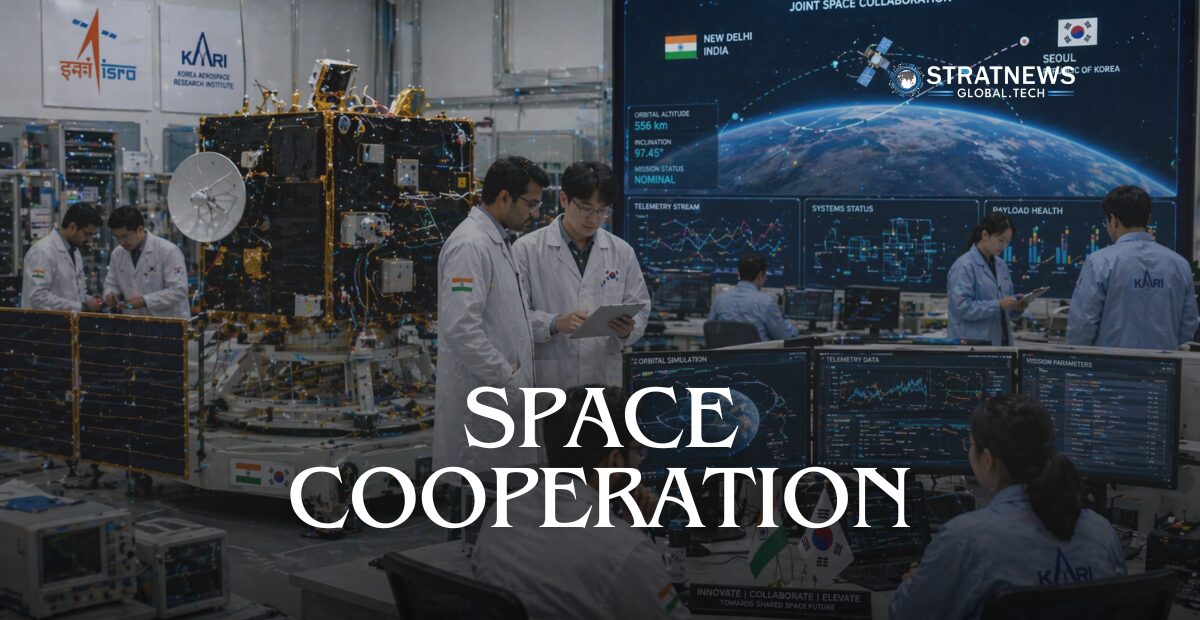
India and South Korea are expanding cooperation in the space sector through both government agencies and private industry partnerships, in line with India’s Act East policy and wider regional priorities.
The two countries have agreed to establish a Joint Working Group between the Indian Space Research Organisation and the Korea AeroSpace Administration. The group will focus on identifying and advancing areas of cooperation between the two national space agencies.
The decision follows the India–Republic of Korea “Space Day” held in Bengaluru on 20 April 2026, organised with IN-SPACe. According to diplomatic sources, the event brought together space startups, industry representatives and research institutions to promote collaboration across the space ecosystem.
Following talks, Prime Minister Narendra Modi and South Korean President Lee Jae Myung encouraged both sides to explore cooperation on satellite navigation systems, signalling interest in practical technological engagement.
In the private sector, INNOSPACE and Grahaa Space signed a memorandum of understanding to collaborate on multi-launch services for small satellites. The agreement was formalised during the Bengaluru Space Day event co-hosted by KASA and IN-SPACe.
The partnership builds on earlier engagement during INNOSPACE’s first commercial launch attempt in December 2025, when Grahaa Space flew its payload on the HANBIT-Nano rocket under the SPACEWARD mission. The mission did not succeed shortly after liftoff.
Despite the setback, both companies have continued their collaboration and expanded it into a longer-term framework. Grahaa Space CEO Ramesh Kumar V said the company retains confidence in INNOSPACE’s technical capabilities and responsiveness.
He noted that space missions are inherently complex and said the agreement reflects continued engagement, trust in INNOSPACE’s development approach and a shared focus on improving reliability and transparency in future nanosatellite missions.
INNOSPACE CEO Soojong Kim said the agreement represents a broader partnership with an early customer that has already used its launch services. He stated that repeated missions would help demonstrate the reliability of the launch system and strengthen the company’s position as a provider for global satellite operators.
He added that a multi-launch model would offer customers greater scheduling flexibility and reduce mission costs, while also enhancing competitiveness in the small satellite launch market.
At a broader level, India and South Korea view each other as important partners with shared interests in regional stability, economic growth and Indo-Pacific cooperation, with space emerging as a key area of engagement.