


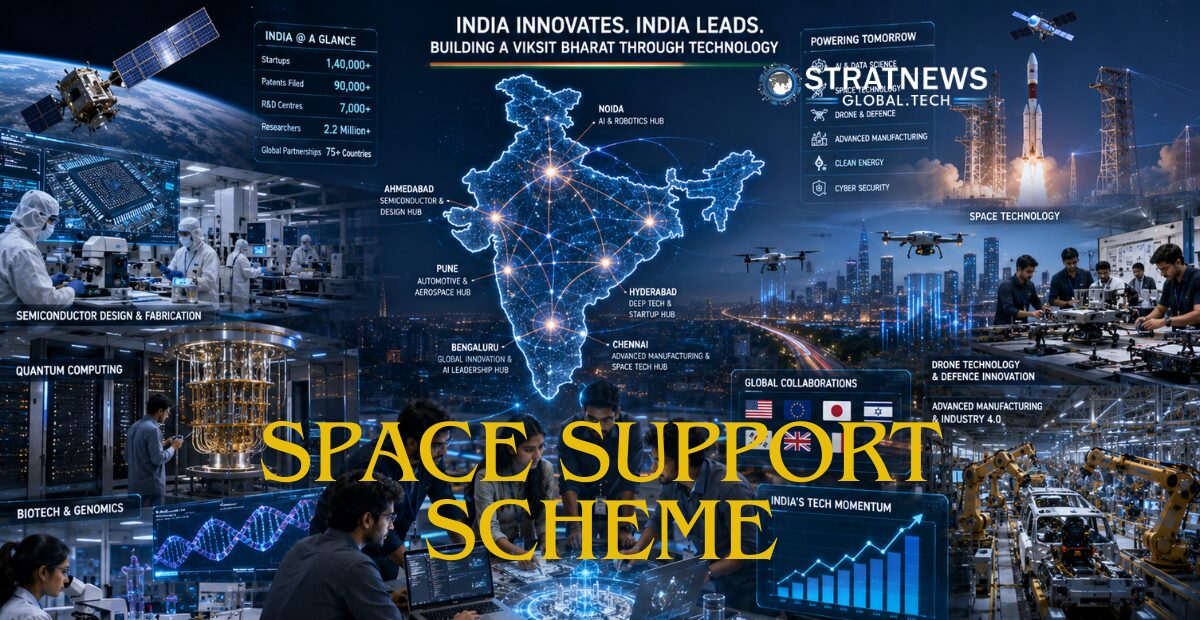
Government Launches Space Support Schemes to Boost India’s Private Space Sector
India’s private space companies and non-government entities will receive government support ranging from 30% to 100% under two new schemes introduced by the Department of Space (DoS). The initiatives are designed to reduce costs associated with launch services, technology transfer, satellite data and access to ISRO facilities, while encouraging greater private sector participation in the country’s expanding space industry.
The two programmes — the Launch Services Price-support Scheme (LSPS) and the Price Support Scheme — will be implemented by the Indian National Space Promotion and Authorisation Centre (IN-SPACe). Together, they aim to lower entry barriers, improve global competitiveness and accelerate the growth of India’s commercial space ecosystem.
Launch Support Scheme Backed by ₹800 Crore
The larger of the two initiatives is the Launch Services Price-support Scheme, which has been allocated a budget of ₹800 crore over five years until June 2031.
The scheme is intended to strengthen domestic commercial launch capabilities and position India as a leading global launch destination.
IN-SPACe Chairman Pawan Goenka said the objective is to make launches more competitive by reducing launch costs.
“The idea is to make the launches competitive. Therefore, we are trying to defray the cost of launch, thereby making the launch cost globally competitive. The ultimate beneficiary will be the satellite launch,” Goenka told The Times of India.
Four Categories of Launch Incentives
Under Category A, eligible entities can receive up to 50% financial support for using ISRO and Department of Space launch facilities. The benefit is available to non-government entities (NGEs), government organisations and launch vehicle providers.
Category B offers a 30% subsidy on contractual launch costs, or up to $3,000 per kilogram, whichever is lower. The incentive applies to Indian small launch vehicles carrying satellites, experiments or payloads weighing up to 500 kg. Satellite owners and operators are eligible for the support.
The subsidy also covers launches by Indian private companies conducted from Indian soil.
Goenka said the scheme would apply to launch vehicles such as Skyroot Aerospace’s Vikram rocket. He added that the policy is specifically aimed at encouraging the growth of India’s emerging small launch vehicle industry.
Under Category C, the government will provide 100% funding for repurposed upper-stage platforms carrying payloads of up to 120 kg. The assistance is capped at $13,000 per kilogram and limited to four missions. This category is available to NGEs, government entities and launch vehicle providers.
Category D extends support to satellites weighing up to 100 kg launched aboard PSLV, GSLV and LVM3 missions. Eligible beneficiaries will receive a 30% subsidy on contractual launch costs, or up to $3,000 per kilogram, whichever amount is lower.
Price Support for Space Infrastructure and Technology
Alongside the launch incentives, the Department of Space has introduced a separate Price Support Scheme for Indian entities. The programme will remain in effect for three years until February 2029 and is intended to reduce the cost of accessing India’s space infrastructure, technologies and satellite data.
The scheme consists of three components.
The first provides up to 50% financial support for the use of Department of Space and IN-SPACe facilities, as well as access to technical expertise.
The second offers a 30% subsidy on Technology Transfer Fees (TTF) for technologies licensed from ISRO, reducing costs for companies seeking to commercialise government-developed technologies.
The third provides a 50% subsidy on standard Earth observation data and related data products. The measure is expected to make satellite imagery and geospatial datasets more affordable for Indian companies developing applications in agriculture, urban planning, disaster management, climate services and other downstream industries.
The two schemes are expected to improve access to critical space infrastructure while supporting the growth of India’s private space sector through lower operational costs and enhanced commercial opportunities.