


Amazon’s Zoox Robotaxi Approval Marks Milestone for Autonomous Ride Services
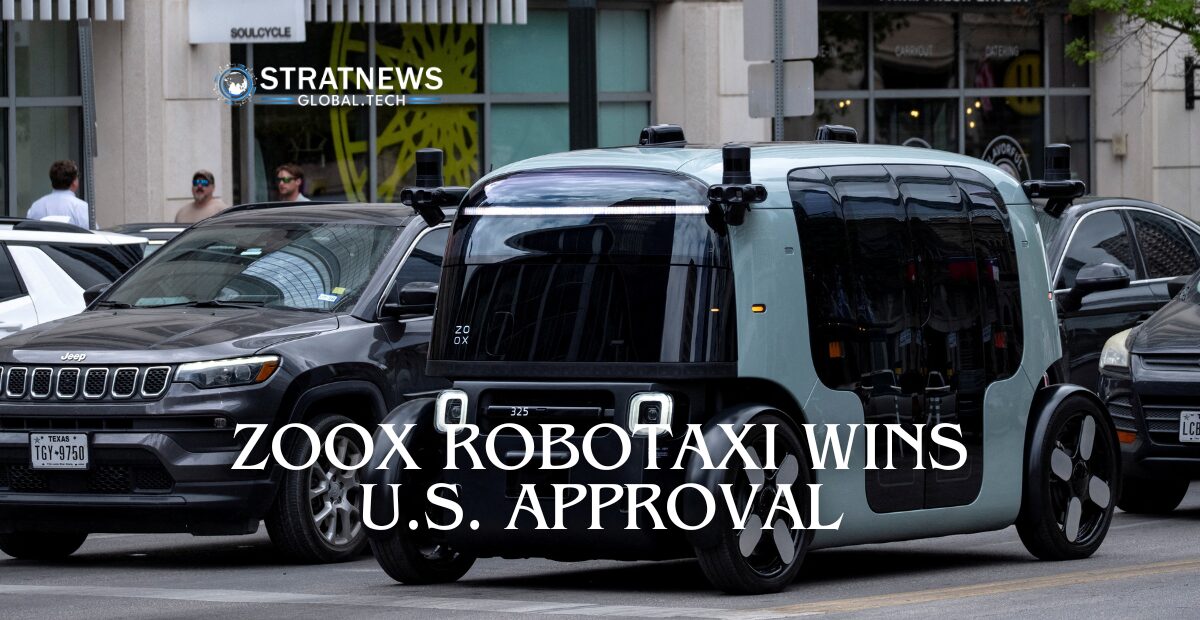
Amazon-owned Zoox has secured U.S. approval for the limited commercial deployment of its steering-wheel-free robotaxis, marking a significant step for the autonomous ride-hailing industry. The decision allows the company to move closer to offering paid driverless journeys, beginning in Las Vegas before expanding to additional markets as it satisfies state-level requirements.
The U.S. National Highway Traffic Safety Administration (NHTSA) granted Zoox an exemption from federal rules that normally require vehicles to have traditional human controls. As a result, the approval represents an important breakthrough for companies that have designed autonomous vehicles from the ground up instead of adapting conventional cars built under decades-old safety regulations.
Federal Approval Clears Path for Paid Robotaxi Rides
Zoox confirmed that the NHTSA decision gives it federal permission to begin charging passengers for rides. The company plans to introduce paid services first in Las Vegas before expanding into other locations once it completes the necessary state and local approval processes.
The exemption, first reported by Reuters, reflects changing regulatory approaches as self-driving technology continues to develop. Existing federal vehicle standards were created long before autonomous driving systems became a commercial reality.
NHTSA Administrator Jonathan Morrison told Reuters that Zoox has received approval to deploy up to 2,500 vehicles commercially during each of the next two years.
Currently, Zoox operates passenger testing services in selected parts of Las Vegas and San Francisco. However, the exemption now enables the company to charge passengers for those journeys, provided it also meets local regulatory requirements.
Safety Requirements Remain in Place
The NHTSA said it determined that Zoox’s robotaxi provides a level of safety equivalent to vehicles complying with the federal safety standards that have been waived. Nevertheless, the approval does not permit Zoox to sell these vehicles to members of the public.
“What we did today was we issued an exemption to Zoox, which is a developer of automated driving systems, the manufacturer of a novel designed robotaxi,” Morrison said. “We granted them exemption that allows them to commercially deploy vehicles, that don’t conform to federal motor vehicle safety standards.”
Furthermore, the exemption includes additional reporting obligations. Zoox must notify regulators about incidents such as crashes or situations where vehicles stop inappropriately on public roads. The agency also said it may revise the exemption’s conditions based on the vehicles’ real-world performance.
Morrison added that the NHTSA retains the authority to withdraw the exemption if Zoox fails to meet the required safety standards.
In addition, all remote operators supporting Zoox’s robotaxi fleet must be based in the United States. The company must also publish maps showing the operating areas of its autonomous vehicles.
Autonomous Vehicle Rules Continue to Evolve
Morrison said the NHTSA expects to develop the first federal safety standards specifically for automated driving systems before the end of the Trump administration. At the same time, the agency is considering updates to existing regulations that were originally written for vehicles operated by human drivers, including requirements for brake pedals and rear-view mirrors.
The approval concludes Zoox’s years-long effort to commercialise its purpose-built robotaxi under regulations established before self-driving technology emerged.
Meanwhile, Tesla has begun producing its Cybercab, which also lacks conventional human controls. However, the company has not detailed its regulatory approval strategy.
Regulators are seeking to encourage the wider adoption of autonomous driving technology while maintaining public safety.
Earlier this month, Morrison sent a letter urging autonomous vehicle developers to “immediately focus” on addressing what the NHTSA described as “a clear pattern of driverless AVs interfering with law enforcement and other first responders.”
Concerns have also grown over robotaxis travelling through construction zones, driving past stopped school buses, becoming stranded on flooded roads or busy intersections, and committing traffic violations. These incidents have contributed to recalls and increased public scrutiny of autonomous vehicle safety.
“If we continue seeing issues, we will not hesitate to use the full extent of our enforcement authority,” Morrison said.
Following the letter, Zoox recalled its fleet of 105 autonomous vehicles to update software after identifying that the vehicles might not detect heavy smoke, particularly during active emergency situations.
Morrison is scheduled to discuss the agency’s latest safety initiatives at SAE International’s Automated Transportation Symposium in San Diego.
With inputs from Reuters