


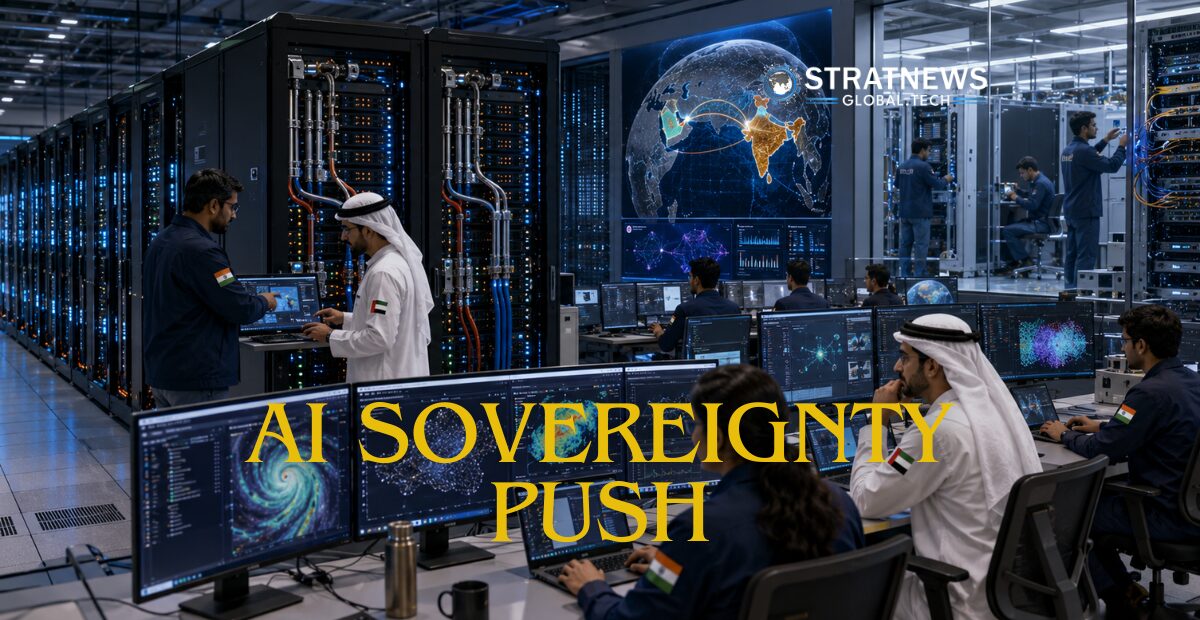
India’s AI program, valued at nearly $1.25 billion is diversifying from dependence on US tech majors. And no, it isn’t looking at China. The new player in the game is UAE.
Abu Dhabi-based G42, a tech holding company focused on AI and cloud computing, and backed by Abu Dhabi sovereign wealth fund Mubadala, signed an agreement on May 15 to deploy an AI supercomputer in India. It formalized the framework and the commercial terms deployment of Condor Galaxy India, an 8-exaflop AI supercomputing cluster comprising 64 Cerebras CS-3 systems.
The Condor Galaxy India supercomputer will be one of the largest AI compute clusters in India and a foundational asset for New Delhi’s sovereign AI ambitions. Under the framework, G42 in partnership with the Centre for Development of Advanced Computing (C-DAC) will be responsible for the installation, deployment, operations, and maintenance of the system.
The AI computer cluster will underpin a new era of joint R&D across sectors such as health and genomics, energy, and geospatial analytics, etc. It will enable researchers, institutions and emerging innovators to advance frontier science and address consequential challenges.
Currently, all governments that want to use AI today typically rent computing power from Amazon, Microsoft, or Google. India already has at least $45 billion in commitments from the three companies. Microsoft plans to invest $17.5 billion over four years, Google has pledged $15 billion, and Amazon Web Services has earmarked $12.7 billion, all built around Nvidia processors and the companies’ own cloud platforms, reported Rest of World.
On the other hand, the G42 deal will ensure that India has machines on its own soil, under its own rules, run by a non-U.S. partner. However, it does face some challenges in entering the Indian market.
Chris Miller, professor at the Fletcher School at Tufts University and an expert on global semiconductor competition, told Rest of World that Amazon, Microsoft, and Google offer integrated packages of hardware, software, developer tools, and customer support that any newcomer has to match.
The deal may also give India less control than it appears. The data protection law allows personal data to be sent to most countries. Whether the Indian government has imposed stricter rules for this deal is unknown yet. But for now, the message is clear: India is ready to build its capabilities with whoever has the capacity to provide.

